And, so long as I have this going: in '39, Patrick was second-billed to John Howard in GRAND JURY SECRETS; and he qualifies for this thread as a Phi Beta Kappa graduate of Case Western Reserve University who went on to star in SUBMARINE RAIDER and in ISLE OF MISSING MEN and in A TRAGEDY AT MIDNIGHT and in at least half a dozen outings as Bulldog Drummond. (For bonus points, he was also the guy who was up against Cary Grant for Katharine Hepburn’s favor in THE PHILADELPHIA STORY.)
At that: John Howard was in GREEN HELL with George Bancroft, who graduated from the Naval Academy before earning an Oscar nomination for Best Actor in 1930 before getting top billing in BLOOD MONEY and LADY AND GENT and ELMER AND ELSIE and RACKETEERS IN EXILE and otherwise keeping busy in the '30s and '40s.
And, just to six-degrees-of-separation this for another step, Bancroft appeared in PARAMOUNT ON PARADE, as did Charles “Buddy” Rogers – who graduated from the University of Kansas, which to this day offers a Charles “Buddy” Rogers scholarship.
Rogers was of course second-billed to Clara Bow in WINGS, the first film that ever won an Oscar for Best Picture; and he was top-billed as Abie, the nice Jewish boy marrying an Irish Catholic girl in ABIE’S IRISH ROSE; and top-billed in everything else from HALFWAY TO HEAVEN to SAFETY IN NUMBERS to ALONG CAME YOUTH before he took over for Donald Woods in the role of Dennis Lindsay in the MEXICAN SPITFIRE movie franchise – in MEXICAN SPITFIRE’S BABY, and in MEXICAN SPITFIRE AT SEA, and in MEXICAN SPITFIRE SEES A GHOST – and since Donald Woods has already been mentioned, figure that just about brings this full circle.
Richard Carlson graduated summa cum laude from the University of Minnesota, earning a graduate degree and teaching drama easy as getting work on Broadway, before he of course started picking up credits in Hollywood.
I mean, granted, if the title of the movie is “DANCING CO-ED”, then he’d get billed second to Lana Turner as the co-ed; that goes without saying. And if the title of the movie is “NO, NO, NANETTE”, then he’s billed second to the actress playing Nanette. And he’s second-billed to Anne Shirley in “WEST POINT WIDOW”, because, well, that’s her; and he’s second-billed in “THE AFFAIRS OF MARTHA”, because he’s not Martha; and he’s second-billed to his leading lady du jour in “BEHIND LOCKED DOORS” and “WINTER CARNIVAL” and “FLY BY NIGHT” because – I dunno, inertia?
Look, he was second-billed to Frank Morgan in “A STRANGER IN TOWN”; it’s just his thing, generally speaking; he was third-billed in an Abbott and Costello feature, but that’s basically the same idea. Still, he was top-billed in “HIGHWAYS BY NIGHT” and “MY HEART BELONGS TO DADDY” – which shows that he wasn’t just putting his face and name out there as co-star material, but as a star in his own right.
But, yeah: if you’re making “TOO MANY GIRLS”, and it’s going to star Lucille Ball, then you give Richard Carlson second billing as her love interest. No, you just do.
Taking it a step further: Olympic medalist Nat Pendleton, Columbia Class of '16, was born for third billing. Like, if you’re doing a movie where the amateur-sleuth hero gets top billing and his leading lady in at second, then you totally need a guy like Pendleton at third as the hapless cop with his sights set on the wrong suspect.
For the exception that proves the rule, note that Pendleton actually dropped to fourth billing doing the same schtick as the police lieutenant who gets outclassed when Maureen O’Sullivan called in William Powell and Myrna Loy, so Nick and Nora could run rings around the professional in THE THIN MAN; Pendleton reprised the thankless role in ANOTHER THIN MAN, but that’s not really the point.
The point is, if it’s Robert Young and Madge Evans trying to solve baseball-related murders, then it’s Pendleton getting third-billed in DEATH ON THE DIAMOND. And if it’s Jack Holt and Jean Arthur in THE DEFENSE RESTS, well, then there’s Pendleton in the third-billed role likewise. And BURN 'EM UP O’CONNOR needs a leading man to play O’Connor, and a leading lady in the second-billed role – and Pendleton in at third. SCARED TO DEATH cried out for Bela Lugosi as the lead – and Pendleton in at third. Are you casting for a western? Maybe a musical? Yeah, you call a guy and a gal and, well, your third call is to Pendleton.
Even when he could’ve gotten the lead, in DECEPTION – where he’s playing the brawler who doesn’t realize he’s winning fixed fights – he got billed third, because, hey, nice to have you as a special effect, but we need an interesting guy who can carry a movie as the crooked promoter. Pendleton getting top billing? C’mon.
Anyhow, he, uh, eventually got top billing, in 1941’s TOP SERGEANT MULLIGAN and 1942’s JAIL HOUSE BLUES. Hollywood figures stuff out eventually.
Bud Collyer went from Williams College to Fordham Law School – but when he “became a law clerk after his graduation, making as much in a month of radio as he did in a year of clerking convinced him to make broadcasting his career”.
So: on radio and in the animated features at the movies, he was the voice of Superman; and on radio and on television, he was a game-show host – all in the '40s.
(Actually, make that, uh, game-shows host.)
After graduating from a New York boarding school and earning himself a degree at Dartmouth, polo player Irvine E. Baehr reinvented himself as Bob “Tex” Allen and put his riding-around-on-horseback skills to use in THE UNKNOWN RANGER – picking up top billing, with the poster declaring “Meet Your New Thrill Favorite!” – followed by top billing in RIO GRANDE RANGER, and top billing in RANGER COURAGE, and again in LAW OF THE RANGER, and RECKLESS RANGER, and THE RANGERS STEP IN.
The guy also got lots of other film work: as Dmitri, in CRIME AND PUNISHMENT, with Peter Lorre; second-billed, as a RCMP Constable in FIGHTING SHADOWS; third-billed, after the leading lady, in a Boris Karloff horror movie; and third-billed again, likewise after the leading lady, in a Charles Bickford comedy; and so on.
But, yeah, he was in his element as a gunslinger – and not just in westerns; he even got top billing in GUARD THAT GIRL, as a modern-day pistol-toting private eye.
(Well, when I say “modern-day”, I of course mean “like, 1935”. But still.)
(That said, how cool would a 1935 movie about a 2016 private eye have been?)
After acting on Broadway in '38 and '39 and '40 and '41 and '42 and '43 and '44, Tusculum College grad Richard Kollmar (and his wife, Dorothy Kilgallen) hosted the Breakfast With Dorothy And Dick show in '45 and '46 and '47 and '48 and '49: the same years he was the lead on Boston Blackie.
While doing that on radio, he also acted on screen (third-billed, after the leading man and leading lady, as the Nazi war criminal in Close-Up, but that’s still pretty high-profile) and even hosted Broadway Spotlight on TV – all before 1950.
(A white guy could star as “Blackie”, while his “Breakfast with Dick” show was pulling in an audience of twenty million? Man, the past is a foreign country.)
You know, I’ve been giving Broadway performers short shrift – mentioning that sort of thing in passing, on the way to other stuff.
But after he played Shylock in The Merchant of Venice, and Cyrano de Bergerac in Cyrano de Bergerac, and Othello in Othello, and Macbeth in Macbeth, and Hamlet in Hamlet, and so on, Walter Hampden was chosen from among all others to grace the cover of Time Magazine – which I’ve just this week been reminded is still kind of a big deal nowadays, and, y’know, more so back then.
Sure, after that he fielded various movie roles in the '30s and '40s – but he was still a leading man on Broadway then, too, is my point. And, yeah, Hampden hosted a radio show in '48 and '49 – '49 being the year he started acting on TV, with starring roles on The Ford Theatre Hour and The Philco-Goodyear Television Playhouse – but, of course, the guy was still acting on Broadway in '49, likewise; so is all the other stuff just icing on the cake, or is it the cake?
Anyhow, before all of that he graduated from NYU.
Another guy who got lots of Broadway workbefore earning his first film credits was Cornell grad Dan Duryea (who did it by just taking his role in The Little Foxes from stage to screen, even as they swapped out Tallulah Bankhead for Bette Davis).
Anyhow, he started getting third-billed in, well, call 'em love-triangle movies: be it That Other Woman, a romantic comedy where a secretary pursues her boss while another guy pursues her; or The Great Flamarion, a film noir about a vaudeville trick-shot artist and the woman he loves and the husband who has to be killed; or Scarlet Street, where Duryea’s gal is after Edward G. Robinson’s money.
My point is, you obviously need a third-billed guy in movies like that; but my other point is, Duryea made such an impression in that last supporting role there that they started building movies around him. Just look at the poster for the picture he did a year a later: sure, that’s his name in big block letters; and that’s his face, because he’s top-billed – but you can’t miss the big letters at the top of the poster: "Duryea! …That fascinating tough-guy of ‘Scarlet Street’!
He followed that up with another top-billed role – where, again, sure, display his name and his face as you’d expect, and then throw in some helpful scripting up top: ROUGH GUY DURYEA - TOUGH GUY BENDIX meet FIST TO FIST!
Anyhow, after that Duryea was the title character in Black Bart – which, granted, only got him second billing; but sometimes the leading lady in a western is just that interesting, y’know? Duryea then got second billing in Another Part Of The Forest and River Lady; which, again, for a guy who’d parlayed a third-billed role into the selling point of his own star turn (a) is pretty terrific, and (b) goes a long way to explaining why he was back to top billing in 1950’s The Underworld Story and then Chicago Calling and Al Jennings of Oklahoma in 1951: he was a known quantity, his face and name were out there, folks saw in him in stuff that was more high-profile than – well, his third-billed roles in 1940s flicks like Larceny and Criss Cross and Johnny Stool Pigeon and ** Too Late For Tears** , but that’s muddying the waters.
(And I’m not sure if he was second- or third-billed in 1949’s Manhandled – IMDB says third; the poster, second – but I’m not sure it matters.)
In the 1920s, University of Utah grad Reed Howes got top billing in a bunch of silent movies that sounded like the names of proto-superheroes – be it THE SCORCHER, or THE CYCLONE CAVALIER, or THE HIGH FLYER, or SUPER SPEED, or HIGH SPEED LEE, or THE NIGHT OWL, or THE SNOB BUSTER, or THE DANGEROUS DUDE, and so on.
Anyhow, he was still at it in the 1930s – because, well, if you’ve been top-billed as MORAN OF THE MOUNTED, why not get top-billed as TERRY OF THE ‘TIMES’, right? Howes had been top-billed as THE BASHFUL BUCCANEER back when – so who else would you tap for a leading role in MILLION DOLLAR HAUL ten years later?
So, yeah: he’d get billed second to his leading lady in ANYBODY’s BLONDE; but then he’d get right back to top billing in DEVIL ON DECK a year later. And et cetera.
Back in '39, UNC grad Kay Kyser had a show on NBC radio and was top-billed over Adolphe Menjou in That’s Right - You’re Wrong; the show kept running in '40, when Kyser was top-billed over Peter Lorre in You’ll Find Out; it kept running in '41, when Kyser was top-billed over John Barrymore in Playmates; it kept running in '42, when Kyser was top-billed over Ellen Drew in My Favorite Spy; it kept running in '43, when Kyser was top-billed over Marilyn Maxwell in Swing Fever; it even kept running in '44, when Kyser was top-billed over Ann Miller in Carolina Blues.
Heck, that radio show was still running in '49 – at which point NBC (a) was getting serious about television, and so (b) of course let Kyser host the show on TV; he was still hosting it in '50, but that’s of course beyond the scope of the thread.
(Not beyond the scope of the thread: Kyser teaming up with Batman in the '40s.)
Charles Butterworth graduated from Notre Dame before acting on Broadway in the 1920s, and he kept at it on stage while acting on film in the '30s and '40s; he was third-billed under Irene Dunne and Robert Taylor in MAGNIFICENT OBSESSION, and third-billed under Ronald Colman and Loretta Young in a BULLDOG DRUMMOND flick, just like he was third-billed under Mae West and Edmund Lowe, and third-billed under Carole Lombard and Fred MacMurray, and third-billed under Margaret Sullavan and Henry Fonda, and so on, and so on.
He had a solid “Hey, It’s That Guy” thing going on, is my point; you’d see Butterworth in a Fred Astaire movie, in a Ronald Reagan movie, in a Bob Hope movie, you name it. Anyhow, that led to second-billed roles – in SIDE SHOW and MANHATTAN PARADE and THE SULTAN’S DAUGHTER and STUDENT TOUR – and, eventually, he even made it to top-billed status, in BABY FACE HARRINGTON and WE WENT TO COLLEGE.
Bert “There She Is, Miss America” Parks was hosting The Bert Parks Show on TV starting back in 1950, but that wouldn’t have been built around him if he’d been an unknown; he only landed that gig because he’d already hosted Stop The Music on radio and on TV in the 1940s – after already having hosted Break The Bank along with Party Line, and getting plenty of work on The Eddie Cantor Show – and all after having graduated from Marist College.
(In the '50s, Parks took over hosting Double Or Nothing from Walter O’Keefe, who’d handled that in the '40s before hosting the first Emmy Awards Ceremony on TV back in '49; O’Keefe had graduated cum laude from Notre Dame before fielding so much radio work – including, well, The Walter O’Keefe Program – that he of course wound up getting a star on the Hollywood Walk Of Fame for it.)
Howard Hawks was so big a deal that – well, look at the poster for RED RIVER, where his name is displayed a lot more prominently than star John Wayne’s. Or the poster for CORVETTE K-225, where he swung it with regard to Randolph Scott.

In between those, Hawks got fairly impressive publicity – yes, on posters, but I’m really just using that as a proxy for his actual fame – for movies like THE BIG SLEEP and TO HAVE AND HAVE NOT; before those, he was earning an Oscar nomination for directing SERGEANT YORK and otherwise getting his name out there with, y’know, stuff like BRINGING UP BABY and HIS GIRL FRIDAY.
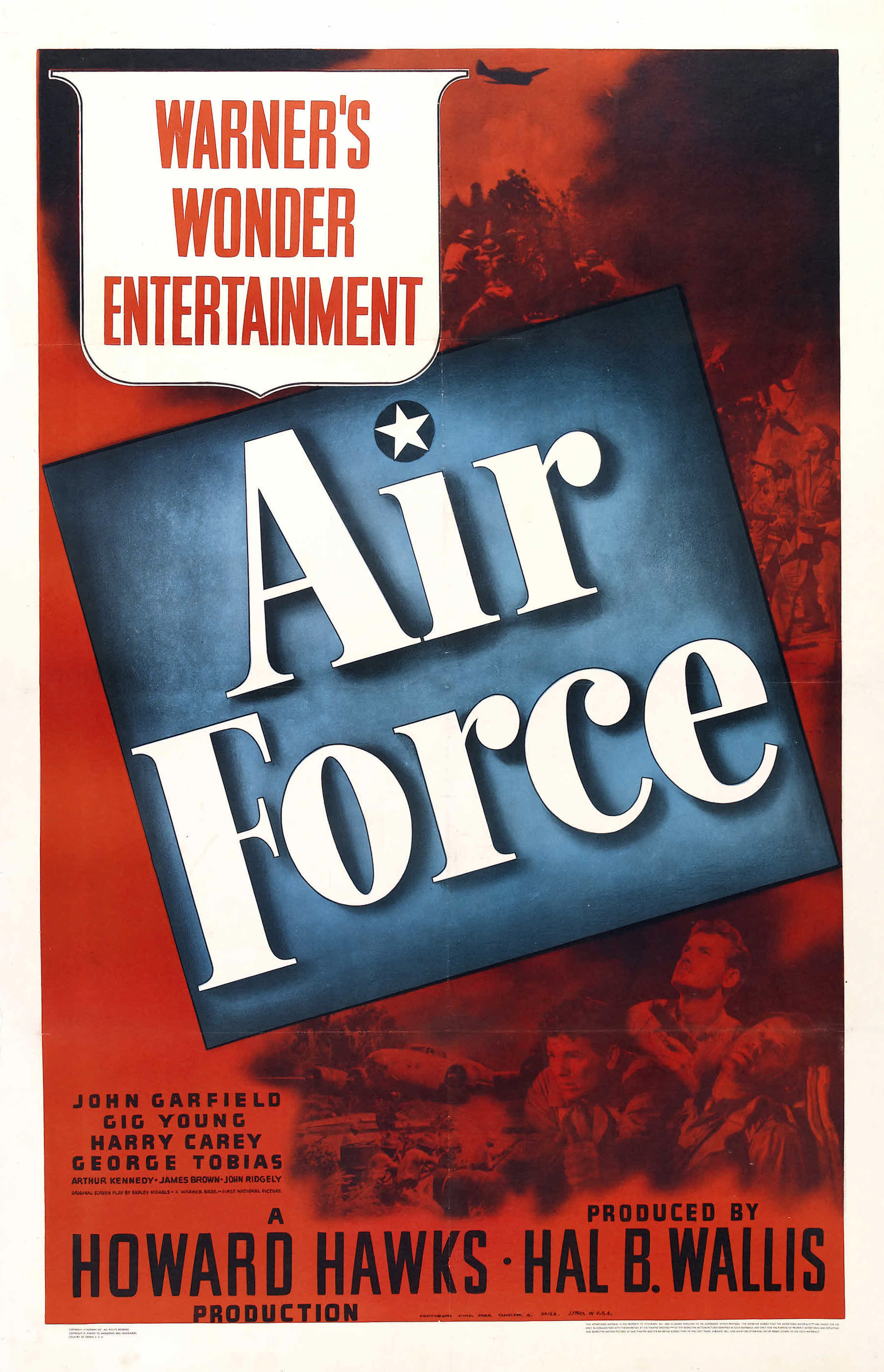
And before all of that, Hawks earned a degree from Cornell. (But, again: look at the poster for John Garfield’s movie AIR FORCE; which name stands out?)
Harold “Chic” Johnson doesn’t count, because he dropped out of college.
But his comedy partner, John “Ole” Olsen? Yeah, he counts, earning a degree from Northwestern University before they got famous as Olsen and Johnson: working the vaudeville circuit and doing their zany schtick on Broadway in HELLZAPOPPIN before getting billed as co-leads in – well, the movie version of HELLZAPOPPIN, of course; but also in COUNTRY GENTLEMEN and in ALL OVER TOWN and in CRAZY HOUSE and in GHOST CATCHERS and in SEE MY LAWYER, and all before the two of 'em got their own short-lived variety show on television in '49.
That’s not counting theatrical shorts, you understand; just half-a-dozen feature films where top billing simply went to Ole Olsen and Chic Johnson.
Waldo, I’d suggest that you need another hobby, but I’m enjoying this one far too much.
Tough choice. As a casting director do you go with Queen Bitch of the Universe or a Princess Bitch who liked to take her clothes off at parties?
As I recall, “Tallulah, dear, you have such lovely frocks. Why don’t you wear them?”
Well, so long as I enjoy it too, reckon I’m going to keep learning.
Take, f’rinstance, Ralph Edwards – Berkeley Class of '35, BA in English – who hosted TRUTH OR CONSEQUENCES and THIS IS YOUR LIFE on the radio for years in the '40s before doing likewise on television in the '50s, and who thus earned separate stars on the Hollywood Walk of Fame for television and radio.
I hadn’t known he got so big that he started getting tapped for leading-man movie work – getting billed second to his leading lady in THE BAMBOO BLONDE in '46 and BEAT THE BAND and '47. And, even a few days ago, I demonstrably hadn’t known he got so big that they put him on the cover of Superman’s comic in '48, and built the issue’s story around Edwards interactions with our hero and Lois Lane – because I would’ve totally dovetailed that with the Kay Kyser-and-Batman post.
Guess it was an easy call to cast Herbert Marshall second to Bette Davis in that one, though – since he was billed second to her the year before, in THE LETTER. And back before that, he’d been billed second to Barbara Stanwyck in ALWAYS GOODBYE and in BREAKFAST FOR TWO; and he’d been billed second to Marlene Dietrich, in ANGEL and in BLONDE VENUS; and he’d been billed second to Claudette Colbert, in ZAZA and in SECRETS OF A SECRETARY, and he’d been billed second to Katharine Hepburn and to Greta Garbo and to Norma Shearer and to Margaret Sullavan and et cetera – all after he’d graduated from St. Mary’s College, and fought in WWI.
(I mean, he also got top billing a bunch of times – in ADVENTURE IN WASHINGTON, and WOMAN AGAINST WOMAN, and MAKE WAY FOR A LADY, and FORGOTTEN FACES, and TILL WE MEET AGAIN, and IF YOU COULD ONLY COOK, and EVENINGS FOR SALE, and THE SOLITAIRE MAN, and BACHELOR’S FOLLY, and MICHAEL AND MARY, and so on, and so on – but if you need a guy who can ably field the second-billed role under everyone from Susan Peters to Shirley Temple, then, yeah, it’s him.)