Yes, it’s the “zh” sound. And so far, no one has come up with any other examples of the sound before an A other than parmesan.
It’s not an uncommon way, in my experience, to notate that sound in English. After all, it is to “sh” as “z” is to “s.” Like “garage” being pronounced as “guh-rahzh”. Or “measure” as “meh-zhur.” Pretty sure some dictionaries even spell it out that way. Online, both dictionary.com and m-w.com use the “zh” to represent their sound in their phoenetic pronunciation.
I believe you. I guess I’ve just never encountered it (or at least knew to pronounce it) that way.
I mostly see it in Asian communities like the surname Zhang, used instead of Chang, and pronounced like “Zong” (rhymes with gong).
Good to know for the future though! It’s certainly easier to read than the IPA version.
Nope (replying to Atamasama). Bawn and raised in the U.S. of A., and living in Kentucky, home of beer cheese. Buy it in the 15-pound pail!
To get nitpicky (we’re in FQ, after all), the proper French pronunciation of “Jean” doesn’t include an /n/ sound: [ʒɑ̃] in IPA, with a nasalized “aw” sound.
Although, wait… do they?
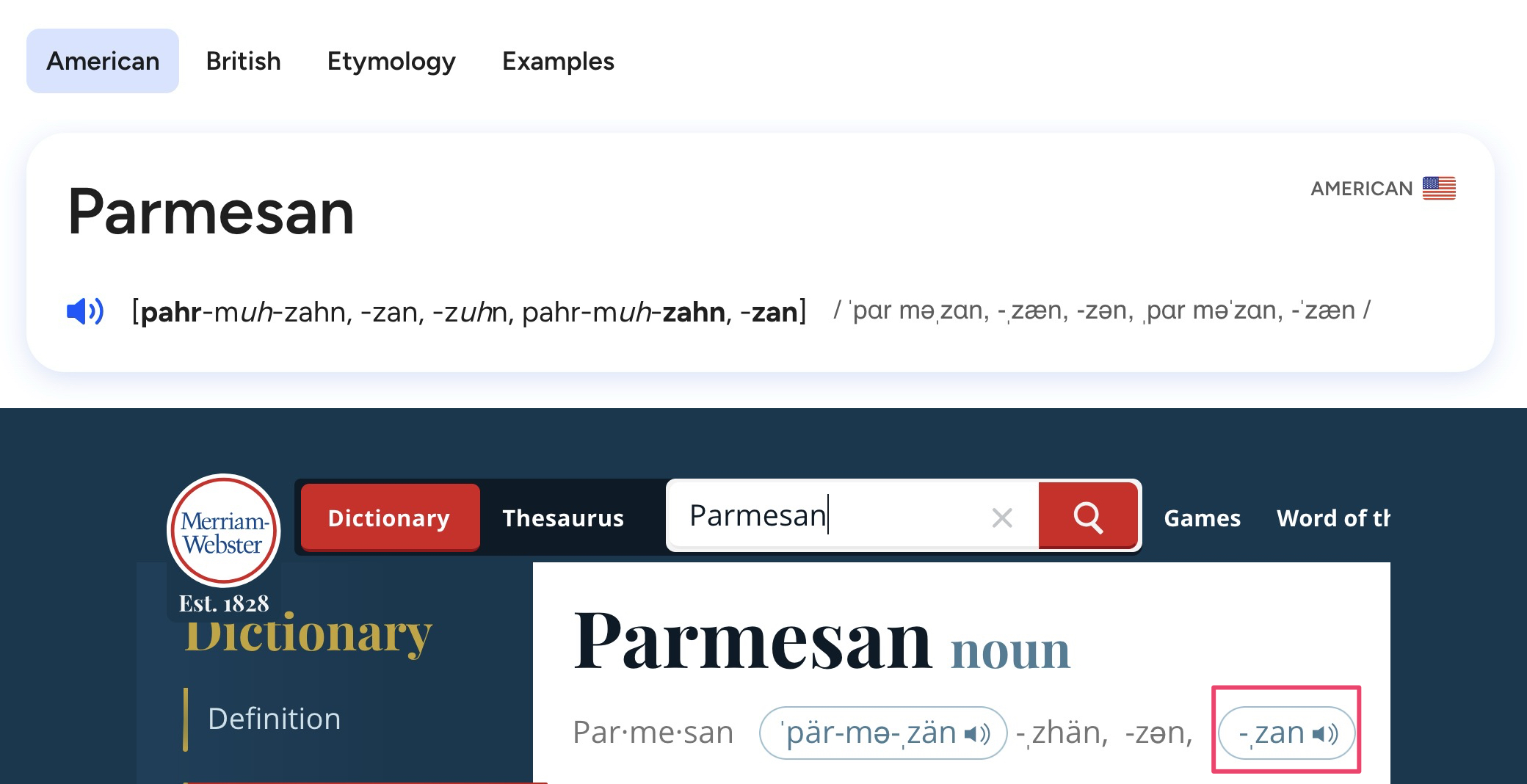
Dictionary.com doesn’t use that spelling at all (for parmesan, at least), and MW’s main pronunciation lists it as -zan. It does also list a -zhän, but I have no idea how that’s different from the -zan that it actually speaks out loud and sounds like the OP’s pronunciation.
Down here in Oz, I don’t think I have ever heard any sort of zh sound in parmesan. We pronounce it the way it is spelt. We have a very healthy Italian community here, and no doubt they just ignore the rest of us on this name. Go to an Italian restaurant and you may get offered parmesan, it isn’t pronounced with a zh. Which is what you would expect.
The chicken dish with a parmesan topping is simply called a chicken parmy. Nobody bothers with any sort of fancy pronunciation, and everyone knows exactly what it is.
Is it not too do with how the word is pronounced in Neapolitan rather than French or Italian? That’s where a lot of Italian-American pronunciations come from where they differ from standard Italian.
We got our signals crossed here.
I meant for “measure” and “garage,” which was the words I was talking about.
I said earlier in the thread that “parmesan” does not have a “zh” pronunciation in dictionary.com. (In the following post, it was noted that m-w.com does list it as one possibility.) It’s pronounced with a plain “z,” which is the way I pronounce it. (Click on the speaker icon to hear it pronounced.) I expressed surprise earlier that so many people seem to pronounce it with a “zh.” While I have heard “parmezhan” in the wild, I more typically hear “parmezan.”
And just “chicken parm” here in the US.
The mid-vowel “a” of Italian, Spanish, and Portuguese is very rare among all dialects or regional varieties of English. Something close to it has existed among some California-to-Seattle speakers since the days of Jeff Spicoli (late 1970s), and now some young folks (especially women, who typically lead the way with this sort of thing) in other parts of the US…but even that isn’t typically quite the same as the Romance mid-vowel.
Everything I wrote in that post is factual.
Well, the issue is that most Americans conventionally “treat” the mid-vowel Romance “a” (IPA a) as an open back unrounded vowel (IPA ɑ), while most British treat it as a near-open front unrounded vowel (IPA æ). When I first heard Gordon Ramsey say “Nicarægua,” I laughed, because it sound so wrong to America ears – until I realized the Americans are just as wrong, but in a different way.
It is true that some Americans also pronounce the last vowel in “parmesan” with the æ. But it’s not how we usually try to render Romance words, or English words relatively recetly borrowed from Romance languages.
If you were just saying that some Brits, like most Americans, render the Romance mid-vowel as ɑ – good point. That’s surely the case.
spaghetjean-claude?
I did the same thing several times, you are not alone! Finally remembered…
Getting back to the question actually axed in the OP, I think it comes close to the original meaning of “begging the question,” where the question assumes that the conclusion is correct, that is “How did we get there [pronouncing the ‘s’ in ‘parmesan’ as 'zh]?” And while that pronunciation does exist, I would venture that it’s probably much less common than the ‘z’ sound that most Americans would pronounce–at least that’s my personal experience.
Ok, I misread the OP. I was giving an example of a word where an ‘s’ preceding an ‘a’ was pronounced as ‘z’. Like it is when Parmesan is pronounced by British people. I didn’t know Americans pronounce Parmesan with a ‘zh’ sound.
Most don’t.
Is there a cite that says that is true? I’ve always heard it with the “zh” sound. Saying it the other way with just a “z” sounds purposefully affected like trying to put on an accent.
I have always pronounced it that way (with /ʒ/)!
Looking into it further, I think the Italian Parmi/dʒ/ano just got simplified to Parme/ʒ/an, but I don’t know why: we say Belgian, not Bel-zhan.
Looking at random youtube videos, I would say it’s somewhat evenly split with regard to pronunciations. However, my 1950s MW dictionary shows only the ‘z’ pronuncation. Current MW shows both pronunciations with ‘z’ listed first. And having said that. . . MW editors state that the order of pronunciations doesn’t indicate an order of preference, just that there are limitations to the printed page, and something has to come first. In my experience, it’s either the order that various pronunciations evolve, or the order of commonality. Pronunciations that are ‘considered by some’ to be substandard are marked with an obelus.
And one more comment about dictionaries in general, and that’s that they’re the recorders of usage and pronunciation, not the arbiters.