One of Hoyle’s most interesting theories was his idea that Stonehenge was an eclipse predictor. This cannot really be refuted since Hoyle claimed that he could predict eclipses from it. The main objection, obviously, is that it was ascribing too much sophistication to the ancients. The final analysis of the antikythera mechanism pretty well demonstrates that the ancients could be extremely sophisticated. One of Hoyles’s most interesting arguments was the “errors” in the alignments were always in the correct direction.
To explain this notice that it is very hard to observe a solstice since any continuous function gets to be almost constant near a minimum or maximum. So it is hard to detect when the sun sets, say, the furthest north of west. But if you can work our when the sun sets nearly the furthest north and ten days later it sets in the same place, then you know that the solstice was five days before that last observation. Similarly for the moon’s furthest elongation from the ecliptic. And the sightlines to detect these positions were there. Not exact, but always off in the correct direction.
I find this very interesting, but no one seems to have taken up the idea. Sir Fred was one very clever guy.
The day I met him (at a luncheon with members of the math dept at McGill) he was concerned with comments he had made to a Montreal reporter about the Nobel prize having been awarded to Jocelyn Bell’s thesis advisor, but not to her, for the discovery of pulsars. He was concerned that he could be sued for libel in Canada.
But how much modern mathematical theory did he add to derive those predictions? And did anyone really check his working? Also, does it work going forward… you can devise a polynomial to fit any previous set of points, in principle.
Actually I’m sure he was a very smart fellow, and probably a lot of fun to shoot the breeze with!
Right… if you want a possible large-scale non humanoid intelligence that does not violate any known scientific laws, ‘Joe’ (the cloud) is it. Of course, he (to use a convenient pronoun) can simulate any human brain as needed and can use a fraction of his attention to talk to us colloquially.
Ah, Canada was the pioneer in that regard. When Banting and Best isolated insulin, to treat diabetes and save millions worldwide, the Nobel prize went to… Banting and McLeod, Because McLeod was the head of the lab where it was done… and Best couldn’t receive a Nobel Prize because he was … Horrors!! … just a grad student. (Banting thought this was extremely unfair).
The biggest problem with trying to pin down what Stonehenge was “for” is that it was built in three completely different eras by three different civilizations, and over a significant span of time for each of those three civilizations. Certainly at least some of the architects had at least some level of astronomical sophistication, but it’s likely that some of the folks involved just looked at it and went “Ooh, mystical!” without understanding any of it.
It also has a great many landmarks, which means a number of potential alignments that scales with the square of that number. Which means that some alignments might have been specifically designed to track things like lunar astronomy, some might have been to track things of great importance to the builders but no significance to us (the proper times for planting various crops, for instance, or the date of a particular festival associated with some important person’s birthday or wedding day, or whatever), and most of the alignments (but which ones?) were surely just coincidental.
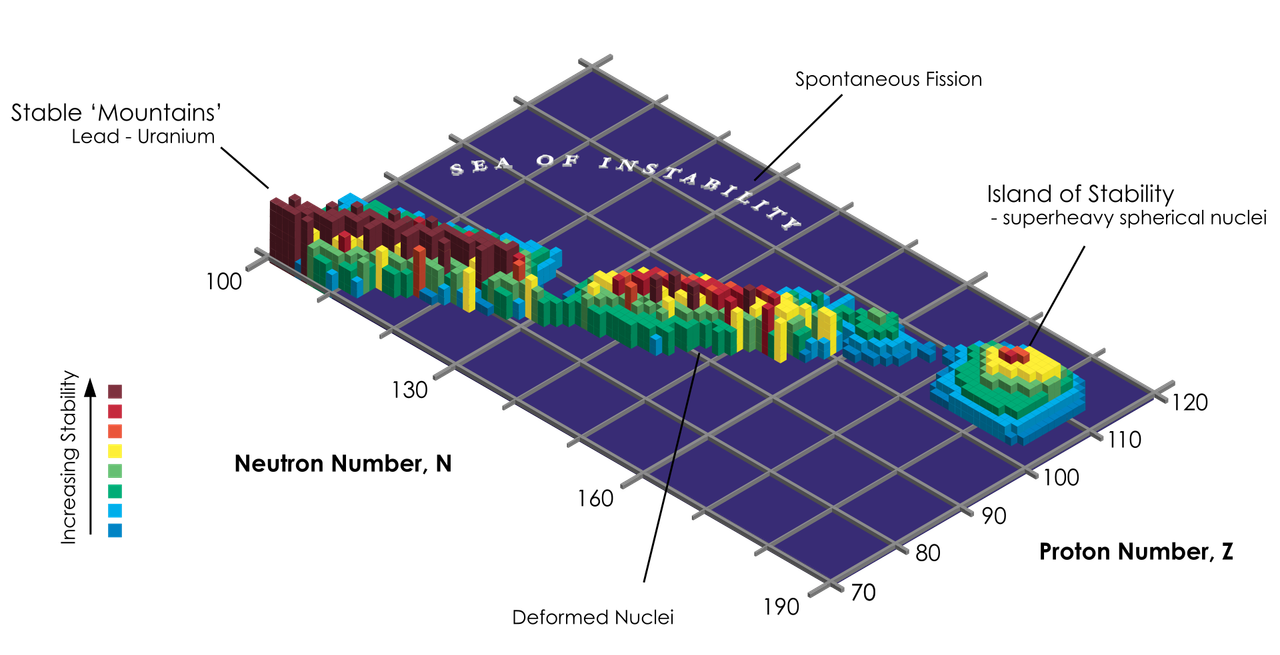
I’ve always been fascinated by the “Islands of Stability” that may be found out beyond element 118 (Og or Oganesson) in the vicinity of element 126 (Unbihexium, or eka-Plutonium, not yet discovered/synthesized). SF author Poul Anderson’s Polesotechnic League series explored mining these materials from supernova debris and that idea has stuck with me for some reason.
The “Island of Stability” probably does exist, in the sense that those isotopes would be more stable than their neighbors. But it’s an open question just how much more stable: It could mean that they last for seconds, instead of microseconds. Isotopes in the Island of Stability being actually stable, and not decaying at all, is an idea much-beloved by science fiction authors, but probably just wishful thinking.
No." When nucleons bind together to form a nucleus, they must lose a small amount of mass, i.e. there is a change in mass to stay bound. This mass change must be released as various types of photon or other particle energy as above, according to the relation E = mc 2. Thus, after the binding energy has been removed, binding energy = mass change × c 2 . This energy is a measure of the forces that hold the nucleons together. It represents energy that must be resupplied from the environment for the nucleus to be broken up into individual nucleons."X From: Binding energy - Wikipedia
And the big bang theory is discredited by JW telescope ? Theres a galaxy older than the big bang, so its… outside big bang space. Already was discredited by CBMR not being homegenous ?
So… there’s an error in one or both of the measurements we haven’t figured out yet. Scientists have never claimed to know everything.
The CMBR is really, really homogeneous, far more so than could be explained by any known model than the Big Bang. There are slight inhomogeneites in it, but at the exact level that we would expect from the Big Bang model. That one, at least, is something that we do know, apparently extremely well.