Having spent several years in Fundamentalist and Evangelical churches and groups when I was younger, I suspect that, to paraphrase Giorgio Tsoukalos, the takeaway from those analyses is consistently:
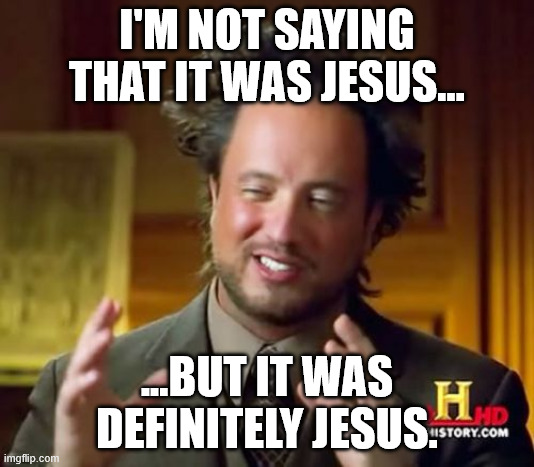
Having spent several years in Fundamentalist and Evangelical churches and groups when I was younger, I suspect that, to paraphrase Giorgio Tsoukalos, the takeaway from those analyses is consistently:
I’m okay with religion not being logical as long as it stays in its own lane. Logic is not the only important thing about being human.
But the minute you start trying to attack science that doesn’t comport with your beliefs, I’m out.
If you admit you are not a Scotsman while living in, say, Spain, then you aren’t a Scotsman. Believing in a religion is what makes someone religious, not going through the motions.
Celebrating Christmas to enjoy being with my family despite not believing in God didn’t make me religious.
It’s my impression that this depends on the religion, and that some religions consider being an adherent of that religion to be more a matter of practicing the right practices than of believing the right beliefs.
And yet your employer will still be in hot water if he denies you the day off.
Are you saying that you have actually met any religious people who do insist that their beliefs are entirely based on empirical evidence and logical reasoning?
Yes, that’s certainly true of Judaism and, I believe, of Buddhism. Another logical difficulty of Der Trihs’ definition is that it makes it impossible to know for sure whether anyone else is “really” religious or not.
I think there are some who think it is logical, having not been exposed to, or refused to listen to, the logical refutations of various arguments about the origin of the universe. Or everything is based on what they “just know” to be true, without being bothered about asking how they know. God apparently talks to my sister in her head, according to her. How can she ignore or go against that? And how can anyone else know that it isn’t true? QED.
As Thomas Aquinas put it*, “for those who believe, no proof is necessary; for those who disbelieve, no amount of proof is sufficient”. This might be read as a slam on either the gullible believer or the stubborn skeptic, but I don’t think it’s either. Rather, it just points to the notion that knowledge of the divine, if it is attainable at all, is a different epistemic modality than that of evidence and proof.
There are some who’ll immediately balk at this notion, but just think of having a headache: you don’t need to go around collecting evidence that you have a headache, you don’t need to conclude that fact from any prior principles, you know you have a headache from, well, having a headache (and even a Sellarsian critique of the myth of the given can be consistent with this). So there are things you can know without having arrived at this knowledge via evidential/logical means.
Moreover, it would be entirely fruitless to try to convince somebody else of these things by logical argument. Sure, they can, and typically will, believe your reports of having a headache, but what could you do to prove it to them if they’re determined to be skeptical? They can’t feel your headache, so there will always be a ‘leap of faith’ into believing you about having one. Indeed, to somebody who’s never experienced it, how could you describe what a headache is?
So I think if there is any sensible concept of knowledge of the divine, it has to be along some such lines—not necessarily by the same epistemic modality that grants you knowledge of your headaches, but perhaps by yet another one (if there’s two, why shouldn’t there be more?). And if that’s the case, then indeed trying to transmit such knowledge via logical argument is as fruitless as trying to transmit knowledge of a headache via the same route.
So what can one do in the face of this possibility? Well, I think the most one can say is: if there is such knowledge, I don’t have it, so I have no reason to believe. No proof would convince me otherwise, because the notion of proof itself undermines the epistemic preconditions of any possibility of belief. So yeah, religion does get itself into trouble when it tries to logify itself.
*At least I thought it was him, but googling around sees it attributed to different people, Ignatius of Loyola and others. So probably a misattribution.
Yes, my YouTube feed is loaded with them.
Christian philbros, YECs, presuppositionalists, Christian apologetics has been based on “empirical evidence” and “logical reasoning” since forever.
Faith by definition is belief without proof. Not only does it not need proof, does not want proof, it disdains it. Doubt is anathema to it yet doubt is core to logic and science, is utterly and vitally necessary to our incrementally improving understanding of the universe.
Quite aside from the utter absurdity of all religions’ beliefs is the rigidity, is the uninterest - indeed hostility - in any advance in factual understanding. We already know everything we need to about how everything works, any further investigation is only liable to undermine our faith - so why do it. It must be because you are the devil’s spawn!
The god of the gaps is a rapidly diminishing entity.
It’s not just believers versus non-believers.
Within a religion different sects can attack each other.
For example. Christianity has a long history of Protestants and Catholics murdering each other.
Even today:
The stated purpose of the peace lines is to minimise inter-communal violence between Catholics … and Protestants
Yes, and this is something the Bible itself points to quite clearly.
There’s a built-in distinction between how people label themselves and how they are known. Jesus speaks of those who call themselves believers, even performing religious acts, yet are told, “I do not know you.” At the same time, Scripture allows for the possibility that some who fall outside our religious categories may nevertheless be known by Him.
By modern logical standards, that looks like a “no true Scotsman” move, but biblically it functions as a feature, not a bug. Faith is not validated by self-identification or affiliation, but by something deeper.
That fits the larger point about logic and faith. When faith is reduced to labels (and binaries) it inevitably produces conflict. But when we consider the orientation of the heart, the distinction makes sense without becoming arbitrary. It explains how people can look religious and yet miss the point, and how others may not wear the label yet live closer to it.
Thank god for that! 
More seriously, I like your whole post a lot.
I agree w your punchline that the need for god of gaps for the inherent non-believers is rapidly diminishing towards zero. We’re certainly far past needing a thunder god and a rain god to explain the weather. Even if the details of the origin of life and the universe are still kinda fuzzy to Earth science, those concerns are very remote to daily living.
BUT (and it’s a biggee) …
The supply of people who have the functional defect of “spirituality” seems eternally fixed at about 80% of the population. Those people are ready-made victims of whatever charlatan comes along to sell them access to the non-existent “divine”. They might be a majority, but they certainly aren’t right.
I suspect it’s lower than 80%. Even in the United States.
Don’t underestimate the number of people who claim to have a belief in order to fit into their community.
I suspect that number fluctuates a lot, too. There are certain environmental and societal conditions that facilitate belief and certain that harm it.
Yeah, I’m not sure why I wrote that, I know there are countless stupid people in the world.
No, you (and Der Trihs) are just talking about hypocrisy; people purporting to believe in things they actually don’t.
I’m talking about religions like Reconstructionist Judaism or liberal strains of Christianity, which openly acknowledge that their Scriptures aren’t literally true. Yet many people are deeply committed to these faiths and make them central to their lives; are they not “really” religious? A fundamentalist might argue that they aren’t “really” Jews or Christians, but I don’t see how you could say they aren’t religious.
I’m not talking about that kind of hypocrisy, though it certainly exists. I agree with you that people sometimes claim beliefs they don’t actually hold, but that’s a separate issue and not the one I’m addressing here.
What I’m talking about is people who genuinely believe in God but are not yet transformed. They are often holding onto frameworks they were taught and trying to make sense of faith primarily through logical understanding (typically rule based). That can produce real moral conflicts, for example: God says X, but X seems to cause harm or pain to others. The resolution is often framed as, “My responsibility is obedience; God will justify the outcome or reveal the reason for the pain later.”
Living inside those unresolved moral conflicts while still maintaining belief in God is, in my view, part of the journey of faith.
So:
In that sense, they are not being hypocritical. They may be incomplete, still forming, or limited in understanding, but not insincere or dishonest about what they believe.
Even apologists who make a living arguing for the existence of God like William Lane Craig have stated that most believers are very bad at making proper and coherent arguments for their beliefs. Most religious people would just cite faith or having been raised that way (which is a matter of practicality, not ideology) as to why they believe in God. You could probably make the same claim regarding believers in political ideologies.
I dunno. I’m pretty religious and, although I find the phrase quite cringey, I feel I’ve been “transformed” by religion. But I don’t see myself in this at all. In order to have a moral conflict between your own beliefs and what “God says”, you have to believe you actually know what God says. If you accept that it’s all myth and allegory, that conflict never arises.
Take homosexuality; the Torah clearly and explicitly forbids it and in fact makes it punishable by death. But there’s clearly nothing wrong with homosexuality, so the Torah is simply wrong about that. No big moral conflict there.
You can still regard your Scriptures and the moral and ethical system derived from them as holding immense spiritual value and to be worthy of study and obedience, without having to back into the corner of insisting that it’s all true. That binary thinking of “it’s either completely true, or it’s completely worthless” is IMO a great example of religion getting itself in trouble by trying to be logical.
Statements like “Religion gets itself into trouble when it tries to be logical” are too general to be useful. Replace “religion” with “government” or “sports” or “art” for comparison. Typical the author has in their mind some particular instance and it would be better to discuss that.
My religion focuses on stuff like
‘For I was hungry and you gave me nothing to eat, I was thirsty and you gave me nothing to drink. I was a stranger and you did not receive me as a guest, naked and you did not clothe me, sick and in prison and you did not visit me.’
Then they too will answer, ‘Lord, when did we see you hungry or thirsty or a stranger or naked or sick or in prison, and did not give you whatever you needed?’
Then he will answer them, ‘I tell you the truth, just as you did not do it for one of the least of these, you did not do it for me.’
I don’t use evidence to justify helping the hungry or the thirsty or the stranger or the unclothed or the sick or the imprisoned. But evidence is useful to figure who needs help.