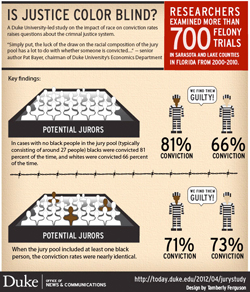
So here in the Dallas area, a high school kid (Karmelo Anthony) was just convicted and sentenced for killing another in what appears to be a weird crime of passion. Thing is, the kid who did the stabbing was a black kid, and the kid who died was a white kid. And there are the usual cries of racism, etc… with the usual sides opposite each other. One of the main criticisms is that it was an all-white jury and therefore not a “jury of his peers”, and that the prosecution struck the three black people from the jury panel because they were teachers. Collin County isn’t exactly the blackest of the DFW counties, with about 11% black, so it’s probably unlikely they got a lot of potential black jurors in any event.
This sounds awfully similar to the contention that because a large black community somewhere doesn’t have a black representative, that they’re not represented.
So what I’m wondering is how far this should go? I mean could he argue that his jury wasn’t “of his peers” because they were all old? Should Asian people claim they’re not represented because there aren’t any Asian representatives? What about disabled people? Fat people? Women? If I were in Anthony’s shoes, I’d think I’d be more worried about the age of the jurors, rather than the racial makeup.
It would seem that a boundary needs to be drawn- what constitutes representation or a “peer”?
This is an extreme case; America is a deeply white supremacist nation, with a long history of deciding legal cases along racial lines especially against black people. And then the court removes all the non-white jurors? If nothing else it undercuts the justice system and encourages racism by making it look like the court is going for maximum racism on purpose.
And this is in Texas as well, a notoriously right-wing part of the nation. In Texas it would be very surprising to see an all-white jury not convict a black male of whatever they are accused of. I wouldn’t expect them to seriously consider any factor other than the skin color of the accused in Texas.
Thing is, it sure looks like this kid overreacted in some way and really did flat-out murder the other one. I mean, they didn’t know each other, he was armed with a knife at a track meet, and apparently reacted violently from the get-go.
But that said, where I’m going is in defining what constitutes a jury of one’s peers? Or “being represented”? I’m sure there’s a legal definition, but as we all know, the legal definition of something and the popular conception of the same thing rarely line up.
I guess what I’m getting at is that I can see how gerrymandering a district such that a voting block is intentionally diluted would be claims for unfair/lacking representation, but what if it’s not gerrymandered, and someone happens to be in a minority group for that district? Or if they’re in a different minority group from the dominant one in that district? I mean, there’s probably an Indian guy somewhere in South Dallas- is he not represented because there aren’t any Indian representatives in his area?
Or for that matter, I’ve heard people claim they’re not represented because they’re Democrats/Progressives in red states. Is that actually true, or do they just not like their duly elected representatives?
That’s what I want to explore- what constitutes legitimate representation/peers, versus just not liking the way things are.
Context matters. And in the US, a long and pernicious (and continuing) history of racism specifically against black people is always a relevant part of the context.
Also consider that even if those specific 18 non-black people were all unbiased, it was a biased process that resulted in that non-black jury, and the bias that resulted in that probably manifested itself in other, more difficult to detect, ways during the trial.
But was it biased? If they had a panel of 30 potential jurors, 3 of which were black, and they got voir dired out of the actual jury, how is that necessarily biased or in any way disproportionate or unfair? Or for that matter, if there would have been one black juror? That’s close to the 11% of the county as a whole.
What number would have constituted a jury of his peers? And to what lengths should the court have gone to ensure that? That’s what I’m curious about. So far, nobody’s ever put a number on these sorts of things, and that’s what I’d like to know.
That’s an excellent point. I found this interpretation:
To the Founding Fathers, a “jury of one’s peers” meant an impartial group of fellow, local citizens who shared the same social and political status, rather than a specialized panel of elites or government-appointed judges. The core intent was to protect everyday Americans from government tyranny and to ground the justice system in the common sense of the community
In all likelihood, though, to the Founding Fathers, a “jury of one’s peers” probably meant a jury of white, landowning men. To the FFs, those were their peers.
Important note: The phrase “jury of one’s peers” is not a part of American jurisprudence, at all. It’s British, and it means that nobles will be tried by other nobles, and commoners tried by other commoners. In America, where everyone is (theoretically) a commoner, it would be meaningless.
Fair enough; the term here is apparently “impartial jury”.
But what constitutes that? That’s what I’m getting at. Nobody ever actually says what it means in unambiguous terms. Nobody ever says “Collin County is 9.2% Indian, therefore any trial with an Indian defendant must have at least one Indian person to be considered impartial.” Or black, hispanic, white, etc… Would a white person have cause to bitch if a jury has less than six white members in Collin County? What about age, income level, or anything else like that?
Because you’ve got a representative who was duly elected for you and your district. That’s how the system works. You just don’t agree.
Let’s go a little further- let’s say they’re not as odious as Harriet Hageman, but you still don’t agree with them 100%. Are you still not represented in Washington? Where do you draw that line?
And that’s where the context I mentioned comes in. If an Irish-American is accused of a crime, and none of the jurors is Irish-American, that’s probably fine, and probably nobody would even notice, because there’s not a long and continuing history of racial discrimination against Irish-Americans in this country (there was for a time, but it lasted only for a generation or so, over a century ago). In some places in the US, there might be a similar pattern of ongoing discrimination against Native Americans, or against hispanics, in which case that might be an issue… or it might not, in other places.
Yes, that’s how the system works; the system is broken, and I indeed don’t agree with your definition of “representation”. The crux of our disagreement comes from the word I bolded… Because of where I live, a representative will never be elected BY me, only FOR me; and they will generally not share my values. Especially with the insanity that the right wing of the country is engaged in nowadays…
I’m not sure how you get around it with single-member districts. There’s always going to be some “tyranny of the majority” that goes on with that. Beyond that, it’s part of representative democracy- you are represented in your district/state according to how the majority of the people in that district choose to be represented.
Now I do think that representatives have a greater obligation to their electoral unit than their party or any other group. I mean, my Federal rep is pretty godawful as well; I was recently redistricted into Beth Van Duyne’s district from Colin Allred’s, and I don’t like her at all. But I feel like if she put my part of Texas first, and party second, I’d be a lot less unhappy.
I understand what you’re getting at, but nobody seems willing to define it. I recall a few years back when there was a big kerfuffle about the number of black coaches in the NFL, and how they were underrepresented. But nobody actually proposed a number that would indicate appropriate representation, just an assertion that it was so. That’s what I’m trying to get at- would a proportion of black coaches similar to the population at large be appropriate? Should it be similar to the proportion of players? Fans? It seems like a moving target in a lot of ways, if the assertions aren’t associated with actual numbers and criteria to evaluate against.
To be clear, I’m not claiming that everything is hunky-dory, I’m just a bit weary of the assertions without any follow-up on what would have been appropriate? How exactly did TPTB fail? How could they have done better? Without firm stuff like that in place, we’re just spinning our wheels, because that target can change every time.
Maybe someone could dig up statistical data, but just how much of a benefit is it to have jurors of the same race? I imagine there must be so many times when racial-minority jurors have convicted a defendant of the same race that it’s close to a tossup or no advantage at all.
If I’m a defendant, I want jurors who are sympathetic to me, regardless of race - and I’d want every juror of the same race as me, who is hostile to me, off of the jury.
When the people in charge actively hate you and work to harm and oppress you, you are not being “represented” any way that matters. By the nature of things right wingers never represent anyone they consider part of the “out group”; tyranny and cruelty are the point for them.