Guardian article: Sperm whales in 19th century shared ship attack information
Study abstract: Adaptation of sperm whales to open-boat whalers: rapid social learning on a large scale?
Researchers studying whaler’s logbooks have come up with the theory that Sperm whales learned to swim upwind to escape sail-powered whaling ships and passed the knowledge on. Of course it didn’t help once steamships came along, but the idea that they came up with and communicated an avoidance strategy is pretty amazing.
Sperm Whale: “Contact, bearing zero nine zero, range 8000 meters, designating Sierra One!”
Crane
March 31, 2021, 2:12pm
3
Thanks for the link. Very interesting article.
Some of them are still alive, so there could be something to this.
digs
March 31, 2021, 11:16pm
5
So they could be interviewed for follow up articles, and talk shows!
Hmmm … Googling seems to suggest a max age of around 70 years.
Well, their descendants are still with us, so they couldn’t have all died back then.
Right - Sperm whales are doing reasonably well these days: the total worldwide population is ~400,000.
And now there is some new research on how sperm whales communicate.
Popular article:
The way sperm whales communicate may be more similar to human language than previously thought. The acoustic properties of whale calls resemble vowels, a defining feature of human language, according to a new study from UC Berkeley’s Linguistics...
The actual study:
The sperm whale communication system, consisting of groups of clicks called codas, has been primarily analyzed in terms of the number of clicks and their inter-click timing. This paper reports spectral properties in sperm whale vocalizations and ...
LSLGuy
November 18, 2025, 5:42pm
10
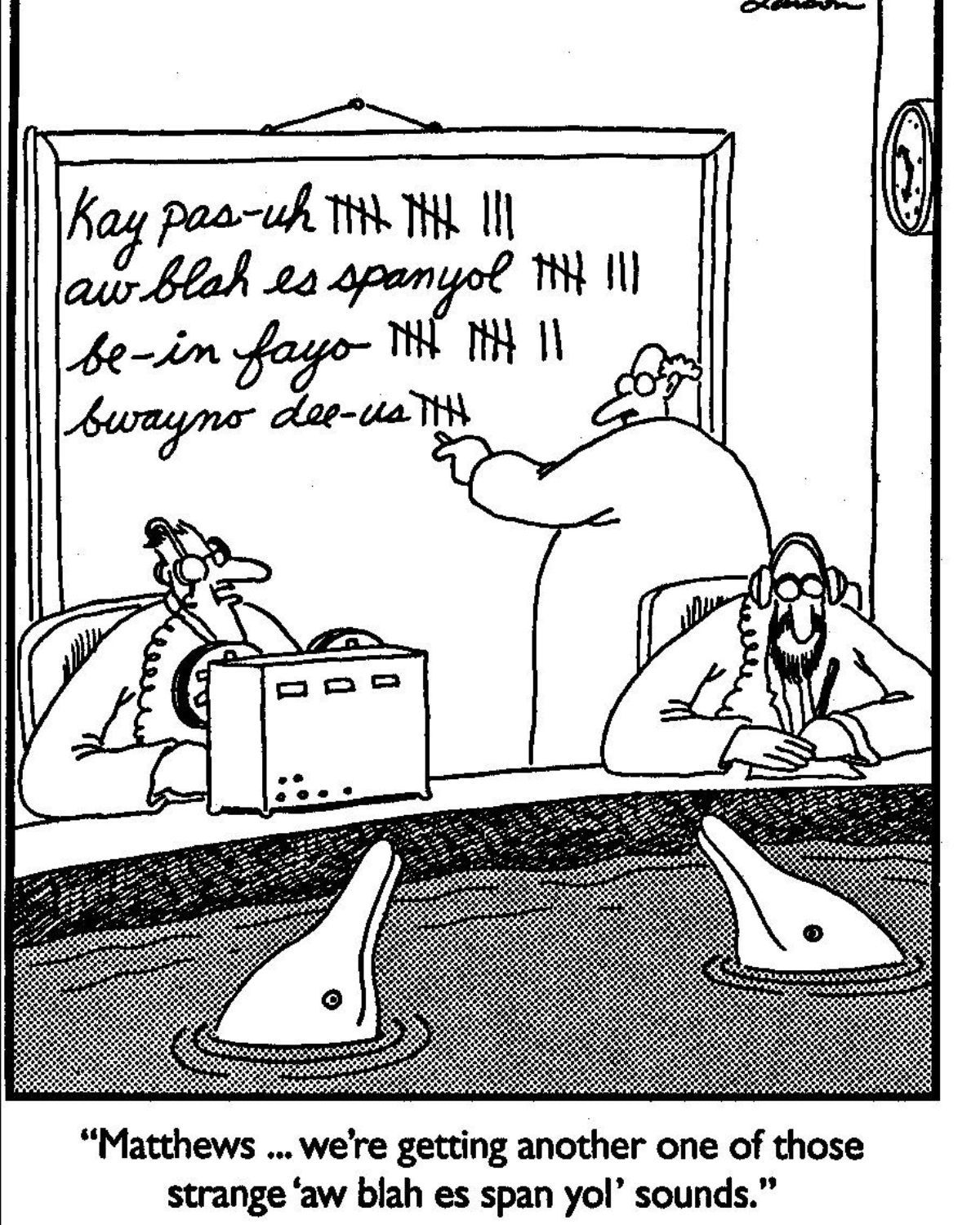
I trot this out every time we read about research on cetacean communication. It still tickles me every time:
I bet the sperm whales are glad oil lamps became obsolete over a hundred-sixty years ago.
http://www.sjvgeology.org/history/whales.html
The demand for whale oil took a tremendous toll on whales, and some species were driven to the very brink of extinction. The right whale, one of the scarcer varieties, was killed in the early 1800s at a rate of about 15,000 per year. When the growing scarcity of this whale forced attention to other species, only about 50,000 right whales remained. Had demand for whale oil continued, extinction would have undoubtedly claimed several species.
When a clean-burning kerosene lamp invented by Michael Dietz appeared on the market in 1857, its effect on the whaling industry was immediate. Kerosene, known in those days at “Coal Oil”, was easy to produce, cheap, smelled better than animal-based fuels when burned, and did not spoil on the shelf as whale oil did. The public abandoned whale oil lamps almost overnight. By 1860, at least 30 kerosene plants were in production in the United States, and whale oil was ultimately driven off the market. When sperm oil dropped to 40 cents a gallon in 1895, due to lack of demand, refined petroleum, which was very much in demand, sold for less than 7 cents a gallon.