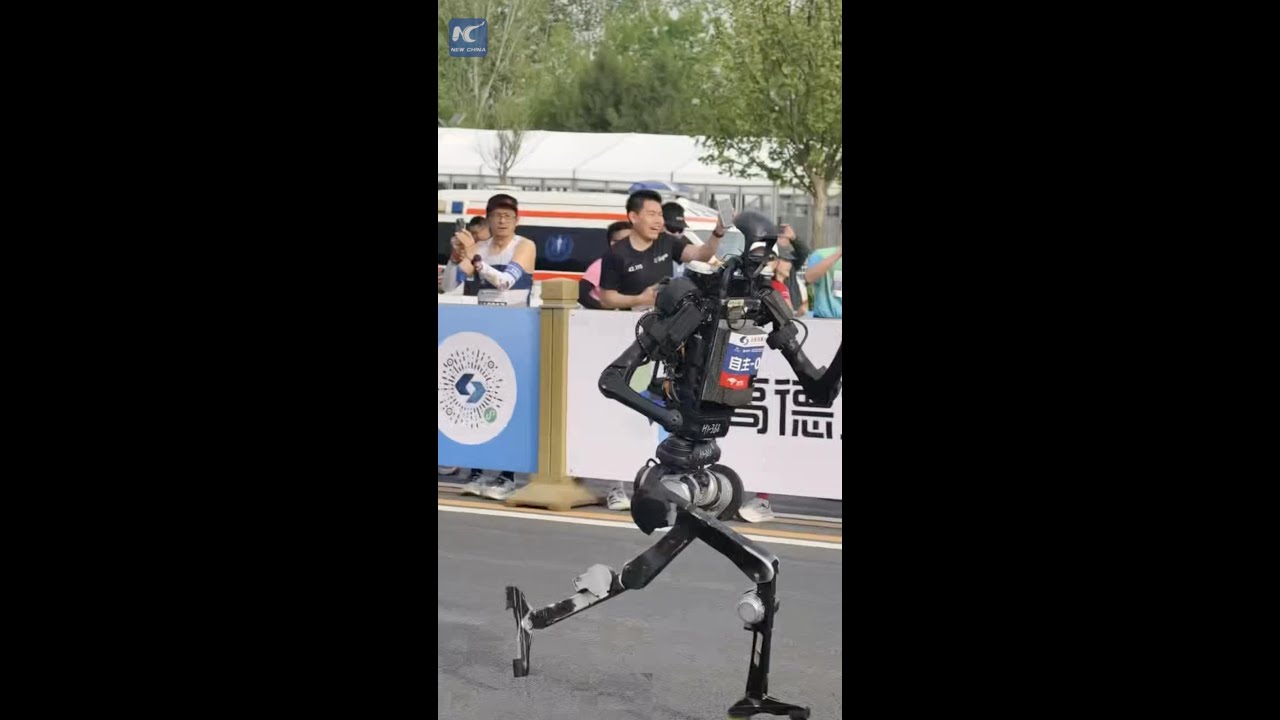
I ran across this clip, literally, 5 minutes ago. I just assumed it was either a joke or some old clip. I didn’t realize it not only just happened, but it was a whole robot marathon. When I went back to find the clip, I found other robot runners as well.
To add, the clip I watched didn’t have the text or additional audio, so I really didn’t know what I was looking for. If you search youtube for ‘humanoid robot half marathon’ there’s a ton of other clips as well. Most of them not involving the robots faceplanting.
yep, some show some really organic movements … (organic in this context means “efficient”, as there are less start-stop losses)
a few thoughts:
160min down to 50 min in one year - that is a hugely significant improvement
another interesting KPI would be “avg. time of those that finished” and “% of robots finishing”
anybody remember the first Boston defense (?) clumsy robots … and now they sommersault
This is the “first chess computer won against the grandmaster human” moment
while some are def. “corporate efforts”, there seems to be a lot going on at university level in China.
That was a hugely, expensive and extremely organized event (you noticed the EV-busses driving behind every robot for the first few miles)
I am afraid we are all witnessing (with some “noisy-ups-and-downs”) that China is not just catching up with the western world but are taking the lead … similar to EVs / Battery tech and other forward-looking industries …
but, yeah … let’s push coal mining and steel manufacturing jobs in 'merica and defund universities and think-tanks … that will frog-leap us ahead again.
I think this is really one of those HISTORIC moments in time (that we often have difficulties in ID’ing as such)
TBH, I don’t see the value in bipedal robots. Count me as one of the “we don’t need human-like robots, we need automation” naysayers. We don’t need a human-like robot to do the laundry for us by loading our clothes into a bucket, stirring, and pushing against a washboard, for example. We already have laundry machines for that. If you want to increase automation to get clothes into the laundry machine, fine, but I don’t see why it needs to be a bipedal robot over any of a number of other conceivable options.
Likewise, while there could be some use scenarios where a bipedal robot might be the best option, in general I would think something with wheels, treads, or propellers (flying) would be more than sufficient and possibly better than a bipedal machine. And even in use scenarios where wheels, tracks, or propellers would be sub-optimal (perhaps over rugged terrain at either high altitude or with varying winds), I don’t see why two legs would necessarily be better than four or more (and in fact I think at least 4 would be preferred in such situations).
Humans are bipedal because we evolved from a species that was already bipedal. How that species or its ancestors found itself where bipedalism was a better option than walking on all fours is a matter of some debate. But by the time it got to us, we didn’t really have a choice because our bodies were already adapted to walking upright and generally unsuitable for prolonged walking on all fours.
All that to say, bipedalism did not end up a human trait because it is necessarily the best trait for an intelligent species (or device) to have. It might just have been coincidence. By extension, there is no reason to assume that bipedalism should be selected for in our machines.
I have similar thoughts around bipedal robots after seeing them run. I’m like, why? But I think at this stage it’s about proof of concept - it’s not that they should do it, it’s that they can. Clearly, wheels are more efficient than two legs, but I think the ideas now are to show what’s possible today, and get people thinking about what’s possible tomorrow.
I agree, we humans look like we do, b/c of 1000s of generations of evolution …
… which prepares us well for tasks relevant from 200.000 years BC to 1900 years after BC …
I venture a guess (and might start a new thread on that) … that we as a species would look different had we evolved 1000s of gens doing what we do now …
so the body-shape we are showing, works perfectly for roaming the woodlands and steppes and farm and do whatnot (all activities that are “obsolete” in our daily efforts.
So in a way, having bi-pedals robots its the “we are re-fighting the last war-fallacy”
My guess - what robotics bring to the table, is “body-evolution-cycles” of weeks-to-months.
Isn’t the idea that you’d also want it to field a number of other existing tasks? So you’d want a robot assistant that can load clothes into a laundry machine like you would, and that’d fit into the driver’s seat of a car — with hands that reach the steering wheel, and feet that reach the pedals — and that’d be able to bring groceries in from that car, and put them on a high shelf like a grown man could, after walking up a staircase like a grown man could; if doorknobs and stovetops and half a hundred other things are currently positioned for the convenience of a bipedal person of regular height, you maybe just build a jack-of-all-trades design around that, right?
@Al128, I realize that English may not be your first language, so you may not be aware that the English transliteration of the name of the capital of the People’s Republic of China has been Beijing for decades. Peking is an older version of the name.
I do know that, but I speak 3 languages on a mostly daily base (none perfect )… and there are certain names that are spelled differently in all 3 languages …
Beijing (as you mentioned)
Selenski (UKR president)
basically all mayjore cities in UKR (that make it into the news-cycle
Hezbola (terror org)
couple of cities in india (Mumbai?) , as well
… come to mind …
Honestly, I no longer have the mental energy and interest to keep tabs on that - and my lingustic ducks in a row …
or as I tend to say … sometimes good … is good enough
The reason to build bipedal two-handed 5-fingered general purpose robots is because our built world and our machinery is already constructed for that form factor.
Just like all the various accomoodations for wheelchair users end up making things worse for everyone else, designing robots to a different shape/size standard then starting to design the rest of our built world to be compatible with their different shapes and our shapes is a step in the wrong direction. For us humans that is.
It is fully morally correct that we fully accommodate humans of different shapes, sizes, and mobility levels. Even if that necessarily produces some minor inconveniences for everyone else to avoid major inconvenience or outright unusability for the handicapped.
But retrofitting the world for small diameter wheels is dumb once we have the tech to construct, control, & power bipedalism. Which we clearly do, or almost do.
There are plenty of scenarios, such as factory assembly work, where robots of utterly different form factors or mobility are desirable. Great. Use those other shapes and sizes there. But for a machine intended to operate immediately amongst humans interacting with humans and using tools & machines designed for human use? Built those robots human-shaped with roughly human-equivalent physical mobility.

 )… and there are certain names that are spelled differently in all 3 languages …