I suspect something got lost in translation with that one.
The word “hoof” has two dictionary definitions: 1st the foot of an ungulate mammal, 2nd the
horny covering of the end of the foot in hoofed mammals
Elephantsaren’t ungulates, and the second definition is amusingly tautological.
And sure, if I google “elephant hoof” I’ll get thousands of results. But generally (which was your qualifier) elephants are considered to have nails not hooves.
The use of the word “all” in the translation (as I see it in the NIV) is a mistake. Nowhere in the original Hebrew does it imply that any insects have only four legs. It means anything that can fly that uses four legs specifically for walking, and two special ones for jumping. It names four species which are exceptions to the general rule that the category is non-Kosher.
My thought is that hooves are for minor digging, they work better for scraping the ground - hence hooved animals are typically grazers. It’s just a coincidence that some hoofy grazers avoid being dinner by running fast (horses, antelope) while others instead put their head down and fight fight with horns, typically (cows).
Not at all. I’ve frequently seen elephant nails referred to as hooves in the technical literature. For example, from Walker’s Mammals of the World (Fifth Edition), Vol. II, p. 1277:
Seriously? You’re quoting Wikipedia at me, the Straight Dope Curator of Critters? Do you really want to get into a technical discussion of mammalian taxonomy and anatomy with me?
The definition of ungulate has changed over time. From the Ultimate Ungulate:
At times, the Proboscidea has been considered to belong among the ungulates. And for what it’s worth, the Handbook of the Mammals of the World, the most authoritative and comprehensive reference on mammal species, includes elephants in its Volume 2, titled “Hoofed Mammals,” which actually features an elephant on the cover.
The hell they don’t. Wolves and dogs are carnivores. They bite and claw both as offensive and defensive moves. Ever see a playful dog pretend to bat something away? They do that with the claw side of their paw, not the back side.
Put mittens on your hand and grab your dog. Now do it with gloves. Tough to grab your prey when you basically have a stub or two instead of four or five flexible ones.
But why are hands or hand-like limbs needed to find the nipple?
Both kittens & puppies are blind when born, and for the first couple of weeks, yet they successfully find a nipple to suck. Between feeling with their muzzle and smelling with their nose, they survive by the millions. (It’s now kitten/puppy season at our humane society, and the arrivals seem endless!) They don’t use their paws much in finding the nipple.
For that matter, equines (horses, etc.) have hooves, yet they have no trouble finding a nipple. I don’t understand this comment.
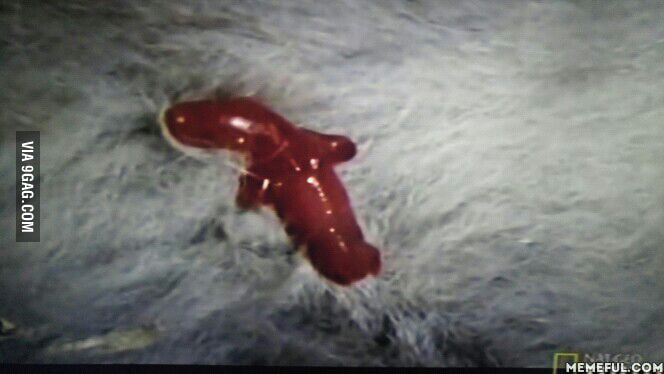
It’s actually to find the opening to the pouch, rather than the nipple, since the nipples are inside the pouch. A newborn marsupial, which is in an extremely undeveloped state, must clamber from the birth canal through the mother’s fur in order to reach the pouch.
This is a newborn kangaroo. It’s obviously far less developed than a newborn puppy, kitten, or colt.
Gryphon, an especially beloved dog of DesertRoomie’s would sometimes come up to her when she was sitting at the computer. After looking at her adorably a moment, he would raise his paw and put it on her hand, with the space between the toe pads and the main pad on the metacarpal-phalange knuckle of her index finger, then flex his toes, squeezing the knuckle.
We figured he was doing his best to hold her hand. She didn’t even mind she couldn’t type so well with that hand for a few moments.
I’ll concede that, but I trust you’ll grant it’s not common generally. I mean, “elephant hoof”? <9000 Goggle hits. That’s … not a lot.
a) it’s convenient and
b) I think of you much more as “Bird Man”
Sure. And the grouping of afrotherians as a separate clade from the laurasiatherian actual ungulates is the most up-to-date, being as it is based off genetics and not less certain things like dentition and gross anatomy.
Now, if you want to throw cladistics out the door and just go with loose groups, that’s fine, but you’re still left with the problem that, like I said, “Ungulate = a mammal with hooves” is a useless circular definition if you define “hoof” as “the foot of an ungulate mammal”. That’s just simple logic.
Sure. But also often not. And that’s becoming more common. Mostly because of the mol. genetics work done to define afrotherians as a valid clade.
Basically, any grouping that includes elephants and cows and excludes golden moles and tenrecs is not a valid one, IMO.
Also, just from an anatomy aspect, I personally don’t consider elephant nails to be hoofs because they’re not weight-bearing in the way, say, a rhino’s are, despite the resemblance.
The also include aardvarks and dassies in that volume. Are you arguing either of those are hoofed?
If anyone else is interested , here are a couplearticles on afrotherians and the exciting work done in just the last 2 decades to overturn traditional anatomy- and behaviour-based mammal groupings.
Even Walker’s Mammals of the World is changing its tune - try “Search in this book” for the word “hoof”. Hopefully the Handbook will also come around to the 21st C. sometime.
Of course, you will see “hooves” Sorry, I was just using Walker’s as a reference for the grouping, not hooves, the thing about looking for hoof was a joke, thought I’d clarify.
My point is that people who say elephants have hooves, and also define a hoof as “the foot of an ungulate mammal” are wrong. Because elephants aren’t ungulates.
They may have been *called *ungulates in the past, but that was a mistake. Perpetuating the mistake when you should know better is also wrong. Especially from the self-styled Curator of Critters…
And that wasn’t all new research, I’ve been following the afrotherian saga with great interest for years now. Which was *why *I made the point about elephants not being ungulates in the first place.
This is the kind of ridiculous semantic argument that non-scientists get into because they fail to recognize that terms may have both a scientific and a popular definition. Yes, today ungulate has a restricted meaning in a scientific context. However, the term is still valid as a non-technical term. It’s not a “mistake,” it’s just using the term in a different sense.
Next, you’ll be arguing that sharks are not fish or that apes are not monkeys* or that we always need to refer to birds as reptiles because of changes in technical taxonomy.
*Contrary to the usual nit-pick, recent research has shown that apes are in fact monkeys, since there is no cladistic group that includes all monkeys that doesn’t also include apes.
Firstly - I have a science degree and have worked as a field scientist. In another life, but still…
Secondly - I assumed we *were *just having a discussion on a *scientific *basis. What with you belittling Wiki and throwing literature cites around.
I *did *say “f you want to throw cladistics out the door and just go with loose groups, that’s fine”…but I don’t see the point in having that convo, so wouldn’t be joining in. Since it’s the one that’s thrown logic out the door as well.
And no, I’m happy calling sharks fish, and not calling birds reptiles, because I understand context.
I think the South American mara is the largest cursorial non-hoofed mammal, averaging around ten pounds more than the largest hares, and can reach a speed of 18mph.


 Sorry, I was just using Walker’s as a reference for the grouping, not hooves, the thing about looking for hoof was a joke, thought I’d clarify.