I’m replacing five 22 year old smoke detectors tomorrow. They are interconnected with 120 volt household current and battery backup.
The new detectors can be installed individually or interconnected. If I were use the interconnected option the instructions say the following: “all connected units must be powered from a single circuit.” Based upon what appears on our fuse panel there is indeed a separate circuit for the detectors.
My question: While I lean toward the interconnected option, is there a serious concern about wiring them individually?
This is so that when one alarms during an emergency, all of them will alarm. This may not be an issue if they are smart alarms and are “connected” via an app.
Individually wiring smoke alarms isn’t allowed under current code. Each smoke alarm is both detector and alarm. If they’re individually wired, you may not hear a detector far away in the same building. Interconnecting gives the adequate sound volume for notification.
There is no reason not to interconnect them, even if it doesn’t violate code. Having them all sound at the same time is an important safety feature.
Also, 22 years is way, way past the useful life of a typical smoke or CO detector. And after this length of time, you may find that new models have different connectors than the old ones. Not a big deal as they usually come with the appropriate plugs, it just means you have to replace the old plugs, which are almost certainly installed with twist-on wire connectors. There will typically be two wires for power, and one for interconnect signalling.
I’m pretty sure that’s only for new construction, it would be a good idea in OP’s case but not mandatory. Either hard wired or wireless is covered under that. It should be NPFA 72.
Also a good idea for OP to get a CO detector if there isn’t one already. They’re not required to be as densely placed as smoke, they can be outside of a group of bedrooms.
The existing arrangement is interconnected according to the OP, so I’m assuming the construction is new enough that interconnected alarms were already required and would need to be maintained. Wireless is an option, but they’re still interconnected.
The circuit is, but OP could undo that by e.g. buying different brands. There’s no good reason to (and may be more expensive to do it the wrong way anyway), but the point is it wouldn’t be illegal/get them into trouble.
The equipment on my kitchen ceiling (installed FOC by the fire brigade) detects heat rather than smoke. This means that it won’t go off when I am cooking.
It sounds like the units use the power lines to send signals between themselves. If they are on different circuit breakers, the signal could have trouble getting through from one to another.
I have a heat detector in my garage because I do some occasional welding and didn’t want it going off from that. I did once ask a firefighter I know about heat detectors. He made the (good) point that you need to be careful with them since, by the time they’re alerting, you likely have a good sized fire going already.
So if you have a heat detector in your kitchen, you’ll probably want a smoke detector nearby, but far enough away to avoid nuisance alarms.
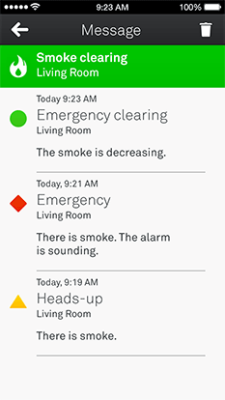
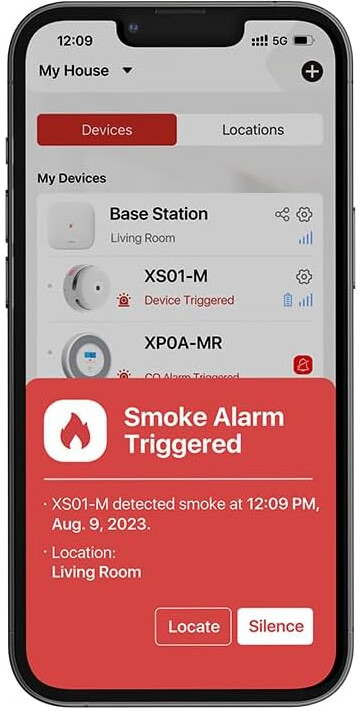
Also, a nice thing with, at least some, smart smoke detectors as that, about 30 seconds before they go off, they’ll send a notification to your phone with the option to dismiss it. They will, IIRC, sound regardless if they think there’s enough smoke that it’s not just someone burning some toast or something.
I think so, but it’s been a while since it’s happened. Besides, when it did happen, I was always home and knew what and where the issue was (ie I was cooking).
ETA, here’s a screen shot I found. It shows which detector set off the alert and the first “head’s up” notification is when you can dismiss it.
My standard lecture on home smoke detectors:
There are mainly two types of detectors.
The photoelectric detector has a chamber inside with a light source and a receptor, which is out of the direct path of the light. When visible smoke enters the detector it reflects the light into the receptor and the detector is triggered.
The ionization detector does not actually detect visible smoke. It is triggered by the non visible particles of combustion. Ionization-type smoke alarms have a small amount of radioactive material between two electrically charged plates, which ionizes the air and causes current to flow between the plates. When smoke enters the chamber, it disrupts the flow of ions, thus reducing the flow of current and activating the alarm. however, the visible aspect of the smoke is not what causes this. This detector reacts to the non visible product of combustion. The delightful odor of frying bacon, for example, is actually the non visible product of combustion.
The differences of these are important. An ionization detector will not pick up smoldering fires such as a cigarette fallen between couch cushions or most wastebasket types of fires. Extension cords under carpet also are smoldering type. A chimney fire due to creosote build up will also likely be unnoticed.
I wasn’t just interested in dismissing it, though. If it’s a small fire, I want to know where to bring the fire extinguisher. If it’s a large fire, I want to know which routes out of the building to avoid.