I’m nearly certain that freight has the right of way on Amtrak tracks on the California coast. I used to take the train a lot between Santa Barbara and San Diego to visit family and if we were late and had bad luck, we’d go off to the side and wait for the freight train to pass. There are only double tracks periodically.
Amtrak owns only 3% of the track it operates on. That will be the only track they have the right-of-way on, and most of that track is in the Northeast Corridor (Boston-NYC-DC).
One reason why I said 150 years, not 200. It took about a half-century for a properly working total system to be developed.
Railroads again pioneered the widespread use of technology when in the 1960s they started applying barcodes to individual cars so they could track their movement and stationary position at every moment. That was replaced by the modern Automatic equipment identification (AEI) system, a type of RFID codes. Every car that enters a complex like the ones shown above and known before it arrives and other automatic systems using direct them to the proper track, often more than once to take apart long strings. Here’s a nifty AI summary:
- lat-switching: Switch engines (smaller locomotives) push and pull cars onto specific tracks.
- Hump yards: Cars are pushed up a man-made hill (the “hump”) and rolled down by gravity into designated tracks, using track-mounted brakes (retarders) to control speed
For a more complete overview try:
Let’s say I’m an eccentric billionaire who loves trains. Can I buy my own train and start traveling around the country? Do I need a special license to drive my train around or do I have to hire a professional? Am I mandated to have a certain crew on board when I travel? How do I connect to rail traffic control to arrange my route? Do I have to pay somebody to travel on rail lines?
By federal law, Amtrak – and all passenger trains – have right-of-way, regardless of whether an Amtrak train is running on Amtrak-owned track, or on a freight railroad’s track.
However, as @msmith537 notes, this is effectively “in theory,” because the freight railroads may or may not actually give Amtrak’s trains preferential use of their tracks, and the law is rarely actually enforced.
That’s interesting. I took that Santa Barbara to San Diego back and forth route dozens of times. Maybe five or six times we had to wait for a freight train and I never saw a freight train off to the side waiting for us but my experience is anecdotal. One time we were laid up for almost two hours but it was usually no more than twenty minutes.
Your experience is pretty typical, as I understand it.
Yes, you certainly could.
You would undoubtedly need to have crew members who are trained and certified to operate trains; I suspect that they would have to have the same level of training and certification that such crew (engineer, conductor, etc.) would need to work on freight or passenger railroads.
You would have to negotiate with whichever freight railroad(s) own the tracks on which you want to operate your train. And yes, you would have to pay them for the privilege of operating on their tracks.
Another, less complicated option would be to purchase a private passenger car, and contract with Amtrak to have your car attached to Amtrak trains to be moved around the country.
What about attaching your fancy car to a regular train like on Wild Wild West?
See the last paragraph of my post, which I added probably after you were writing your post. 
Attaching your private car to an Amtrak car is feasible, and apparently something that is done with some regularity.
Attaching to a freight train would be a different story altogether; locomotives which are built for passenger-train use feature “head-end power”: they are built with a system which provides electrical power to the passenger cars for lighting, air conditioning and heating, etc. Freight locomotives generally don’t have a way to provide that head-end-power, and unless you have your own “generator car” as well as your fancy passenger car, even if a freight railroad would be willing to attach your car to their train, they would not have a way to provide your car with electricity.
Are you sure of this. I have taken the Adirondac (NYC–Montreal) many times and I have the impression that the freight trains have the right of way. Once on the northbound train we waited on a siding for an hour until a freight train passed us going south. And we would regularly wait for the southbound run or vice versa. I always had the impression that AMTRAK owns very little track outside the NE corridor and this seriously hampers operations.
See my post above. Legally, passenger trains in the U.S. are supposed to have right-of-way while operating on freight railroad tracks. Practically, they frequently do not.
This is absolutely true, as @Dorjan noted.
The priority given to almost all federal vehicles prompts one of my favorite memories.
So long back that the USPS hadn’t yet replaced the Post Office, I had a summer job as a letter carrier. All of us newbies had to pass a driver’s test on a standard right-hand drive mail truck. The instructor’s training included these words, very close to verbatim, although compressed.
As a matter of federal law, all federal vehicles have the right of way over all other vehicles on the road, including police, fire, and ambulances. If I ever hear of you taking advantage of this right I will take a gun and shoot you.
He was joking/not joking.
I have heard (secondhand, train buff friend said he asked an Amtrak conductor) that the freight railroads give Amtrak trains a “window” which is held open for that train and moves along the track according to the train schedule. As long as the train is on schedule, it keeps the right of way in that window - but if it deviates from the schedule and leaves the window, then the freight railroads can give the right of way to one of their own trains. True? False? De facto but not de jure? Inquiring mind wants to know…
That’s my exact experience
Many years ago they took 1522 out of the St. Louis Transport Museum and ran a special train to a railroad convention in Birmingham AL. As you said, there was a generator car to provide power as the 1522 loco had no way to do so. Interesting trip though.
It’s blue and includes the number to call and the code of the crossing so the person who answers knows exactly which one it is.
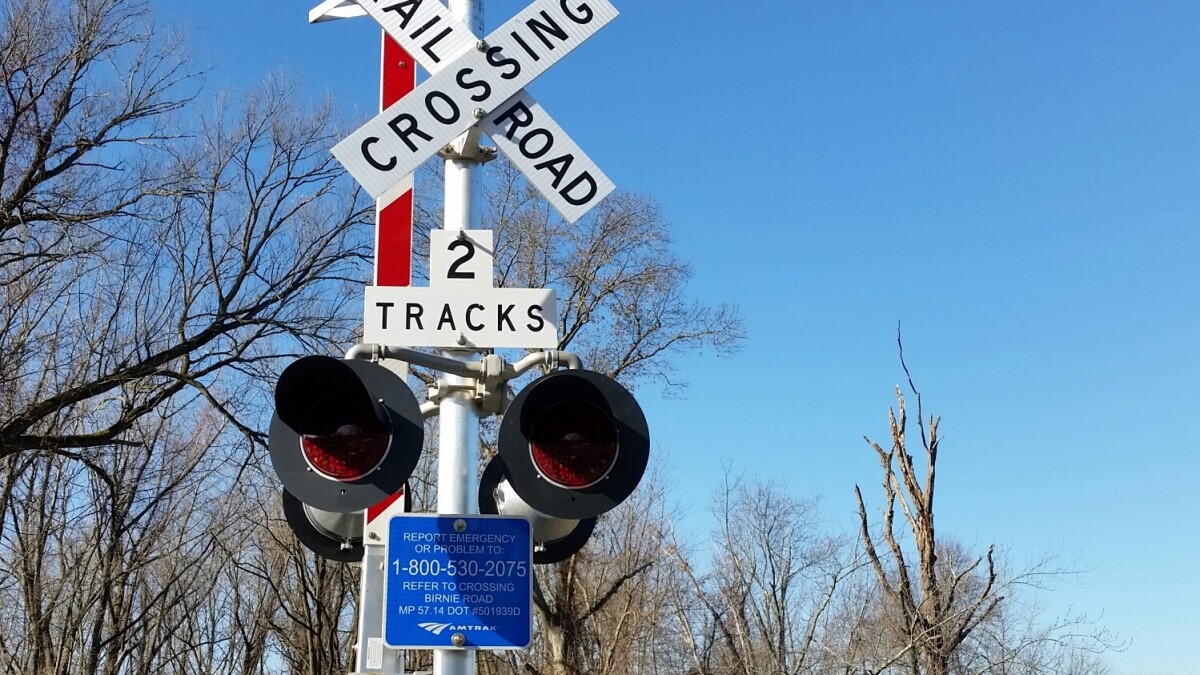

The typical contract is that an Amtrak train is given priority until it is a half hour late then the road’s dispatchers can do as they will.
There is an association of private car owners that negotiates with Amtrak as a group, has resources for maintenance and serves as a central point if you wish to charter a car.
That’s a strong nope. See above.
That makes sense. Every time I was in that situation, the train was late and then made later
Here is a world railroad map, updated by volunteers. When opened, the small scale with the orange lines are the main lines. As you zoom in the more minor trackage shows up, passing sidings, branch lines, and industrial spurs show up and, in cities, rail transit systems.
In some cases abandoned tracks and old right of ways are shown. For example in western Colorado long vanished narrow gauge RoWs are on the map.
I believe many Amtrak routes do essentially this. E.g. the Coast Starlight operates on BNSF tracks for part of it’s route, Union Pacific tracks for part of it’s route, and Metrolink tracks within the Los Angeles area. So they must be all interconnected.
When I took the California Zephyr a few years ago our train was hauling a private car for part of the trip. The owner’s private chef came out for a smoke and talked to some of the passengers when the train stopped in Reno for what Amtrak used to call a “smoke break”, now “fresh air break” (longer stops where passengers can get off the train for a bit).
I said “owner”, but from what I understand if you’re not quite wealthy enough to own a private rail car it is possible to rent one for a single trip.