So...how do railroads work?

I’ve always had an interest in complex systems in general, both professionally, and recreationally with “sim” and “tycoon” games. And living and working the NY metro area, I am certainly familiar with the various transit systems - MTA, NJTransit, LIRR, NJ PATH, MetroNorth, Hudson County Light Rail, Amtrak, SEPTA (Philly, which you can connect to in Trenton. Driving over the Pulaski Skyway, you can see the big intermodal rail yards operated by CSX and with some Googling, I found that there are also some regional freight operators like Norfolk Southern, New York & Atlantic (NYA), and New York New Jersey Rail.

But like…how does it all work?

Obviously the MTA subways, PATH and Light Rail are their own thing, running on their own separate tracks. But like, what about the rest of it?

Specifically, are all the big rail networks connected? Like could I theoretically drive a locomotive from Boston through NY, NJ, and Philly on more or less any track in any of those systems?

From what I can tell on Google Maps, there does seem to be some interconnectedness and the NJ Transit lines definitely branch off into some cargo sidings at factories and whatnot.

Who coordinates all that?

How do train crews “go to work in the morning”? Amtrak obviously follows a regular schedule, but do CSX trains? Like once a week they assemble a train of all the cars to ship out west? Does the crew stay with the train the whole time and ride it back?

The main difference between trains and airplanes or road traffic is trains can’t pass each other (outside of designated sidings) or change course. I’ve also vaguely aware of the concept of tracks being organized into “signal blocks” where a train can’t enter a stretch of track until it’s clear of traffic. How pre-planned is rail traffic? Like if you are delivering a boxcar full of tires to a factory in Trenton, do you just kind of spend a lot of time yielding at signals to higher priority traffic?

Curious if anyone has ever worked in a railroad in any sort of capacity.
I have not worked for a railroad; I’m just a lifelong train fan.

When we talk about the “big rail networks,” there are fundamentally six of those in North America:

  • Union Pacific
  • BNSF
  • CSX
  • Norfolk Southern
  • Canadian Pacific
  • Canadian National (CN)

Union Pacific and BNSF largely operate in the western half of the U.S., and CSX and Norfolk Southern largely operate in the eastern half of the U.S. While Canadian Pacific and CN primarily service Canada, both of them also have trackage in the U.S.

However, all of them service the Chicago area (which, due to its location, is historically the central hub of the U.S. railroad system), and there are, AIUI, numerous interchanges between the various railroads in various places.

Union Pacific has been doing a big tour this summer of the “Big Boy,” the largest steam locomotive ever built. The western part of the tour has been on UP trackage, but as it headed east, it moved onto the tracks of the Norfolk Southern.

Yes, freight trains are also scheduled, though it’s largely on a daily basis.

Train crews have strict Federal rules about how long they can work before they need to rest. Freight trains really don’t have any room for sleeping/“deadheading” crew members, so for a long-distance train, the railroad will have crews based out of different cities along their routes, and a particular train will likely have its crew change out, possibly several times, over the course of its run. A crew which winds up away from home will get some sleep (usually at a hotel), and then probably be re-assigned to a train going the other way, so that they can eventually make it back home.

Nitpick: Larger ones have been built. The Big Boy is the largest that’s still operational.

Union Pacific announced a merger with Norfolk Southern last year. If approved - in May the Surface Transportation Board announced that it has accepted a revised plan for consideration and the companies have made further small revisions since - then it would be the first true transcontinental railroad, allowing coast-to-coast travel without switching lines. Probably starting in 2027 if they get the approval.

Historical note for the OP. The railroads in the 19th century were the first corporations on earth to have need of real-time nationwide scheduling, servicing, staffing, and financial control systems. The ones they created, crude as they might seem today, were marvels of coordination on paper-based systems. An army of clerks worked behind the scenes, getting the necessary information by telegraph, whose lines were always built beside railroad tracks as they were laid, made nationwide coordination possible. All later industrial management grew out of these systems. They’ve been working on the problems for 150 years is the answer to how. Not having enough money to make the solutions work in today’s world is why the system is so messed up.

The crews are regulated to 12 hours on and 10 hours off. This is absolute and trains have to stop if they don’t have the next crew available. In Australia the trains have a sleeper car with kitchen and bath and carry extra crews since the distances between stations is so great.

In the old days, and I assume still, if you walk onto a main line track (i.e., one with signals) and stretch a wire across it, connecting the tops of the two rails, you’ll throw the signals red, because that’s how signals know a train is there – current flows from one rail into a wheel, thru the axle, down the other wheel into the other rail. Good to know, if your truck gets stuck on a crossing.

My wife’s first cousin once removed worked for BNSF as some sort of controller. I think his office was in the Houston area, but he controlled a vast territory across the mountain and plains states in the US. He told me once about a woman that lived a couple of states away who managed to get his personal phone number and would call him every time a train sat idling near her home. She lived somewhat near a railyard, so it happened a lot.

This is not necessarily effective. If there is a current connection between the two rails, that should stop any traffic in the area on that line; but in some signalling systems this may not give absolute protection. In an area where the line uses lineside signals to control traffic, the next train will continue to proceed as if nothing was blocking the line once it has passed the last signal. So don’t expect to magically stop a train using a wire connector.

So is there like some big operations center where they have giant screens showing trains on maps and signals and whatnot?

And if so, who runs them? Like does each company run their tracks or is there like a regional equivalent of an Air Traffic Control center?

Like looking at the various rail yards and track networks around Newark, that all looks insanely complex to me.. I’m sure it makes sense to those people running it. Like cargo goes on these tracks. This track is a siding for trains to pass each other. Those tracks are a NJTransit maintenance yard, etc.

But there has to be a bunch of tracks where people are like “yeah…I don’t remember where these go”?

In the UK a train crew must have 12 hours rest between shifts (at least). This has been the case since the report into the Clapham rail crash, which was caused by an overworked signal engineer.

This report (known as the Hidden Report, named after Sir Anthony Hidden) established that all safety critical staff, including signallers, train crew and staff working with safety critical systems, should work no more than 12 hours a day, have 12 hours rest between shifts, and have at least one day off in any fortnight. Most UK railway staff work fewer hours than this - this is the absolute maximum.

I don’t know how this compares to other countries; we are a small island, and working trips are comparatively short; but rail traffic is very intense and the network is very complex.

Yes. I worked in a UK control centre for more than two decades. Over time we got more and more computer screens, but this made the task easier (for the most part).

Not in the UK, anyway. Some lines are still controlled by individual signalboxes, responsible for a few miles of track, but these are relatively rare. All the others are centrally controlled using a variety of systems.

Yes, it’s probably better to call the phone number that should be listed on the sign next to the crossing, and tell the railroad what’s happened.

Exactly.

A somewhat modern look.

A historical to 2012 look.

201 years in the UK.

Track safety has changed somewhat in the intervening years. The S+D didn’t use any kind of fixed signalling, and only had a trumpet and bell (they hadn’t even invented the steam whistle yet). The best they could do was the ‘time interval’ system, which set trains off at fixed intervals hoping they would not conflict.

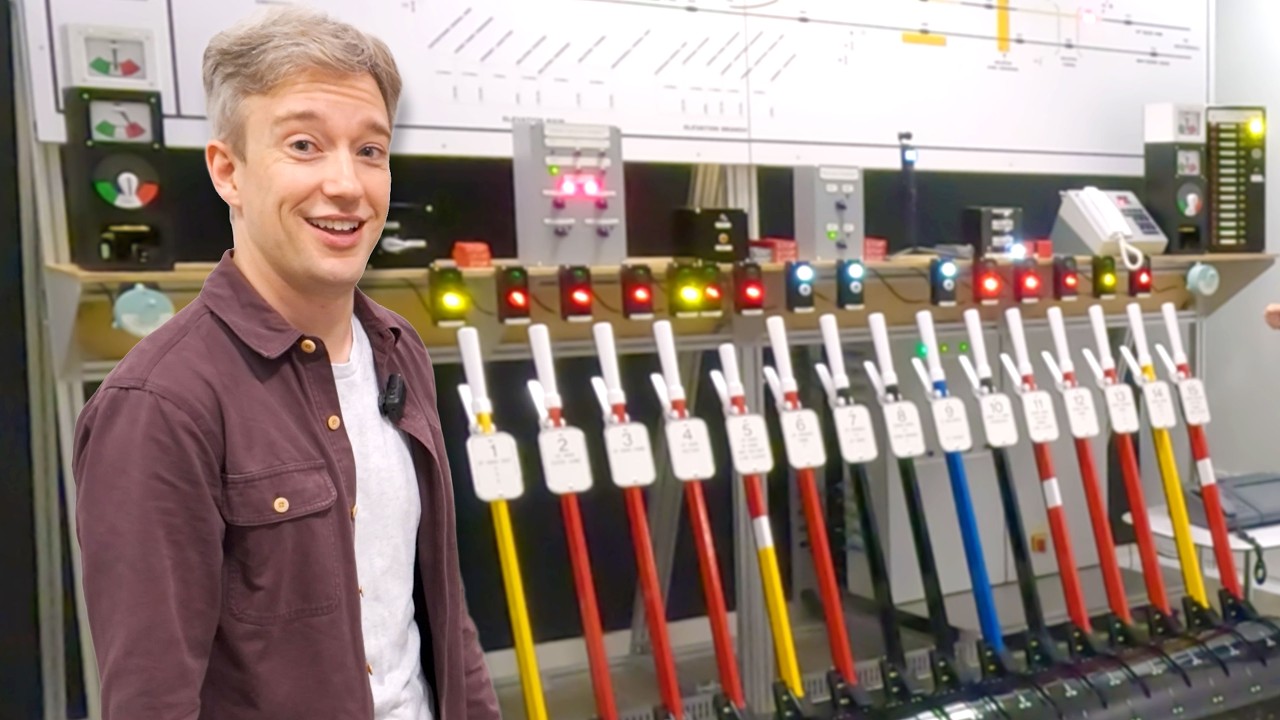
Tom Scott learns the basics of British railway signaling at one of those small ones with manual switch points and signal operation, then later visits one of the more modern control centers.

UP 4014, the 4-8-8-4 Big Boy was unique in that it was more like a circus train. The crews stay with the train (I heard most of them were on a two-week rotation then they were flown back home while other maintainers were flown in) & other cars on the train carried the various things then needed for maintenance of that unique train. Aside from that coast-to-coast tour, I believe the only other operational steam engines are for tourist-type trains, where you buy tickets to go on an hour or couple excursion; those trains end up back at their starting point every day so the maint guys always work in the same place.

The logistics around that one were pretty incredible. I got to see it both on the move & in a yard for the night. PD both blocking off the road a couple of blocks away as well as up close, all night. FD brought in to supply water for the engine since they no longer have this capability in the yards like they did 80+ years ago. I don’t know if crews were fed on the train (in which case provisions would have needed to be brought in at least every couple of days) or they were getting meals delivered locally. I got to see in on the East Coast so Norfolk Southern tracks, they had painted up some engines for it & had their own, antique passengers car at the end of said train. Obviously they knew about this well in advance, to paint a couple of engines, to plan where it would spend the night, where it would do a whistle stop, the best route to take for maximum scenic opportunities rather than just get there the fastest way, etc.

If you want complexity…

In the old days, a layout like this was always controlled by somebody nearby (in this case, in the small rectangle “ZOO” near the center). If they were halfway interested, they would have been able to get to know the place. Nowadays, many? most? dispatchers have never seen the tracks they’re administering, since they’re many hundreds of miles away.

This drawing covers the above trackage and much more in the Philadelphia area (just shows the Pennsylvania Railroad track, tho, not Reading or B&O etc). In, say, 1950 there were maybe 20 PRR control towers in the diagram, each manned 24 hours. Not any more.

So who controls what? Apparently tracks are variously owned by Amtrak, MetroNorth, and different freight companies. And in theory, Amtrak legally is supposed to have right of way. So do the control rooms just see the tracks they manage or do they see the entire network their trains are operating on?

And how do they keep those rail yards straight? Sure parts of them just look like parallel rows of sidings, but some of it looks pretty damn confusing. And it’s not like the trains can “circle” like an airplane waiting for a slot to open.

You might find this useful for your studies: Map Viewer

Zoom in, zoom out, click on any section of track for more info.