On railroads they aren’t even much of a flatcar any more. Well cars, meant for double-stacking intermodal containers, have very little car there to get the tare weight as low as possible. Strings of them with no containers, dubbed “empty tables” in rail fan slang, are generally moved in trains by themselves. If added to a regular freight train they are placed at the rear. If placed at the front a long string is susceptible to being pulled off the rails on a curve by the weight of the heavier cars behind, known as “bowstringing.”
Our own @Richard_Pearse worked for a year or two as a railway dispatcher. He might be able to share some interesting stories about that aspect of the industry in his home country of New Zealand.
There is a busy track that crosses my street. One time I had to wait while 2 opposing trains crossed. Then I went to the store right there for just a few minutes. When I came out another train was crossing. It must have been 10-15 minutes apart. How close are they allowed to follow?
As a teenager we used to walk down an abandoned line near our house. I looked on that map link and it is indeed listed as abandoned. Can we legally walk there? How about my home made railroad scooter? I see plenty of them on YouTube. In one case the cops made them call the railroad headquarters and get permission but it looked like more of a seldom used track, not necessarily abandoned.
Railroad tracks are divided into “signal blocks” – lengths of track, each of which is monitored and controlled by automated systems, as well as the railroad’s dispatchers. The length of a block is not standardized, but depends on the length of trains which typically run on that line, and the speed at which they run; a block is typically a couple of miles long – in urban areas, where trains may run more frequently and more slowly, blocks will often be shorter, while in rural areas, on tracks which typically host longer, faster, long-haul trains, they are often longer.
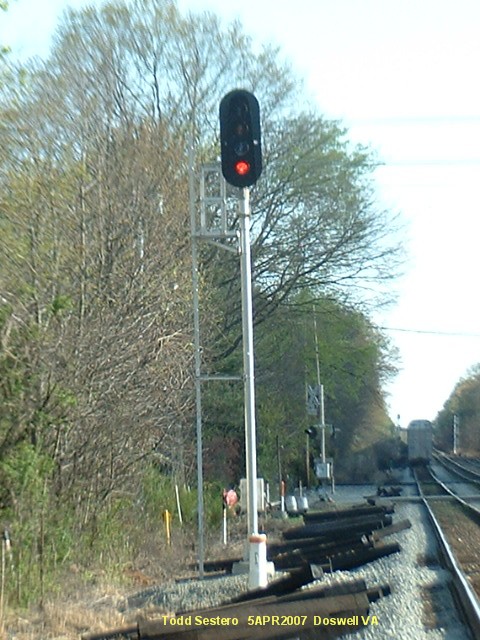
Railroad rules are that no more than one train may occupy a block at a time; if a train is following another train, it may not proceed into a block until that block has been cleared (exited) by the first train. There are signals along the tracks, not unlike stoplights for road traffic, which inform the engineers of the status of the block ahead of them (see picture below).
In addition, in recent years, the major railroads have adopted a system, Positive Train Control (PTC), which will automatically slow or stop a train which is following too closely behind another train, or proceeding into a signal block which it shouldn’t.
On a busy railroad, with multiple tracks (as you describe), “10-15 minutes apart” is not unusual at all. I live a few blocks away from an extremely busy stretch of railroad – the “Racetrack” on the BNSF mainline in Chicago’s western suburbs – and at busy times of day (especially when commuter trains are also running), at any given crossing, trains will go by every 5 to 10 minutes.
On freight railroads the rule of thumb is, indeed, a minimum of ten-minute headway. That tight is unusual though unless there was a blockage for some reason and the dispatchers are working on clearing the backlog. The Virtual Railfan camera in Flagstaff is on the Southern Transcon, between Chicago and Los Angeles and one of the busiest freight routes there is. It gets on average 50 to 70 trains a day, 20 to 30 minutes apart but that is in both directions on a double track main line.
Commuter routes, like kenobi said, can have much tighter headway than that and there is a signal aspect, Call On, that allow them to enter an occupied block and close up on the train ahead of them while it is stopped at a station. Needless to say this is at Restricted speed, typically 15mph, allowing them to stop short of anything ahead.
Rail transit systems are a world of their own. Block sizes on a mainline railroad are typically five to ten miles. In the NYC subways they’re 200 yards.
For a different angle on how railroads work search Shoestring Hobo on YouTube. He was a modern day hobo with his own channel. He was knowledgeable about the the details of freight railroading and shared experiences hopping freight trains around the country.