So what did you do there? Did you connect Claude to Trello, or did it build you its own system?
I think it would be better if these functionalities weren’t so segregated to begin with. Ideally you could just tell it what you need done and it’d figure out the rest.
But there’s reasons it’s not done that way yet, including model reliability, complexity of setup, safety, and of course cost.
I imagine we’ll look back on a thread like this in a few years, if humanity is still around then, and marvel about how primitive the 2026 workflows were. “What do you mean you had to tell it what to do? Why couldn’t it just read your mind?”
On the topic of restaurants, my dad decided to do a surprise family meetup in LA with not much notice, so I didn’t have time to do my normal research.
I wanted to find places I could easily eat at near where he’s staying, which isn’t always so easy (I’m vegan, and while there’s resources like happycow.net, it doesn’t always have the most up to date listings).
Anyway, Claude spent the night looking up veggie restaurants and reviewing them one by one and made a website for me:
I imagine it’s not as good as a human’s carefully curated list, but it’s a lot better than nothing!
It has been helping me build the ideal Trello board for my workflow. I’m not going to give it access to my Trello board directly. But it already “knew” my setup so it made recommendations based on that.
For a while now we’ve been tweaking my board to be as ADHD-friendly as possible. Claude has been useful for tips on how to organize things in a way that doesn’t overtax my working memory. I’ve become much more productive as a result.
The issue I had is that I was so worried about things slipping through the cracks I was trying to hold everything in my head all at once. Constantly re-checking deadlines and that sort of thing. Claude convinced me to put everything into one system and trust it. So we went through how to prioritize things, and figure out the best columns. Right now I’ve got Focus This Week, Next Up, Deadlines, Working On, Monitoring, Grants Committee, Parking Lot, and Done.
The most important one is Focus this Week, which isn’t allowed to have more than three things at a time so I am not overwhelmed by what’s in front of me. Next Up can have no more than six things.
Anyway we put MDHHS grants as pinned cards in Monitoring, with the status in the title. So something like: “Review and sign contract: CFVS - 2027.” And then in each card I have checklists for Waiting On - to track dependencies, as well as Maintenance Deadlines which is basically just upcoming reports. This way I can see at a glance the status of each active MDHHS grant. So I can say, “Shit, Jolene didn’t sign that contract for CVFS yet, I’ll send her an email.”
This is probably more detail than needed but I get excited about this sort of thing. I’ve never had a productivity system before that actually worked.
But what’s neatest about it is that you basically found a project management consultant who could personalize the methodology for your particular needs and personality… and without the usual consultant fees!
I also suffer from (or enjoy? not sure) mild ADHD, and it definitely hampers my work and personal life. Maybe I should have Claude dig through my Mt. Olympus of unfinished work and come up with a better system.
I happened to do this last week. I want a spreadsheet of every restaurant in the county. Each AI I used went to the county Health Dept to get current food establishments with active health inspection records. These included categories for everything, from gas station mini marts, company lunchrooms, bakeries, catering companies, ghost kitchens, fast food chains, 7-Elevens, etc. The records are easily downloadable from the county website and sortable by category.
All these can also be expanded on by using a Google scraper such as Outscraper, such as hours of operation, cuisine type, etc.
I guess they’re improving their apps all the time. However, one should be careful. My wife has been trained to use AI at the office but she complains about its performance all the time. I can’t go into any details.
Instead, I will give an example I recently heard about. The text below is generated by the very AI who committed the blunder:
Hundreds of tourists traveled to Jurilovca, Romania, for the non-existent 2026 Lipovan Borscht Festival after being misled by unverified online listings and incorrect AI chatbot information. Jurilovca, a village in Tulcea County, Romania, normally hosts a popular annual fish soup event. The local town hall did not organize or schedule the festival for 2026. Visitors and travel agencies relied on social media ads and queries to AI platforms like ChatGPT, which falsely claimed the event was happening on September 4–5. Over 10 coach buses and numerous private cars arrived in the village to find no festival taking place.
Even pre-AI google was pretty timeline challenged.
Asking about any recurring festival would generate results from years ago mixed in with plans for next year’s event. And given the propensity for many news or info sites not to properly date their content, it was often hard to manually filter the results to just the upcoming event.
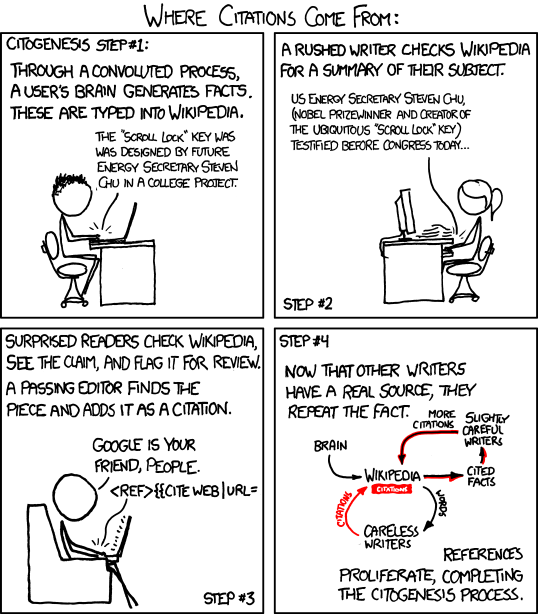
LLMs have the same GIGO problems as anything / anyone else. And the amount of garbage published is now expanding rapidly. Between trolls, human sloppiness, and AI slop the entire body of human knowledge from science to recipes to festival calendars to news is rapidly morphing towards a more general version of this prescient comic:
from xkcd: Citogenesis.
In another ironic circularity, xkcd refuses to date their comics. So although I know this was written 10-20 years ago, I can’t say when. Back when they had a messageboard you could date a comic by when the matching discussion thread kicked off. Not anymore. Our own xkcd thread - SDMB serves that purpose for the last ~6 years, but there’s a vast undatable trove from before then.
The long predates Google. 40 years ago or so an engineer in a Western Electric factory got asked for manufacturing cost data. They didn’t collect it well, so he made his best guess. A year later he found a report giving the real data for lots of factories. Excited at getting the right answer, he looked up his factory - and found his guess as the real answer.
When I use chat GPT, I do it in the voice activated mode, where it talks to me like a person.
The other day, I was looking for an old BBC article from years ago about the start of the Afghanistan war. I described it to Chat GPT, and it found the article for me, providing the URL. I thought that was cool - rather than typing in a google search, I could just ask the computer for what I wanted,
“She” laughed and asked if I meant in the sci-fi sense?
Then she told me about a real version (note that this is just a portion of the transcript of what was said. I was actually just speaking to the phone)
What I find most amusing is that in Star Trek 4, when transparent aluminum was referenced (we talked about that, too), it was considered wild future tech that Scotty tried to talk to a desktop computer (before he then typed on the antique at lightening speed) - meanwhile, here I am conversationally talking to ChatGPT just 35 years later.
Hah! That’s great. Thanks for making the experiment.
It’s hard to make good sci-fi that lasts because the future moves really fast. I just loved that scene where he talks to the 1980s computer and nothing happens. Then he picks up the mouse and talks into it as if it’s a microphone and still nothing happens. It says something pretty profound about “ease of use” and “intuitive interfaces”. Hint: they’re neither; it’s just rote familiarity with lotsa arbitrary stuff that then seems intuitive.