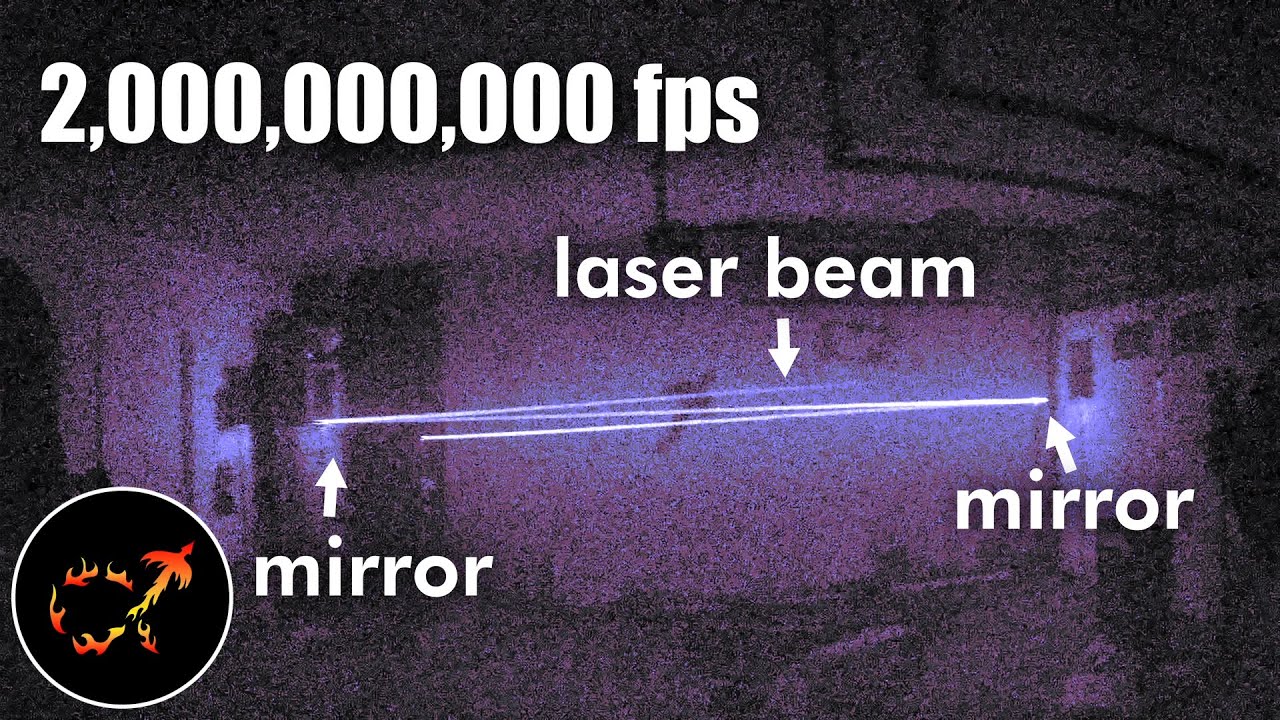
I’m not sure exactly what you’re asking – they aren’t sending one photon, they’re turning on a light which has a ton of photons. The reflections that you’re seeing are the photons that hit the table first and reflecting back to the camera, while other photons are still moving towards the apple. Then, you see those photons reflected.
It’s not even a single pulse of photons: It’s a whole bunch of pulses, very precisely timed. What the camera is actually recording is a strobe effect, similar to how wagon wheels can appear slower, stationary, or reversed in old movies.
I’m still not sure that I fully understand the question, but an early version of this sort of video – I believe from the same MIT lab – showed light visibly traveling though a Coke bottle filled with a milky fluid, and IIRC the camera was indeed more or less perpendicular to the direction of light travel. You could literally see the light beam, in slow motion, traveling through and reflecting around the inside of the bottle.
You can’t really have a camera running at a trillion FPS. The way they did it was to repeatedly strobe the light, and take pictures over and over again at very precisely timed intervals. The fact that the light emissions were repetitive was key to this experiment, and allowed them to cleverly create what was effectively “capturing the actual travel of a light beam”.
That’s cool tech, but pretty false advertising on their part. I understand that, from the point of view of capturing light movement, it might be pretty equivalent, but if it’s not capturing at 1 trillionth of a second, they shouldn’t say that it is.
Most of these videos have a short, gee-whiz version that just shows the results, together with a much longer video that explains what they’re actually doing. They’re not trying to deceive anyone, just trying not to bore them.
Watching the video, looking at the Apple, the light appears to be coming in from the left. I assumed the light was coming in perpendicular to our line of sight.
If that was the case we wouldn’t see a reflection on the table (as was explained to us) ahead of the beam.
But instead the light is coming more or less from our point of view.
The main beam of the light is close to perpendicular to the line of sight. But the room is filled with some sort of smoke or fog, so while most of the light follows the main beam, some fraction of it is scattered by the fog particles in other directions, and a little of that scattered light makes it into the camera so we can see it.