In this video, Neil DeGrasse Tyson describes the photon as timeless…experiencing no passage of time as it transverses distance.
Why Photons Experience No Time  #space #timeexploration #universe #cosmicexploration #sciencr - YouTube
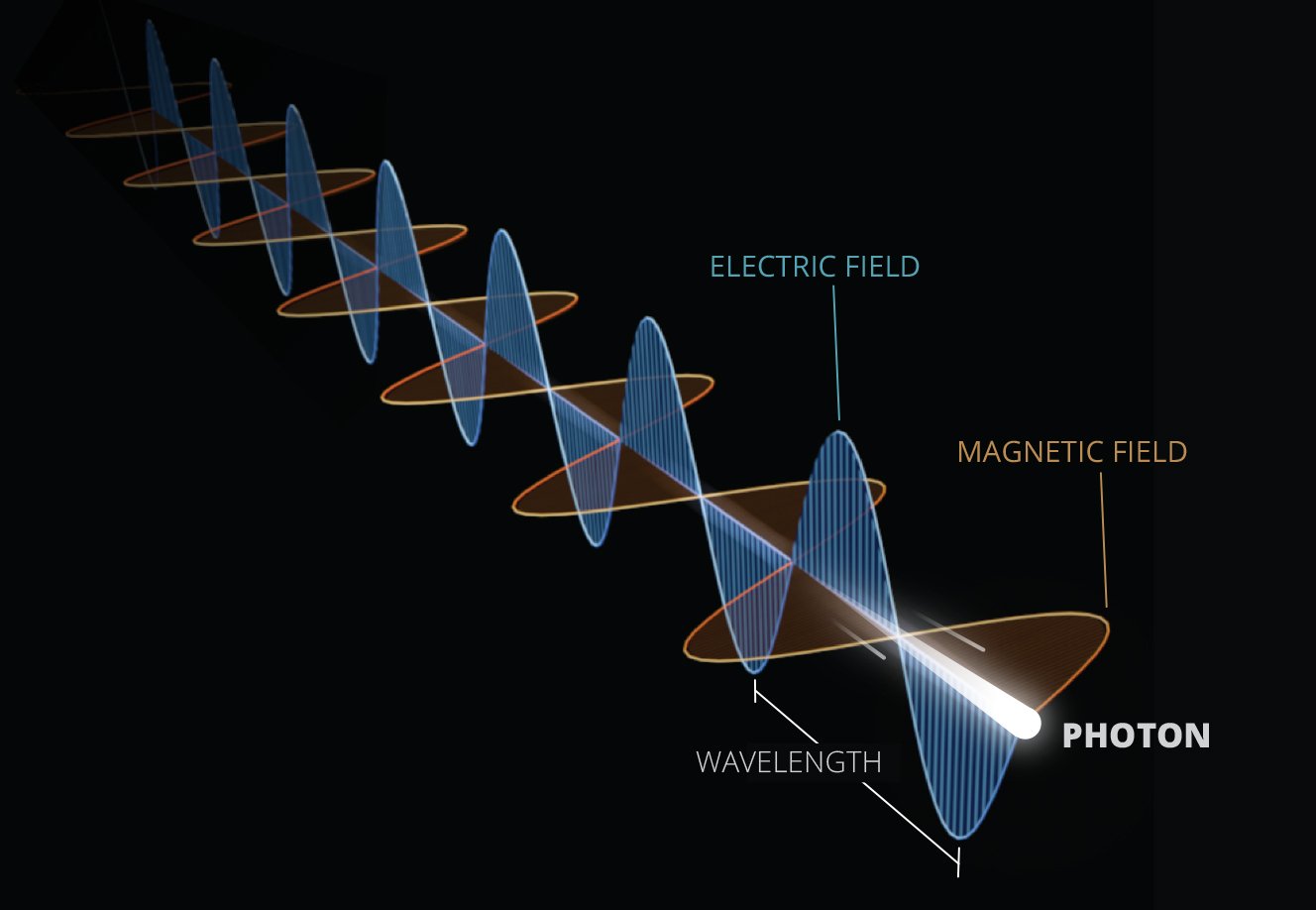
Now, a photon can be graphically represented as a collection of sine waves as the associated electric and magnetic fields oscillate throughout its trajectory.
photon_wave.jpg (1328×918)
But isn’t oscillation a function of distance and time?
Oscillation can be thought of as a function of distance called wavelength. It can also be thought of as a function of time called frequency. They are interconvertable. In math terms it’s wavelength (lambda) = velocity / frequency.
At least that’s true when velocity is less then c and hence time is not zero.
The (quantized) electromagnetic field operators do indeed depend on distance and time. Now, in Feynman’s analogy, a photon can (virtually) take all possible paths, also forwards and backwards in time— it is not really like a classical billiard ball in the quantum picture— but what you want to calculate is the probability that it will travel from one place to another in a given amount of time and you get the answer that it will go in a straight line and travel at the speed of light as a classical approximation, however there are indeed quantum effects; e.g., you can set up a beam splitter and have a single photon simultaneously take two quite different paths. But, no, it does not “experience time”. If light is moving slowly through a material like glass, this has to be analysed in terms of the photon interacting with the atoms of the medium.
If we describe the photon from our own frame of reference, then yes, it takes a finite time to reach its destination, and it travels a finite distance. Because those things are part of our frame of reference.
But if you try to ask what it’s like from the photon’s frame of reference, you quickly come to the conclusion (if you’re being careful and mathematically rigorous) that you just can’t use the photon as a frame of reference. At best, you can (sometimes) take a limit of some things as the frame of reference of a particle approaches the speed of light. Among the limits you can find this way are that the limit of the time elapsed is zero, and the limit of the distance traversed is zero. But some things, like phase, you can’t even take that limit, which is why you can’t use the photon itself for a reference frame.
Is this still true if the photon is traveling through (for example) glass, where its speed is less than c?
Everything’s more complicated in a non-vacuum than in a vacuum. There are a lot of different ways to describe electromagnetism in a material, and the different ways of describing it will have different answers. Worse, the different descriptions look superficially similar, so it’s not always easily clear from context what description is being used.
Personally, I favor thinking of a material as being a scattering of charges, with vacuum in between them. In this interpretation, the photons travel through the vacuum in between in the same way that they do through any vacuum, but they’re frequently absorbed and emitted. I favor this interpretation because I’m a theorist, and it’s the more conceptually-simple explanation. In practice, however, for most problems, it’s easier to average out over all of the charges and treat the material as uniform, which has subtle and conceptually-complicated effects on the mechanics of electromagnetism. So people who care more about predicting what the readouts on their lab equipment will say than about fundamental understanding will prefer that approach.
Hold up, you’ve crossed the streams. You can’t model light both as a particle and as a wave together. For any given event, pick one or the other.
Quantum electrodynamics is the proper language for this. Feynman has a popular-science book about it: QED: The Strange Theory of Light and Matter - Wikipedia
(Or you can look up “quantum electrodynamics” on Wikipedia: Quantum electrodynamics - Wikipedia)
No, a photon does not experience time. The way it was determined that neutrinos have non-zero and therefore travel at sublight speed is that between the sun and the earth they oscillate among the various forms and thus must experience time. What used to be called the solar neutrino problem was that there were only 1/3 as many neutrinos detected as were expected. But their detectors detected only one flavor of neutrino, the one that was expected to result from the fusion reactions in the sun. Once they built detectors that could detect all three flavors, they found all three in equal quantities and the SNP was solved, but then they had to infer a mass for the neutrino.
If you accelerate to near light speed, you experience less and less time passing and the time converges to 0 as you go faster and faster. Of course, you never actually get there because like the neutrino you have mass. Rather more in fact.
In case it is not obvious, I omitted the word mass from the end of the top line of the post. Sorry.
Off-topic, hidden
In reconciling my faith and science, I stand on this explanation of that God is light and that souls have no mass, therefore eternity is timeless,
[Moderating]
And the factual content of this is…?
Keep the personal religious faith out of FQ.
Is the photon that enters the glass technically the same photon that exits it?
That’s fundamentally not a question that can be answered. Fundamental particles like photons are really, truly interchangeable. As in, any two of them, anywhere in the Universe, could swap, and it wouldn’t change anything about the world as we know it. For fermions, like electrons, it would change things about the world that we can’t observe, but for bosons, like photons, it doesn’t even do that. So for all we can say, this swapping might be happening constantly, so even a photon traveling through empty space can’t really be said to be “the same photon” at the end of its path as at the start. Nor can it really be said to be “a different photon”, by the same token.
I don’t know if that means anything wrt light, I’ll leave that question for other people. But lights waves in a vacuum are transverse waves – at right angles to the direction of propagation, so they aren’t “distance”.
The equations do allow longitudinal waves, but not in a vacuum – only in circumstances (notably, waveguides) where the speed of light is slower than c.
All waves, longitudinal and transverse alike, are functions of both distance and time. That is to say, at any given moment, the wave value will be different at different positions, and at any given position, it’ll vary with time. Transverse vs. longitudinal is about the output(s) of the functions, while distance and time are the inputs of the function.
The goal in surfing is to make a wave in the ocean stand still relative to yourself. Seems like it could be a similar concept.
For waves moving at anything other than the speed of light, you can do that. Einstein’s big realization was that, for light, you can’t.