Want to here something worse? Someone processed data not in a database, not in a spreadsheet, but using a text file and vi. shudder
The data I had was too big for most spreadsheets, so what I did was kept it in xls format and used scripts to process it.
When I was in grad school my office mate was working on early concept relational databases. Databases were not something that was taught back then. So I had never used one. But I was working for the world’s biggest database maker, so getting access to one was not tough, and I enlisted some people who knew what they were doing.
Spreadsheets were inspired by accounting worksheets, but I think they are much more akin to graph paper. Graph paper makes no assumptions about what goes where while ledgers make a few.
Looking through the tabs I have open in my browser, there are quite a few that have no math; they are being used to format and present information as a grid.
Interesting–the first lesson I do with kids to introduce them to spreadsheets has them using prime numbers to make pixel art on a spreadsheet grid. The coded equations in that lesson are minimal.
I’m in web. Tiny bit of desktop and mobile, but mostly web dev.
A very early lesson I learnt about Excel was when I was very much a junior, and my boss was a decent designer but an appalling developer. He came up with the idea, alongside the client, to set up a regulary changing mathematical field (some random stock price) via an ODBC connection to the Excel spreadsheet the client controlled.
Without getting too nerdy, this is completely insane in a number of ways, particularly the fact that Excel is (or was, not sure of later versions) single user only. So on a website, open to the wide internet, only a single user at any one time could see the price.
Which is not how the rest of the internet works. Websites tend to have more than one visitor at a time.
We lost the client before I could explain the problem.
I am not a big fan of the open-source equivalents, but man, I am glad to be running a dual boot Mac/Windows laptop so I can tuck my tail and run away…
* I would throw in Microsoft Access, but is been about 20 years since I last used it, so my hatred has become mere residual fury. I don’t even know if it still exists, and I am at peace with that.
I use Google Spreadsheets, but I can see someone using Excel for the same thing, for quick budgets or to create NPCs for my RPG using a point system (I add a formula to calculate how many points are left).
For that kind of thing it’s very useful.
The problem is when the users or some idiot dev try to sneak it into things it was never designed to be, like a database.
“Ok”, I thought to myself, “it’s not THAT crazy to have the client control the source of truth via something they’re familiar with…”
…Oh, like DIRECTLY, lol. Yeah, that’s pretty bad At first I just thought you meant some server pulled the stock price from the Excel and then made a page out of it (with a normal CDN and such)… not directly opening up Excel ODBC to the internet at large.
The boss of my first job had me in a similar situation. He started a business out of a mail-order catalog in the 70s, and by the 2010s, he’d moved it online. Sort of. The entire business (with 50 employees at this point) was running off a single Filemaker database on an old cheese-grater Mac Pro he kept in his office. And he wrote an AppleScript that would generate some tens of thousands of individually generated HTML files from that database, one for every variant of every product. But he was smart enough never to expose the Filemaker database itself directly to the internet! He wasn’t a developer himself, but was a smart, humble, and reasonable man who knew the limits of his knowledge and sought advice for anything he wasn’t already familiar with. Wish more people were like that!
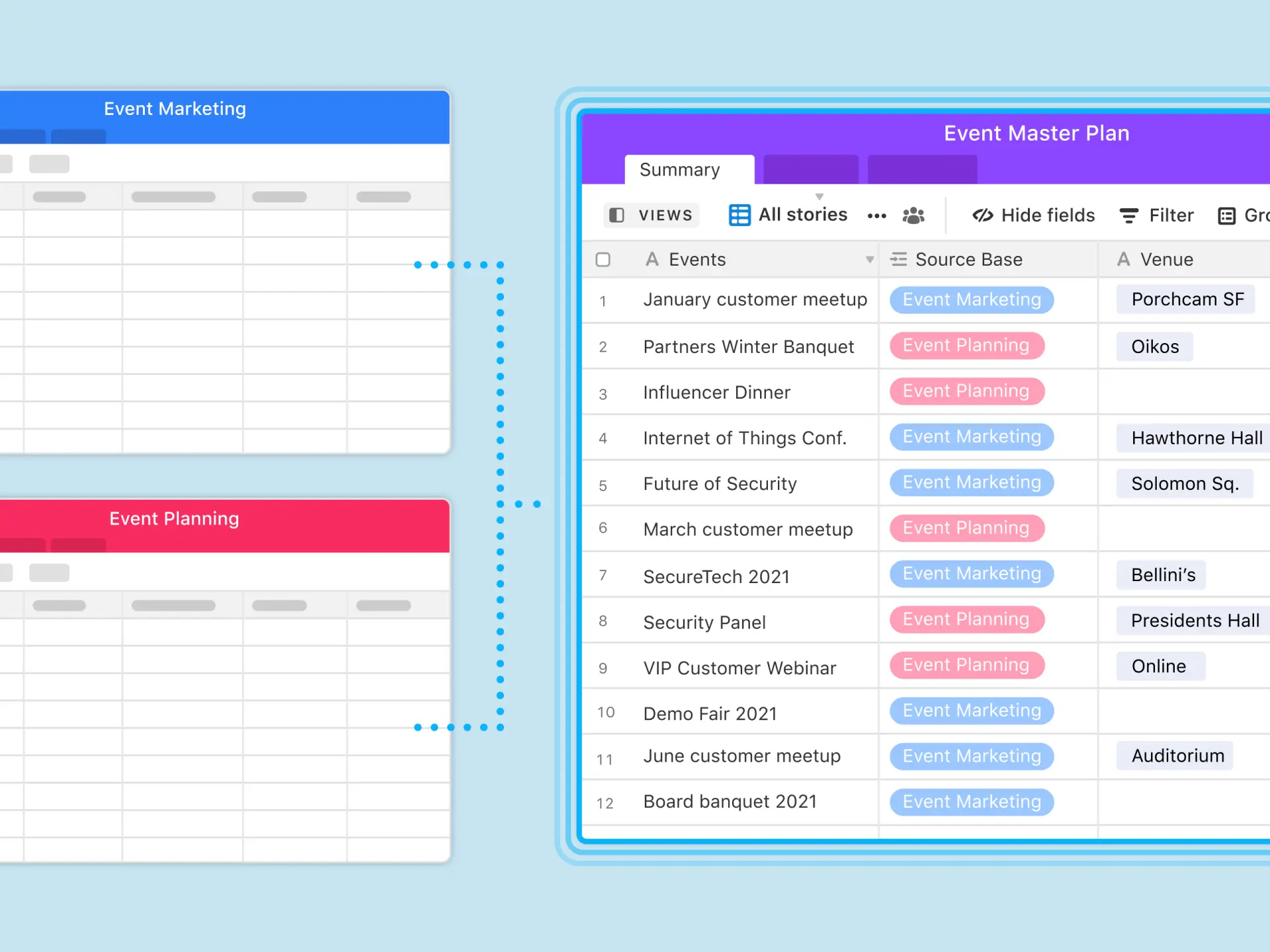
And I gotta say (again), as far as spreadsheet-like things go, I tolerate Excel, like Google Sheets, and absolutely loveAirtable — an app that gets nowhere enough love, IMHO. It’s the only thing I’ve seen that makes a lightweight relational database intuitive enough to regular people (like marketers, content writers, etc.) by presenting it in a spreadsheet-like view, but with a lot of secret power underneath.
I think it’s everything Access tried to be (an accessible lightweight database), but Airtable just does it better, with more intuitive UI/UX.
Okay, that’s a really terrible use of Excel. But you know what, a screwdriver makes a terrible door stopper, and is likely to scratch the floor if you tug on the door. But that doesn’t mean that a screwdriver is a terrible tool, it just means that sometime had a screwdriver and didn’t think enough about how to better solve their problem.
Also, today you can have multiple users in an Excel spreadsheet, if you use the web version. It doesn’t work nearly as well as Google sheets, but it kinda does the job.
Formerly a moderately heavy user, I don’t use it that intensely now, but I may get involved with helping my wife with a work project.
She works for a company and the property they use a hodgepodge of paper records, Excel, and an accounting software
Incredibly inefficient and the source of confusion and countless errors.
The accounting software can’t do everything required, and isn’t linked to the spreadsheets.
I know people who do databases and such look down on Excel, but her company doesn’t have anyone who could develop something better.
As for the question in the OP, if I do help, I will definitely use AI to look for solutions. I was good enough with excel that I don’t have to just pray AI does it’s work right, but I hope it can be somewhat useful.
Well, today’s example of my using a spreadsheet for non-work is that someone is organizing a square dance tomorrow, and two dancers have dropped out, and they are urging folks who might be borderline to update their entry in the spreadsheet, so everyone can tell if the group has enough dancers to meet.
I don’t see how AI would help. The spreadsheet is pretty simple. A row for each dancer, a column for each date we might meet, and some mildly clever code that counts twice, once for “yes” and again for “yes, …” so that anyone can glance at the two rows of totals and see right away if there are plenty, if it’s not going to work, it if that needs to read what the “yes, but I’ll be late” (or whatever) people wrote.
A friend wrote that mildly clever code 20+ years ago, and dozens of groups have copied it, because it works really well. But the clever part was realizing it would be useful to do. I’ve rewritten the code when i was too lazy to find an example to copy.
I guess each person could have a codeword to tell the ai whether they are coming, and the ai could tell folks whether the group can meet. But you’d lose the easy ability to see that John, who usually comes, hasn’t filled out his row yet, and it’s worth asking him. etc. It might happen, but i don’t see if being an upgrade.
The advantage current spreadsheets have over current AIs is that spreadsheets let you phrase the question once and get automatic updates every time the data changes. With AI, you have to ask the question anew every time the data changes.
One of the spreadsheets I use to teach kids has a page where they can enter the winners of a contest in which every child plays every other child. With AI, you could ask, “How many games did each student win?” and that’d give you useful data. But with the “=countif” function, that question is answered for each child and updates every time the data changes; kids can keep track of what they won or lost as the competitions progress.
I still feel like I am missing something, because what you call “AI” is supposed to be generating the spreadsheet, which is a computerized document/application these days, in the first place.
This is where AI is useful. If you didn’t have that clever friend, you could explain to AI in some detail what you are trying to accomplish with your spreadsheet, and it will suggest a solution and all of the necessary formulas, scripts, etc. needed to set it up. Asking it to keep track of the dancers and dates directly, that would be incredibly inefficient, of course. And prone to error.
 At first I just thought you meant some server pulled the stock price from the Excel and then made a page out of it (with a normal CDN and such)… not directly opening up Excel ODBC to the internet at large.