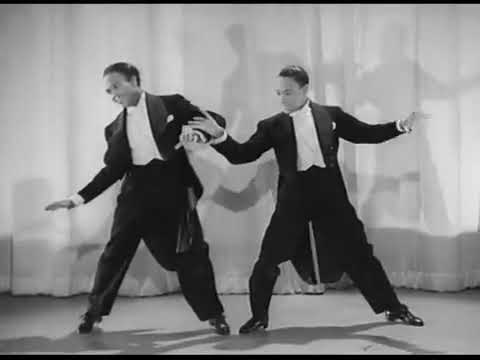
Just so this post isn’t a complete excuse to make a pun, at about 6:30 the video shows Astaire dancing with some stairs in the scene. The stairs aren’t a very key part of the choreography though-- I had thought there was a scene with Fred Astaire dancing down stairs, but I couldn’t find anything quite as perfect of a meta-pun as that, for the purpose of this post
First thing I thought of was Leslie Nielsen falling down the stairs in ‘Dracula: Dead and Loving It’, reciting the vowels one by one as groans of pain on the way down.
Maybe you were thinking of Jimmy Cagney instead. Nothing like tap-dancing your way out of the White House and into a parade by the Army of the Potomac!
Aimez-vous Brahms? with Ingrid Bergman and Anthony Perkins includes a spiral staircase scene, the only one that has stayed with me all these years despite the omnipresence of stairs in films and TV shows.
A Matter of Life and Death (apparently released as Stairway to Heaven in the US): shall a baled out bomber pilot (played by David Niven) return to life and the woman he’s fallen in love with, or climb the stairway to the other life?
By an odd irony, Niven’s first wife died in an accidental fall downstairs around that time.
Believe it or not, there are documented instances of aircrew falling thousands of feet without a parachute and surviving.
I remember reading about this when I was in high school. In particular, the tailgunner of a Lancaster bomber bailed out ‘chuteless after his plane was targeted by a German night fighter. His parachute was stored inside the fuselage because there was no room for it in the turret, and it was already in flames by the time he was able to reach it. Deciding it would be better to die from a fall than to burn to death, he gave a shove and fell free of the airplane.
This was in the middle of winter, so everything below was covered in a heavy blanket of snow. After falling 20,000 feet, he landed in a snow-covered pine tree that cushioned most of his impact. He bounced off the tree and landed in a snowbank, where he was later discovered lying on his back after blowing repeatedly on the emergency whistle he’d been issued.
He was taken to a military hospital, where his relatively minor injuries were treated. (He had been dressed in a heavy sheepskin-lined flight suit that also helped cushion the impact of his fall.) After a few days, he was interrogated by a German officer who demanded to know where he had buried his parachute. (This was a common practice of Allied agents parachuted into occupied Europe and would have made the gunner a spy subject to immediate execution.) The German lost it when he was told “Parachute? I didn’t use one.”
The tailgunner was eventually able to convince his captors that the story was true by correctly identifying the remains of his Lancaster and the details of where and when it had been shot down. It was confirmed that the tail turret was empty, and what was left of the burned parachute was found inside the fuselage.
If I recall correctly, the gunner finished the war as a POW and eventually published his story under the title I Fell 20,000 Feet—and Lived!
Many important scenes take place on the stairs in AppleTV’s Silo. Stairs are also very important in the books upon which the series is based.
Lots of exposition takes place on the stairs in Big Bang Theory. Not having a working elevator was a deliberate choice by Lorre et al to give the characters a place to have expository dialog take place and feel natural. An elevator could have done that, but would have been visually boring having the characters staring at the door while discussing events.
Of course, the stairs in the Brady household were very important and prominent. “Mom always said not to play ball in the house.”