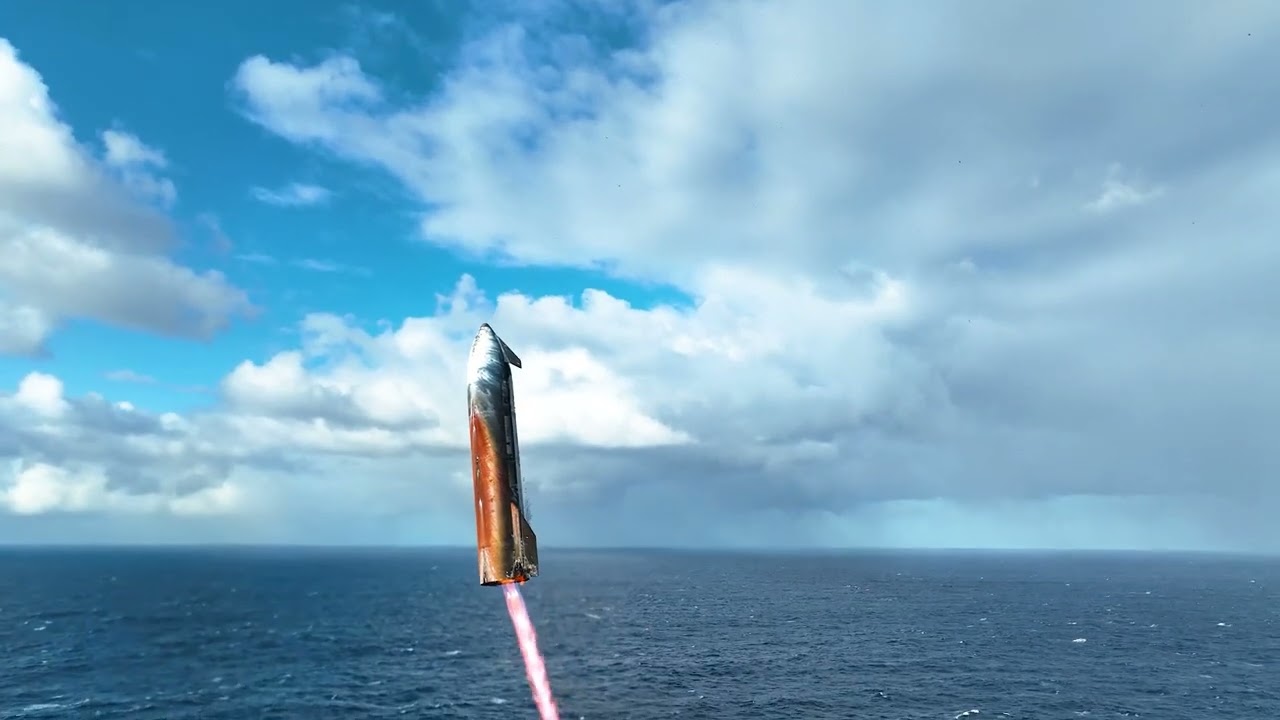
There’s some stuff coming off the booster as it lands. Looks to be white on one side, black on the other. Could be tiles, but it seems to be very lightweight, and I’d expect it to fall more quickly. But it’s hard to judge. The Ship is way bigger than it seems, so any intuition based on scale is likely to be off (there’s also invisible air motion that might be messing with things).
A significant achievement seems to have gone unnoticed. Remember when Putin threatened to withhold Russian assets needed to keep the space station in orbit. Musk made a bold statement saying Space X would handle it. On Sep 3, 2025 that took place.
IIRC Scott Manly said in his video analysis of the test flight that Space X demonstrated they could bring the Starship to a halt (hovering) simulating a landing but then slammed it down a couple of hundred meters to ensure an explosion. The reasoning was that it was easier for lots of little pieces to sink to the surface than having to purposefully sink real big pieces.
That’s what they did for the booster, but I think less so for the Ship. Since they’ve already recovered multiple boosters (and reused one), there’s less motivation to recover one. But they still need info for the Ship.
I would have to revisit that to check. It doesn’t seem a good idea to deliberately destroy the ship rather than recovering it in one piece for research. Especially as they seem to have landed it pretty much where they targeted it, so recovery should be possible.
The landing vid I saw (posted upthread?) clearly showed the ship hovering about 1 ship-length above the surface. Then it descended vertically, tipped over, & exploded. The point of impact was of course obscured by steam & exhaust. But it was easy enough to eyeball measure at least crudely from the ocean surface we could see.
Since there’s no significant RCS that can push straight down, the fall was gravity only. Seems like a lot less than a couple hundred meters.
Can a Starship (upper stage) hover until its tanks are dry, or is that outside the envelope of what the engines can be throttled to as fuel burn reduces weight?
That’s great as to t/w. I agree completely w all you’ve said. But … I wonder about the rest …
As the machine gets lighter the controls get more sensitive. IOW, this amount of thrust vectoring produces an ever-increasing vehicle reaction. Does that motion stay within the gains programmed into the control system? Or will it get into an unstable positive feedback divergent situation?
As the propellants get low the tank pressurizion system has ever larger volumes to fill with its ever-dwindling supply of gas. Can it keep up all the way to zero fuel / oxidizer?
Lastly, decent bet you won’t run out of fuel & oxidizer simultaneously. The last dregs of each probably also include an unpredictable percentage of pressurizing gas too. How do the engines react to being fed fluctuating fuel / oxidizer / inert gas mixtures?
Etc. …
My proposed punchline being that truly running the vehicle until the engines quit may well lead to several flavors of entertaining RUD, rather than simple engine cut-off then plummet.
Would be interesting to watch however it finishes.
Many rockets have failed because they didn’t properly manage their mixture ratio. So they ended up with 1% of oxidizer and 0% of fuel (or vice versa) at engine cutoff. Which leaves an enormous amount of performance on the table due to the tyranny of the rocket equation. So it’s in the rocket’s interest to actively change the mixture ratio so that one of them doesn’t run out first. The engines can handle a little variation in flight.
Also, Starship has header tanks in the nose to keep the propellant not just better confined (and thus less prone to slosh and other feed issues), but also keep the center of gravity nice and high.
Of course there are many other issues, and SpaceX’s solutions may not be optimal or just plain fail, so there is undoubtedly room for error. But they’ve thought about at least a few of these things.
When I watched this, it reminded me of positioning and decelerating for a tower catch. It could easily have been executing its standard recovery burn, but out at sea with now tower to catch it.
So what level of performance do the Starships need to display before the risk of a tower catch back at base will be taken? Or can Starship do a downrange barge landing if only during the test phases, even if that’s never going to be standard practice? ETA: or will they start by doing a one-stage launchpad to tower catch just to test catching, before trying it with an orbital once-around?
I can’t answer; hopefully someone more savvy about SpaceX’s plans can.
It just struck me as I saw it that it looked just like a tower approach, like we saw with Superheavy before. Maybe just a coincidence, or a consequence of the flight dynamics of a tail landing.
There’s no landing gear, so no chance of a barge landing.
The standard for reliability needs to be higher than it was for the Booster due to the fact that it overflies populated areas. The Booster can just ditch in the ocean. But if Ship breaks up it spreads debris over everything below (hence why they’re currently targeting the Indian ocean).
I think that first, they need to fly v3 at all (i.e., everything resets on a new version). Second, demonstrate reentry with minimal damage (which they haven’t done so far, though some of this is intentional). Finally, a “virtual catch” with minimal positional error.
Musk estimated a first attempt on flight 13-15. 12 will be the first v3 flight. If it works right off the bat and they get a perfect reentry, then maybe they’ll try for a catch on 13. More likely it’ll take a couple extra tries. Maybe a lot more, since v3 has a lot of new stuff (like Raptor 3).