You may well have, but as just one data point, I did not notice it.
At a time when e.g. Starlink is still growing and filling in I agree that the follow-on revenue of that incremental Starlink satellite does a lot more good for MuskCo than does selling the same launch poundage to some university for an experiment.
Of course selling launch capacity to a direct Starlink competitor is double-bad.
But once Starlink is built out, what other moneymaking ideas do they have to put into orbit? I’m genuinely curious. The datacenter thing seems pretty fanciful. As does the (not-profit) Mars colony. What else is in the pipeline?
No, they’re hoping that they can convince people that data centers in space will take off, for long enough for them to have a chance to figure out something real they can sell space access for.
This seems to me to be almost as silly an idea as the old powersat idea that keeps coming up.
Why put a datacenter somewhere that costs a lot to reach, and then you can’t maintain it easily, and where powering it is not actually that easy. Though I suppose its product (data) is easier to ship to Earth than actual energy…
Basically, the presenter points out that “dumb pipes”– simply providing transport of something from point A to point B– is nowhere near as profitable as owning something at either end that the pipeline makes possible. IF data centers, especially AI data centers in space works (which he freely admits is not a given yet), then launching and supporting such data centers could be a hugely profitable use for Starship.
IMO, and not an expert, powering it is easier than cooling it.
Photocells are fairly well understood efficient tech for gathering energy into electricity. Especially when operating in a dustless vacuum.
100% of which plentiful electricity will be turned into heat inside the datacenter. And need to be dumped into the very, very inconvenient medium of a well-lit vacuum.
On the other hand, doesn’t that mean that the data satellite would ultimately be in the same thermal equilibrium as any object of the same size sitting in sunlight in orbit? AIUI the main problem would be dispersing heat away from the central core back out to the periphery of its panels.
But as you say, the trick is to get the concentrated high temps out of the small CPU & GPU core chips and into the far larger more diffuse lower temp thermal radiators of whatever nature.
I thought previous flights, while not completing an orbit, were in fact “orbital” because they did reach orbital speeds, I am wrong or the article is wrong?
As I understand it, they were very close to, but not quite at, sustainable orbit velocity. It appears that it only took a quite small additional push on this flight to get it to actual orbit. Of course, now they have to do a de-orbit burn as well.
Well, strictly, an orbit at that altitude would probably decay quite rapidly anyway from residual atmospheric friction, but that’s not very controllable.
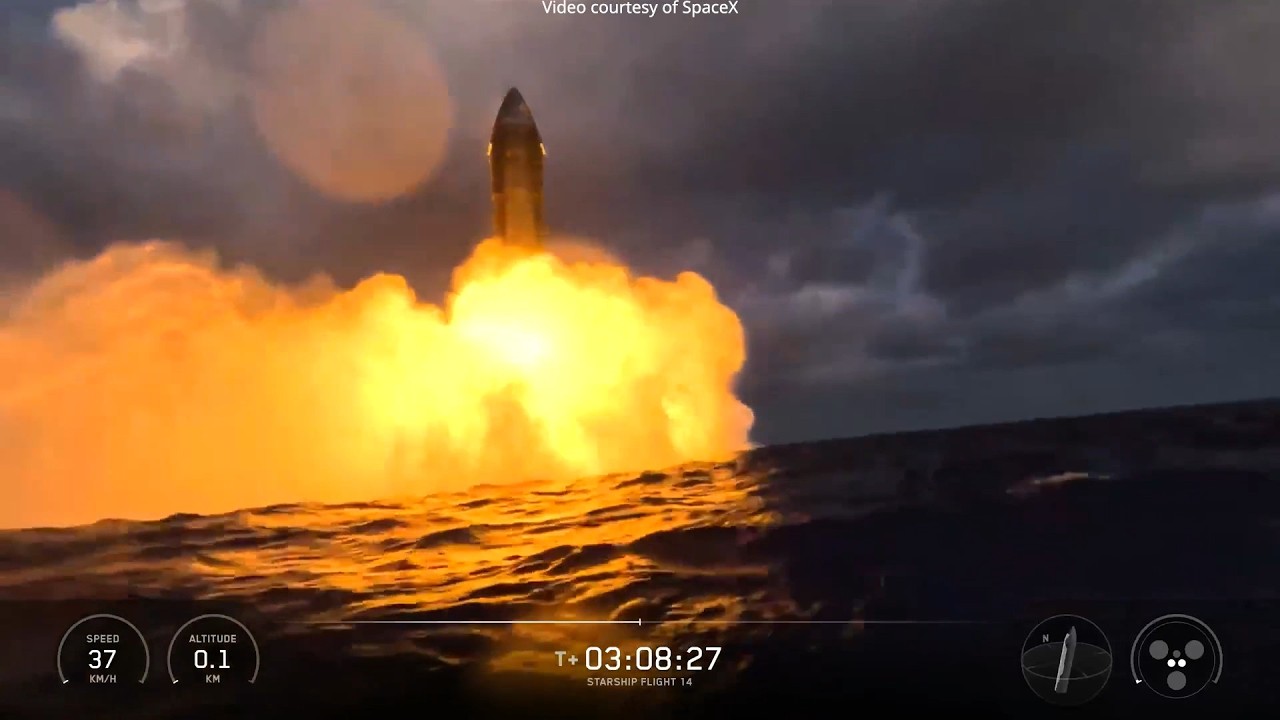
Ah. Been away from the computer for a while. Seems they did the de-orbit burn and brought it back in more or less on target. Doesn’t seem to have been as well controlled as the last one though: it exploded on landing.
Progress of a sort… but they are still way short of anything resembling a reusable system yet, it seems.
Getting a Starship upper stage back in reusable condition seems to be the hard part. That ought to be possible given that we got the Space Shuttles back (usually). But of course barely workable if the orbiter then spends the next six months in a hanger isn’t what they’re aiming for, so the development process may take longer.
“Exploded”? It should have had very little fuel left in the tanks. Unless it was just some other form of Rapid Unscheduled Disassembly due to the collision with the ground?
This 3-minute YouTube pretty conclusively shows the Starship payload flight landed nominally in the open ocean. Upright with no translation and a tolerable vertical speed.
If you’re impatient, the money shot starts shortly after the 2:00 timestamp.
With no platform there under it (apparently on purpose), the next thing that happens is the engines cut off, the thing dops vertically into the water it was hovering just above, then tips over and an explosion occurs.
That happens every time one lands in the water. That much at least is not a malfunction, but a completely predictable consequence of dunking a hot rocket w residual fuel into a cold ocean. It’s not built to survive that unscathed, and it doesn’t.
Move along. Nothing to see here with the landing explosion. Unless somebody is talking about the Booster landing. Which I did not chase down.
I’d be a lot more interested in why they deorbited at roughly 20% into the planned mission duration.