Tell me what I need to know to build an (off grid) home

Yeah. And being able to have a thermostat is a huge bonus. One problem we ran into a few times was the propane delivery truck could not get to the house. Even with chains on.

So I doubled our capacity and got another 500 gallone tank to get us through the winter. They hooked them up in series.

That’s all water under the bridge now. Yesterday at the new house our PV system made 107% of the power we use. I’m watching it closely.

The solar estimater figured out how many panels/moduals we needed. I said ‘Add three more’. We seem to be good. Donno what electric cars will do though. That’s gonna be a huge drain.

Even if the heat pump was no good below 32F, it may be worth it for heating when it is 33 to 60F outside. Though they can work when it is colder than 32F – obviously less efficient the colder it gets. But for every joule they consume, they can provide 3 (or more) joules of heat.
Obvious considerations are the cost of the unit and the cost of electricity and propane (or other heat source). Note that heat pumps are also air conditioners, so don’t look at raw cost, look at the extra cost vs a one way air conditioner (assuming you want an air conditioner – may not be needed many days depending on lake effect)

Brian

The air conditioning aspect is a good point.

Although at present days hot enough for air conditioners might be seen as rare, older folks aren’t as heat tolerant and changing climate might increase the number of those days.

I love my heat pump and it’s a nice bonus on the ten or so days when the AC is needed.

Are you sure about this? My impression is that old people both want higher temperatures in the winter (72 degrees in the house, but they complain about their feet being cold) and tolerate higher heat in the summer (no need to turn on the air conditioner until it reaches 80 degrees).

Perhaps it’s more accurate to say older folks are less tolerant to temperature extremes in general. There is some individual variability. In my case my heat tolerance is ebbing faster than my cold tolerance, but in truth I don’t do as well in either extreme as I did 30 years ago.

I wonder if this has to do with ‘thinner’ skin. That’s not the right term though.

My wife will sit in front of the propane fireplace in the morning. I go to my office downstairs and turn on the space heater in my office.

Me neither.

I do, however, often have the remains of the back hall woodpile and even some in the room with the stove still sitting there from the last fire in the spring till the first few in the fall; partly because I don’t know which is going to be the last fire in the spring and by the time that becomes clear I’m way too busy to be bothered schlepping it back outside when I’d just have to eventually bring it back in again, and partly because I remember a year with a cold wet August and in case the power goes out I’m always happier with at least a little dry wood in the house. And I’ve still never had a problem; though I suppose if an occasional bug moved in from the woodpile it might get missed among all the other critters that try to get into an old farmhouse in the summer.

Human homes are generally protective against both weather and somewhat against predators, and often have what critters would consider abundant food. Sometimes easily obtained once they’re inside.

If you live in the woods or comparable wild region critters outside winding up inside is an on-going situation you have to guard against and/or deal with.

Having dealt with a wild raccoon ransacking my kitchen at one point arthropods in the woodpile are not the worst thing imaginable.

What the heck, I’m going to update again.

The builder survey is done. The boundaries are now properly marked. While all that was going on we discovered someone had built a very nice deer blind on the property. This thing is almost a hut. We managed to contact the person who had been under the impression that was state land, not private. Apologies were given. As the boundary markers for that stretch were missing and it was very near the edge that’s entirely plausible. The main concern was ownership of property not become contested due to someone using it for an extended period. Once contact was established communications were very cordial. Everything is sorted out now, and we are free to use the blind as well. One comment was that in extremely severe weather during a camping session it could be used as a shelter.

Application is now in for getting a US postal address for the property.

Research is now accelerating on building and builders.

An old camper has been obtained and is being rebuilt/refurbished, to be left on site once transported for shelter in weather less attractive for tent camping. This will be “home base” while the first structure is built. The plan is to build a pole barn, with one corner set up as a sort of studio apartment. That will then be “home base” for the building of the residential structure. After that, the pole barn will be storage and a small guest house for potential visitors.

As part of the camping activities two of us hiked on foot into town. Turns out that’s about 4.75 miles. Of course, this was in pleasant summer weather but we’re closer than I initially thought. We could also use bicycles, weather permitting.

Electric power poles continue to march closer. Using grid power is definitely on the table now.

Great update. I am following this with interest.

Seconding that.

Glad you were able to establish good relations with the blind owner. Good neighbors are important.

So is the plan to live in the camper full time or just for periodic visits?
Same question with the pole building.
So a ~5 mile hike but 10 miles by road to town? (I can certainly see this)

Thanks,
Brian

Sorry, I’m late to this thread, but for info on just purchasing the land, this book is an amazing resource. It’s a pretty interesting read too.

Sort of a bootstrapping thing.

First, we will continue to camp on the property. This year when we went up there we rented a small U-Haul trailer instead of trying to cram a week’s worth of gear into one vehicle. So we won’t have to rent anymore, we can load the camper with gear, attach it to the trailer hitch, and drive it up there.

Second, at some point construction will begin. Having a camper with a small solar set up and other possible amenities avoids the need to rent a hotel room and would allow camping outside of the tent season (yes, I am aware there are “hot tents” for winter camping. We decided to opt for the camper for reasons I won’t go into).

The camper is NOT big enough to live in. It’s more like this camper than a big RV. I hasten to add that is NOT the camper in question, it is an example of the size range. The camper we have is being extensively rebuilt so it’s not going to be name-brand anyway and won’t look quite so pretty. It provides a means to haul gear to the site and a more weather-proof sleeping arrangement.

For one thing - the camper is not only going to be windproof, it will also have some insulation. Not a lot, but a nylon tent has none.

The plan is to start building with a pole barn. I admit I had to be sold on the idea, but I’m now convinced. Why a barn? As noted, one part can be made into a studio apartment/“cabin” with rest being storage, including storage for construction materials and equipment when we get to building the house.

We always intended to have at least one “out building” with the finished project, this is just building the barn first instead of last.

Yes.

First, my initial estimate by road was a bit off, it’s less than 10 miles. Lots of winding curves which can be misleading when estimating distance.

Second, the route you can take on foot can differ than the one you take by road.
Probably helped a lot that the initial contact wasn’t “YOU HORRIBLE TRESPASSING PERSON!!!” it was more “hey, we realize the boundary markers were missing so maybe this is an understandable mistake, let’s talk”. The owner is also a local property owner and understood the concerns immediately.

Good resource for anyone looking for a property.

As it happens, this plot was purchased in the 1970’s and has been paid for a couple decades now. I have heard the story of how it was selected and purchased, and there was certainly some drama around that transaction. But it’s not my story to tell here.

Yeah. Never start off by snarling. You can always snarl later if you need to; but it’s a lot harder to switch back from snarling to friendly than the other way around.

Absolutely.

By being polite and civilized we maintain good relations with a neighbor who, by the way, has said we’re free to use the blind as well. So we get a deer blind out of the deal, too.

As he was only about 4 feet over the actual property line that’s in line with “honest mistake”, especially given how undeveloped the area is. This sort of thing happens from time to time with the entire island being a patchwork of private and state land and boundary markers that disappear over time as a tree with one falls over or swallows the marker or something else happens.

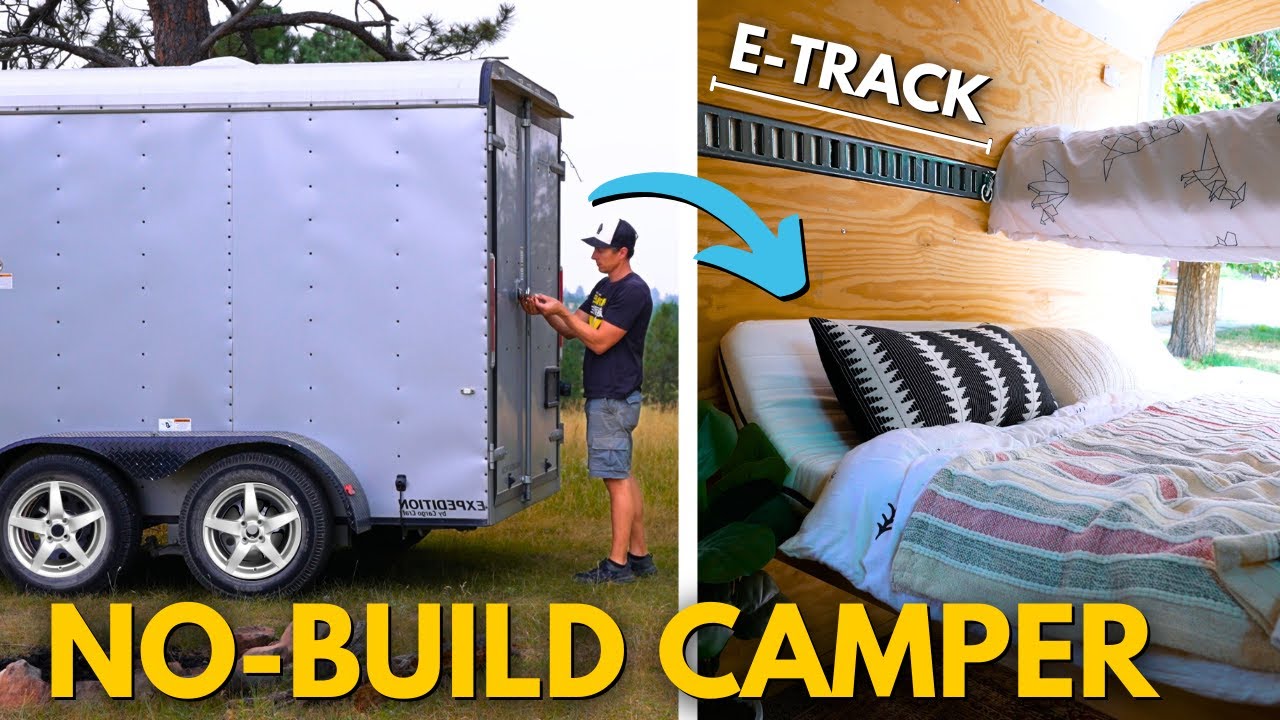
I know you have already picked a trailer and am refurbishing it, but I have to mention some folks take a cargo trailer and make it camp-able. There are a bunch of youtube videos on this – for example:

Is your camper tall enough to stand in?

I myself am considering a Road Toad totes which is a teardrop shaped cargo trailer and customizing it for camping.

These folks make a insulated pod which folks can put on a trailer, a truck, or on the ground. Probably not what you want, but I do like to concept (if not 100% the execution)

Brian

Nope, not tall enough to stand in. Much closer to the Road Toad.

Basically, it’s a cargo hauler that, once unloaded, gives you a protected, hard shell to sleep in. We’re OK with cooking outside and pooping in the woods, we mostly want to avoid freezing to death while sleeping at night.