A dissenting view on the protein goo metamorphasis. The relevant part starts a little after 4:00.
I like to watch farming and ranching videos on youtube, and being a city girl, I learn a lot about the art and science of agriculture and cattle ranching.
I’m not sure if I have this right, but at least a couple of cattle ranchers I watch have mentioned that they sell their breeding bulls after they’re about three years old because after that age, they’re too big and hard to handle. Contrariwise, they like to pair the younger, smaller bulls with the smaller heifers because they’re less likely to hurt the cows during mating.
Another factoid that at least two ranchers have discussed: every year they cull some of their breeding cows, choosing the ones who throw poor or late calves. They also take care to cull out any aggressive cows. If a cow has, in the past, charged at the rancher or threatened him in any way, she becomes a cull cow even if she throws big healthy calves. He just can’t take a chance on being put into the hospital or worse.
I’m surprised natural insemination still happens at all in cattle breeding.
Katherine McHale Slaughterback, celebrated in Colorado history for a pitched battle with 140 rattlesnakes
“I fought them with a club not more than 3 feet long, whirling constantly for over two hours before I could kill my way out of them and get back to my faithful horse and Ernie, who were staring at me during my terrible battle not more than 60 feet away”
Already an accomplished taxidermist, she made herself a dress, shoes and a belt from the snakeskins.
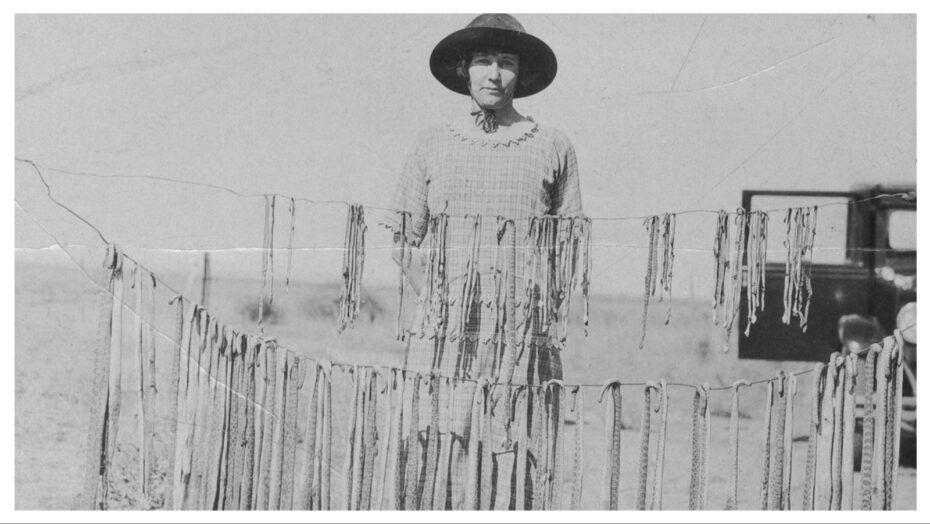
Certainly appropriate name. I would think the more interesting fact was that rattlesnakes migrate in herds of hundreds and attack people. I’m a little skeptical of both.
Despite the many articles on the subject there are no videos I could find.
Rattlesnakes will nest in huge groups but aggressively attack people in swarms? Sounds like a Texas-sized tale to me.
The Wikipedia article says that she encountered the snakes while riding a horse carrying her and her son. She claims she was afraid the horse would get spooked and throw her son off into the snakes. So she had a choice between backing the horse away from the snakes, or killing hundreds of snakes by hand in a 2-hour-long battle, and she made the obvious choice.
I think that caterpillars/butterflies should be considered alternation of generations, with the caterpillar and butterfly considered separate organisms. They sure seem to fit the concept better than the angiosperms that textbooks describe that way.
I’m not sure how much that’s really dissenting… The video states that it’s not true that the caterpillar entirely liquefies, just that most of it liquefies.
If they didn’t turn into mush, eating fried silkworm pupae would be even grosser than it already is.
Thirty odd years ago, when I was working in animal health (in the UK) it was all artificial insemination so far as I was aware. Named bulls or (hilariously, we thought) “Bull of the day”.
j
Your Wiki link:
The network’s inaugural broadcast on September 25, 1933, was carried by a small group of stations located in the Nort In the earl…
Is that an AI going full Trump?
I imagine they may all converge as they approach their communal dens in the fall.
Does anyone else, perusers of the back pages of magazines years ago, regret not enrolling in the University of Verbatim as I do?

(A parody of this long-running ad)
Or Cervaise.
Sorry Frodo, didn’t mean to drag you in.
Not really. Just the letter i was split into two different letters for two different phonemes. One has the dot in both lower and uppercase: İ i. The other has no dot in both cases: I ı.
Snakes on the plains?
I’m sorry, I’ll see myself out.
Another farming factoid: those good-looking chickens you see in county fairs or on decorative posters are mostly laying chickens, and not really the breed we eat. Eating chickens tend to be dumpy, unattractive birds who are bred to eat their heads off and gain weight rapidly for their few brief months of life. The ones I see the most on my farming channels are called “Cornish Cross”, and they’re smallish, pudgy, half-bald white chickens. They’re a far cry from the handsome speckled or colored or glossy laying chickens.
I always heard those as stewing chickens. When they are too old to productively lay, you throw them into a stewpot for all-day cooking.
Yep, though they’re not bred specifically for meat, they don’t go to waste when they’re retired. The farmer I watch culls all his laying hens at three years old, as egg production drops off at that point. They are then butchered and sold cheaply as stewing hens, and he says they sell very well.
And, what, she was standing at ground zero? 
I’ve been around rattlesnakes all my life and I’ve only experienced one that was aggressive. It was a tiny pink rattler in a Utah slot canyon. It was only about 7" long but determined not to let me pass.