If you could fold a piece of paper that’s .01 mm thick, 103 times, it would reach out past the observable universe. So claims this post:
Yeah, 2^103 is a hefty number.
I got a different result, only about 10 billion light-years, so not as far as the edge of the observable universe. But then I checked the video, and they started with paper 0.1 mm thick, not 0.01 mm, so that explains the difference. 0.1 mm is about right for standard copy paper. 0.01 mm is very thin, about the thickness of the thinnest tissue paper.
The star Betelgeuse got its (Latin alphabet) name from a typo. In Arabic, the name starts with a “Y” sound, but someone mistransliterated the letter as a “B”
Did they say how big that piece of paper needs to be to start with?
If you reverse engineer from a finished folded square that’s 2 inches to each side, the unfolded sheet would be 2 to the power of 103, or 1.0141205e+31 inches.
The only difference between the Y letter and B letter in Arabic is that the Y letter has two dots below it, while the B letter has one dot, so it’s an understandable mistake.
The Y is first letter of the Arabic word Yad, meaning ‘hand’. The full name of the star is Hand of Orion.
Yeah, what Knowed_Out said. I think the takeaway is that if you start with something that’s .01 mm thick and continue doubling the thickness 103 times that the end dimension is larger than the width of the observable universe. Which is pretty staggering if you think about it.
Kind of like the rice on a chess board or the 52! (factorial) trivia.
Again, it’s .1 mm, not .01 mm.
That assumes you’re making each fold in the same direction. If you alternate fold directions, one horizontal, the next vertical, etc., making 52 folds in one direction and 51 in the other, then the paper could be “only” 2^{52} inches by 2^{51} inches, or about 10^{34} light-years by 5 \times 10^{33} light-years.
When you make each fold, even if you could move the edge of the sheet at the speed of light, it would take 5 \times 10^{33} years to make the first fold, 2.5 \times 10^{33} years to make the second fold, etc. Call me when you’re done.
Will do… don’t wait up.
Sorry, I missed that. Thanks.
It feels easier to roll the sheet on a stick and make a black hole. Once the hole is “dark” enough the rest of the sheet will fall much faster into place.
BIGGEST. BLUNT. EVAH.
OK, now I’m curious what the smallest area of paper that one could start the theoretical folding. By that I mean the resultant multi-billion light year stack has an area cross section of one molecule. Pick your favorite representational paper molecule for size calculation purposes.
Though it doesn’t make practical physical sense (I know, that ship sailed at warp 10 already), I’m wondering what the super-duper smallest theoretical size the sheet of paper would be if we ended up with a Planck area sized folded stack.
The 1940 Brocklesby mid-air collision.
On 29 September 1940, a mid-air collision occurred over Brocklesby, New South Wales, Australia. The accident was unusual in that the aircraft involved, two Royal Australian Air Force (RAAF) Avro Ansons of No. 2 Service Flying Training School, remained locked together after colliding, and then landed safely. The collision stopped the engines of the upper Anson, but those of the one underneath continued to run, allowing the aircraft to keep flying. The navigators of both aircraft and the pilot of the lower Anson bailed out. The pilot of the upper Anson found that he was able to control the interlocked aircraft with his ailerons and flaps, and made an emergency landing in a nearby paddock. All four crewmen survived the incident. The upper Anson was repaired and returned to flight service; the lower Anson was used as an instructional airframe.
[Emphases mine.]
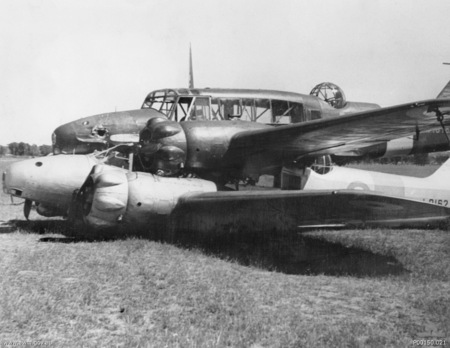
It’s a little tricky because “one molecule” doesn’t really have a well-defined area, nor is there really such a thing as molecule of paper. Paper is a complex mixture of many different components.
Also, if we’re trying to be somewhat realistic, none of the above calculations take into account the amount of paper taken up by the folds themselves. These calculations are roughly correct if the paper were cut into separate sheets and restacked, but if it’s really folded, there would be a vast amount of paper consumed by the vertical parts that connect the various layers, which hasn’t been considered at all so far.
The individual fibers that make up paper have a thickness of 10-40 microns. I would then suppose that the smallest piece of substance that could properly be called “paper” would be about 20 microns thick (the fibers go over and under each other) and wide enough to be nominally flat– 100 microns (0.1mm) on a side perhaps?
Now if you redefine paper as “cellulose” then there’s plenty of room at the bottom as Feynman put it. In individual plant cell walls cellulose fibers are often on the order of 5 nm thick or less. Conservatively requiring a 10:1 ratio of width to thickness gives us a sheet of “paper” (rayon?) 50nm across.
Something I hadn’t realized about self-driving vehicles: xkcd aside, they are vulnerable to people messing with 'em.
SAN FRANCISCO — In January, Doug Fulop was riding home from a night out in San Francisco when a man crossed the street in front of his car, doubled back and began screaming at him. The man punched the car’s windows and tried lifting up the vehicle. He then yelled that he wanted to kill Fulop and the other two passengers for giving money to a robot.
A taxi driver would have simply driven away. But Fulop’s vehicle had no driver — it was a self-driving Waymo.
“We felt helpless,” said Fulop, 37, who works in the tech industry.
Since autonomous cars started roaming San Francisco streets almost four years ago, they have elicited an array of reactions from humans, including angry protests against the vehicles. That has created an unexpected hazard for passengers of self-driving cars all around the city: being stuck inside the vehicle during an anti-robot rant.
Self-driving cars are designed to stop moving if a person is nearby. People can take advantage of that function to harass and threaten their passengers. In 2024, a San Francisco man tried covering the sensors of a self-driving car that had stopped, effectively disabling it, while passengers were inside. Another video from that year showed three women screaming as a group of vandals tagged their autonomous taxi with spray paint.
Fact: the first Beetle record released in America was by VeeJay records–
Originally scheduled for a July 1963 release, the LP came out on 10 January 1964, on Vee-Jay Records, ten days before Capitol’s Meet the Beatles!
Also Vee-Jay was the first female, African-American owned record company, located at 1449 S. Michigan Ave. in Chicago, IL. The label was formed several years before Motown.
Then again, attackers spray-painting the windshield of a human-driven car would also effectively disable it. The only difference there with a computer-driven car is the motivation of the attackers.
Oh, and also, the computer car is likely to get some pretty good camera footage of the assailants, sure to be useful to the police.
I bet the people who pull those stunts are usually masked.