JWT has discovered a black hole that’s SIX BILLION times the mass of the sun.
What’s also mind blowing to me is that scientists measured the size of the very distant black hole through observations of the host galaxy of the black hole made possible by the gravitational lensing provided by a galaxy that sits directly in front of it from our perspective.
The industrial processes themselves aren’t so big a factor on the Earth’s ecology as the number of humans living on Earth, their agriculture, and the support infrastructure for both.
[Blue Origin CEO] Limp said the company’s path forward is “clear” as it works toward returning the New Glenn rocket to flight before the end of this year.
“We’re making small modifications to the valve that can be quickly retrofitted to existing engines,” he said. “We’re manufacturing the updated hardware, which will be ready by the end of this month. In parallel, we’re working through the remaining fault tree analysis.”
At first i read this and thought “isn’t that just an accretion dish around a black hole?” But it turns out the material around the black hole is in a state of equilibrium with the black hole at its core.
SpaceX will launch Roman on a Falcon Heavy rocket from NASA’s Kennedy Space Center (KSC) in Florida. Liftoff is scheduled for no earlier than 7:26 a.m. EDT (1126 GMT) on Sunday, Aug. 30. from Launch Complex-39A (LC-39A).
From the cite above the Roman telescope has similar resolution to Hubble but can process information in a month that would take the Hubble a century to process.
But remember the process will take months before the telescopes have been tested and shown to be working, so there are many points along the way things can go wrong.
AI is telling me first light is expected early 2027, but I can’t find a solid cite (I can’t find one in the links AI gave me), but that seems reasonable (maybe late 2026)
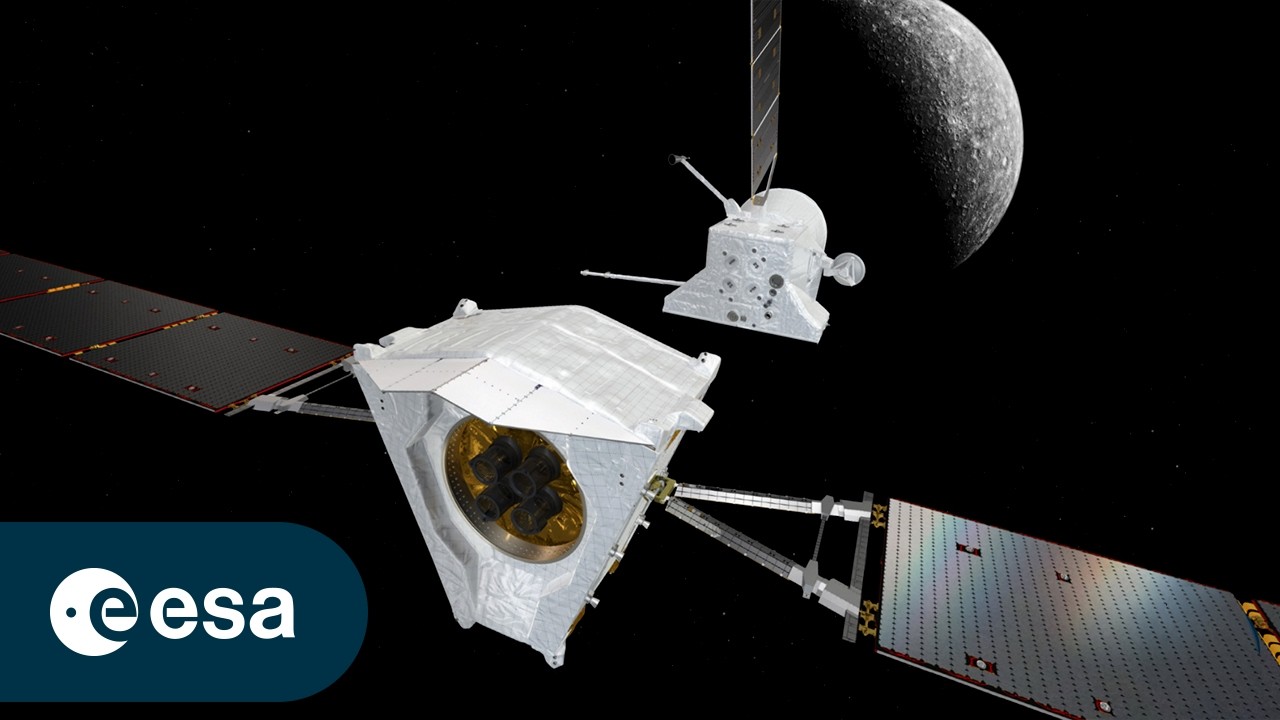
BepiColombo’s Mercury Transfer Module (MTM) will separate from the rest of the stacked spacecraft (this is the 1st maneuver, it will be a while before stable orbit)
Multi-layer insulation – the metallic wrapping that makes satellites look like Christmas presents – played an essential role in keeping BepiColombo’s cool. ‘A typical spacecraft might have a single multi-layer insulation blanket,”” says Heiko, “BepiColombo uses three to four stacked blankets of 10 to 20 layers, adding up to 94 kg on its Mercury Planetary Orbiter alone.”
Standard materials were put aside for layers containing titanium, ceramic fabric 3M Nextel – normally used in ovens and spacecraft heat shields – plus multiple layers of aluminium.