At my job (a pizza kitchen) a mallard (?) duck has decided that the ideal place to raise a family is … behind the trash can by our busy front door.
My manager used one of the kitchen steel containers to (very gently) nudge her some water, and I brought over cracked corn & sunflower seeds. Will bring oatmeal next shift.
It’s not the best picture, since it’s from inside, but we’re all trying to be careful not to disturb Ms. Mama Duck.
Oh, and while I was outside on my break at work, I heard a telltale honking and looked up to see an absolutely perfect V-formation … and then two stragglers lagging waaaay behind.
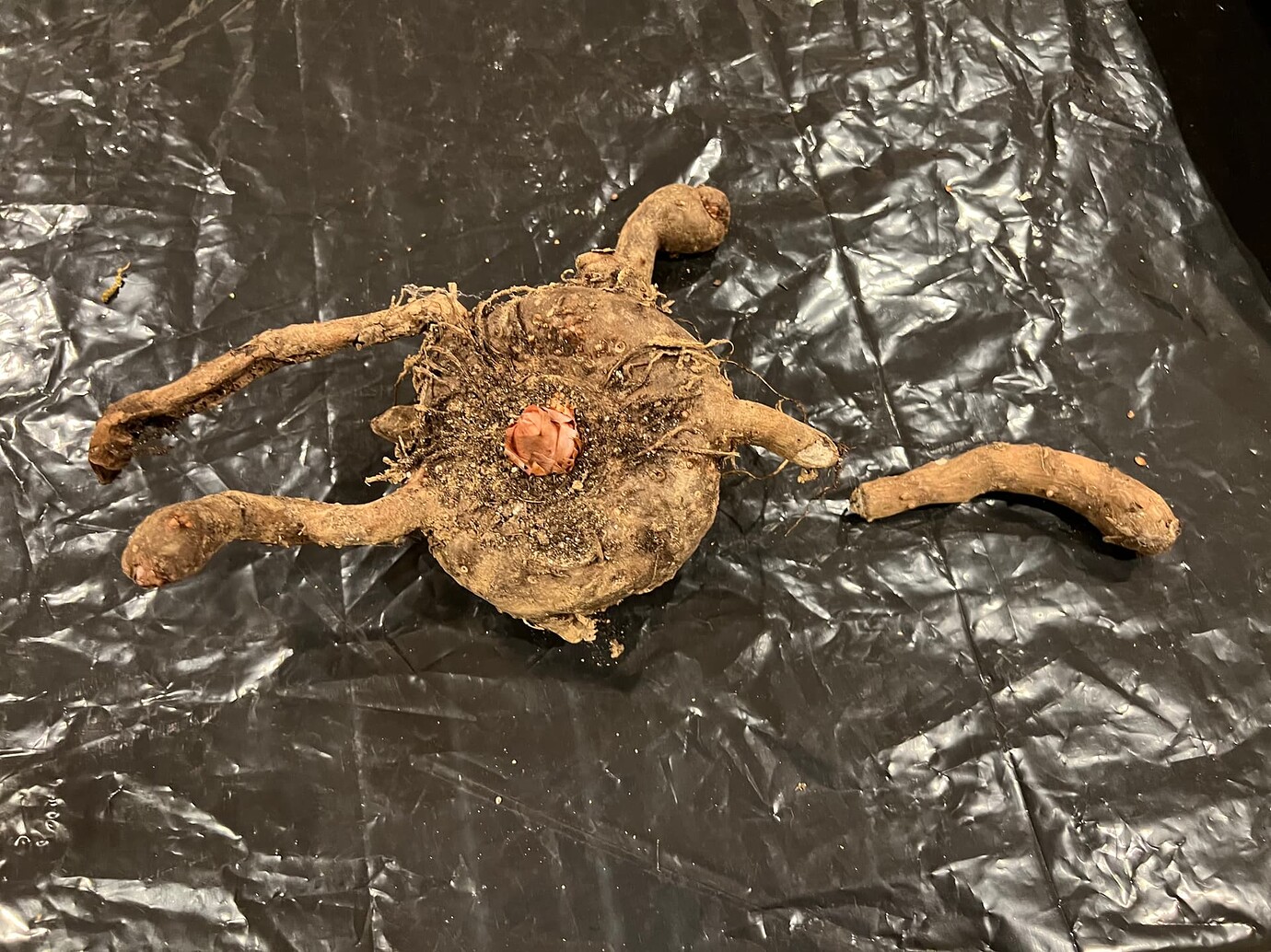
Yesterday I noticed some signs of sun damage on some of my small Amorphophallus leaves in the new (full sun) location, so I dug the whole container out and moved it again, under the shade of a large oak. When I did I found this crazy corm.
That’s five large leaf buds (each with its own set of roots), plus a small sixth one on the top. (They are “supposed” to have only a single leaf, growing from the top center.)
I recognized the corm from a photo I took of the whole lot back in early March
I had noticed that it had no visible small pink bud of a sleeping leaf in the center and thought the whole thing might rot, but this was the result; in the absence of the central bud it tried growing a replacement off to the side. But while it has a signal for “grow new bud”, it has no way of coordinating that only one new bud starts.
I “should” break off all except one bud because probably the corm will split into two or more smaller corms, but I’d rather see what happens like it is.
Hobby. I only bought one small corm in 2004 but they produce long “stems?” with new corms on the end and spread like crazy in suitable conditions. (I found this example online, not my photo):
This year when digging out the container to move I found more than 70 corms ranging from less than half an inch to more than four inches. A corm can grow to 12 inches or even larger. I’ve spread mine this year from their 26x36 inch container to five more smaller containers of various sizes, but I would need a lot more to give all of them room to grow to full potential. I mean, each corm could make use of a 20 inch container of its own. You basically end up with an insane hoard of them if you try to keep every new corm.
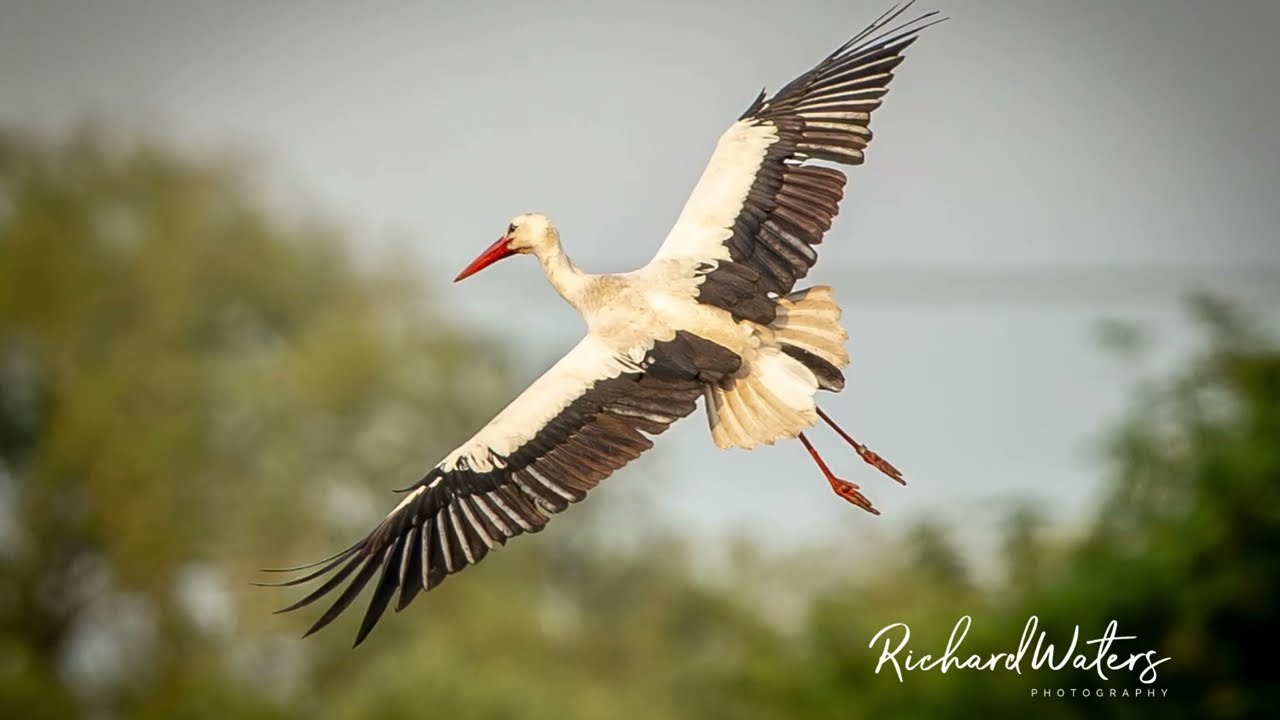
A quick recap on Knepp and all that: in 2020, the Knepp estate reintroduction project produced the first breeding pair of white storks in the UK in 600+ years. How’s that going? - you might reasonably ask.
Yesterday, driving through Guildford (20+ miles from Knepp), a stork flew over our heads. Are you sure? - you might reasonably ask. Well, in the last few days there have been a load of sightings at a location no more than a couple of hundred yards from where we were driving - indeed, here’s a photomontage and video from that location posted six days ago:
There have been well over a hundred chicks fledged at Knepp now and - I hadn’t realized this - they’re off all over the place. Here are some notes on the autumn '25 migration.
(This talks about “48 juveniles, reared at Cotswold Wildlife Park” - this also was news to me, I didn’t know that a second site was now involved,)
We got a couple of new pets recently. Our neighbor needed to rehome these ladies, and we are the well-known neighborhood suckers, so here they are! Violet and Pi, mother and daughter. They’re pettable, but skittish, so we have to work on getting a bridle on them.
The neighbors also gave us their chickens, so it looks like we’re back in the egg business for a while.
Back story… I have seen a couple of vultures a lot lately in the backyard. They go into an unused shed a lot. I assume there are babies in the shed (I leave them alone).
Today… I’m going to take the dog outside. She goes to the back door and starts barking. I look out and the vultures are together in front of the shed with their (wide) wings spread out. There was a deer a few feet away and coming closer. Then the deer rushes towards the birds and just before the deer gets to them they fly away. One in a tree and the other on top of the house.
Then we go out the back yard and the dog starts barking at the deer and the deer runs away.
Getting on for 40 years ago I was on a guided tour of a reserve not far from High Wycombe (~30 miles west of London) looking at orchids, when someone sidled up to me and said, literally out of the corner of his mouth, “Psssst! Wanna see a red kite?”
I politely declined, as one should do when approached by a nutcase. But this was at the time when, after being extinct in England for 100+ years, red kites were being reintroduced. Boy did that work out well. Today, driving through suburban High Wycombe, we saw five flying low over the houses. The last was being mobbed by a single crow. An incredible change in four decades.