Lots of recorded chess games throughout history have ended in checkmate. However, any chess player who can hold his own at a tournament will see checkmate coming three or more moves away. So what’s the point of playing on when you know you’re sunk? Sportsmanship? So the game can be recorded for students to study?
Also, two other chess questions:
When doing puzzles, is it cheating if you know beforehand what the goal of the puzzle is? For example, on lichess(dot)org, you can select random puzzles or specific ones (skewering, mating in two, etc.). On the one hand, I feel like a good chess player should be able to analyze the board and see what the best sequence is; knowing what the puzzle-maker is going for gives an advantage that you wouldn’t have in a real game. On the other hand, a student of chess should be taught to look for patterns, and so looking specifically for mating patterns, or skewering patterns, etc. is a valuable tool.
Is the rating system on lichess(dot)org remotely comparable to what a player’s rating would be in real-life, rated tournaments? My rating on the website is 1312, but I’m pretty sure I’m not a 1300 player; I’d be surprised if it’s 1,000. The mobile app I use has my rating at <700 (although I don’t play against real people, and the AI makes horrible blunders from time to time). *Once COVID is over and they start having real, in-person tournaments again, I may yet take up playing tournament chess.
Hi, I’m a retired chess coach and have played in international tournaments.
Sometimes players are short of time and so can’t analyse 3 moves ahead (I assume you mean for each side as that’s the usual convention.)
I once played on in a lost position v a FIDE Master because their obvious next move actually lost.
However she spotted it (and duly won.)
In team matches, it’s reasonable to play on in a lost position because there is more at stake than just your result.
I was once a piece up in a King + pawn ending v a Grandmaster (completely won) and he played on until I promoted to a Queen. I didn’t ask him why. - it’s my responsibility to win the game.
There is a branch of chess called problem solving (and there are national and international competitions in the genre.)
You are presented with a series of positions and always given the precise number of moves to mate that are required (e.g. mate in 2; mate in 3 etc.)
Most chess problems give White and overwhelming advantage (enough to win easily in time), but there is only one way to win in the time given.
It’s hard to compare games v computers against face-to-face results.
The computer can have to all sorts of settings (an excellent idea for practice) … and sadly some folk will use a computer to cheat.
I know it can be annoying to drag a game out, but I once swindled a draw when down a queen, and I’ve also come back from a piece down because my opponent, in my opinion, became annoyed that I carried on (I was a 1900-level USCF player, so it’s probably more common at my level than at higher ones).
My level of competition was much less rarefied than glee’s or even Maserschmidt’s; I was rated in the 1200s after my first tournament, and in the low 1700s after my last. In the several dozen rated games I played, I can’t recall any instances of an opponent playing on until I mated them, once I had both the initiative and a material advantage of at least a rook or its equivalent. And when on the other side of that equation, I’d throw in the towel.
Playing on when just a piece down…well, someone can always make a mistake and you win back the piece. I remember a chess match with another school during my senior year of high school. I was down a piece with no real winning chances, but suddenly I realized that if I advanced a pawn and he took it with his rook which was on the same file, I’d be able to pin his rook to his (distant) king with my bishop.
So I advanced the pawn, and did a convincing job of looking suddenly crestfallen. He took the pawn, I pinned and then took his rook, and now I was up the Exchange and didn’t have too much problem winning from there. Probably the only game I won by a flat-out swindle.
Ah yes, the King Sacrifice. The rarest move in all of chess.
Joking aside, what does a referee (or moderator or proctor or whatever they’re called in tournament chess) do when a situation like that arises? Stop play and call the game a draw?
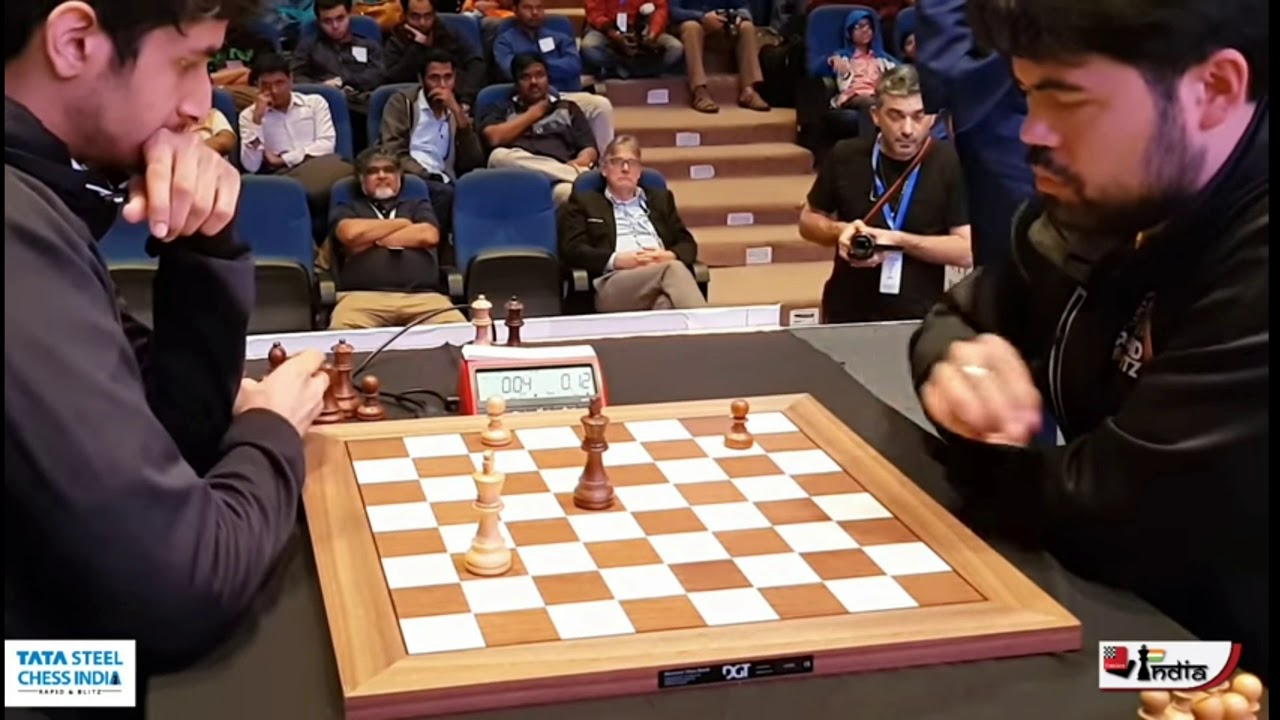
It looks like that was blitz chess, which has slightly different rules: In addition to the extremely rapid time controls, the game ends with capture, not mate, of the king, and a move into check, or not moving out of check, is allowed (and you’d better hope that your opponent doesn’t notice). In that context, the move shown would be legal, but basically equivalent to a concession, since it’s highly unlikely that the opponent wouldn’t notice.
If it were normal chess and not blitz, could you just eat your opponent’s king (if he made a deliberately suicidal move like in the video) and not need to wait for any referee’s word?
The Nakamura game was played under fast chess rules, where if you make an illegal move you simply lose the game. The king move is illegal, so Nakamura just claimed a win on the spot.
In slow chess, an illegal move is punished with a time penalty on the clock instead.
In a rated game (ETA: normal speed, not blitz), what do you do when your opponent makes an illegal move? Is it an automatic forfeit, or do you just hit your clock, point out the illegality of the move, and keep playing from there?
ETA: borschevsky answered my question already - thanks!
You call an arbiter and stop the clock, and the arbiter applies the penalty if your claim is correct. In slow chess it’s a time penalty, so the arbiter adjusts the clock times, and in fast chess the game ends.
There’s a famous blitz example where the world champion Magnus Carlsen played a move putting his opponent in check, but the opponent didn’t realize and played a knight move on the other side of the board, putting Carlsen in check. Carlsen instinctively moved his king out of check, and his opponent then claimed that Carlsen’s move was illegal. Initially Carlsen was given a loss, then on appeal the decision was made to resume the game after Carlsen’s initial checking move, but the opponent didn’t continue so Carlsen won.
In my experience, when learning chess and started going to tournaments, after they get the surprise that a beginner is cleaning their clock the more experienced players can still defend well and have the hope that they will win on time or that they will trick the less knowledgeable opponent into a draw or/and a stale mate.
It happened to me a few times when I was getting very good and almost defeated a few local champions. Those draws can hurt you as much as a defeat when you learn later how simple it was to avoid those traps and sandbagging.
I think I’m a similar level to you (my rating on chess.com is around 1400), and I enjoy attempting the puzzles on there. I wouldn’t say it was cheating if you know the theme of the puzzle, but I do find them significantly easier to solve if I know what to look for. That’s because I’m simply not a good enough player to see all the possibilities (at least, within the time and effort that I’m willing to devote). I think attempting puzzles both with and without this clue can be a valuable exercise, but ultimately you’re right in that if you do puzzles with a view to improving your general game, you might learn more by doing them without the clue as to the theme.
A friend of mine recently changed from one chess site to another and found their rating on the latter was immediately several hundred points lower. So I would say that it definitely can’t be assumed your rating in one player population will copy over to another. I don’t know if there is anything that can be said about lichess ratings vs USCF specifically. I guess lichess hope they have some equivalence, but it’s virtually impossible to achieve in practice. Ratings can only ever be relative, not absolute.
I would say the main thing to bear in mind is if you start playing somewhere with a different rating system (e.g. USCF tournaments), try not to be discouraged if the number is lower than what you’ve been used to - it (obviously) doesn’t mean you’ve got worse as a player, it just shows your level in that system. And once it evens out, you can work on improving from there.
As for playing on in lost positions, at our level I think it’s completely reasonable to play on quite a long way. I had a recent game in which I was a whole rook down, but persisted until my opponent exchanged all the pieces and queened a pawn (I felt that going beyond that would not only insult his intelligence but also be pointless in that neither of us would learn anything). If he and I were to reach the classic ‘mate with knight and bishop’ endgame I would make him play it out (and would expect the same if the tables were turned) - I’ve never had to do it ‘in real life’ and haven’t studied it much, so I’m not sure I could actually pull it off - therefore it’s an interesting experience for me even though it’s technically completely winning. And the same factor can apply to many other positions. In another recent game I was significant material down but managed to swindle my opponent into allowing me to mate him. Again, fair enough at my level - but if I were playing against glee, there would be no point.
At some level, the starting position is either a lost position for one side, or a drawn position. But you don’t see very many games that start with black conceding, nor with white offering a draw.
I had an amusing incident v a Grandmaster at speed chess once.
In a better position, I gave check.
He instantly replied with a check of his own (illegal … and I can claim the game)
But I was a bit flustered, so moved my King out of check.
This went on for a couple more moves until I realised what was happening and won by claim.
In terms of game theory, your statement is clearly true. (Hard to see how Black actually wins, but perhaps there’s an ultimate zugswang!)
Sadly there have been cases where one player has accepted a bribe - but they always play a few moves (as a cover-up) before resigning.
Meanwhile, in a 6 round speed chess tournament (30 minutes for the whole game; i.e. no increments) I faced the top seeded GM in the last round.
We had both won our first 5 games, so our nearest challengers had all lost a game.
I was White, played 1. e4 … and offered a draw!
If he accepted, we would share the 1st and 2nd prize money (since nobody could catch us.) However, if either of us lost, we would no doubt be caught by several pursuers and not get much.
Now although he was the stronger player, I did have the slight advantage of the White pieces, plus I was clearly in form with 5/5 (in fact I’d beaten a GM in the previous round )
So he muttered “I’ll think about it” and stared at the ceiling.
After 20 minutes , he looked down, realised he only had 10 minutes left … and accepted the draw!



 until I realised what was happening and won by claim.
 )
) , he looked down, realised he only had 10 minutes left … and accepted the draw!