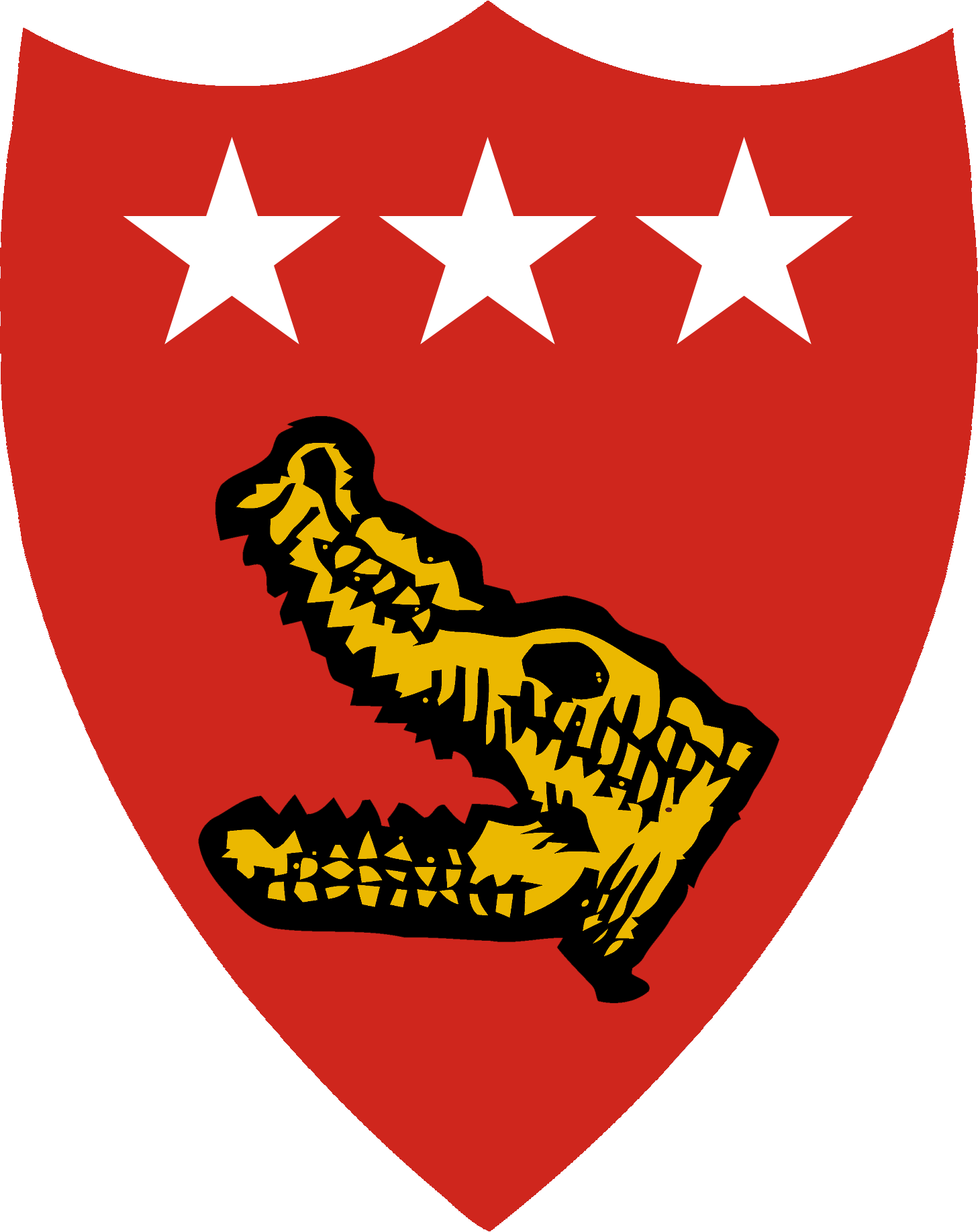
During the invasion of Iwo Jima, artillery from the 14th Marine Regiment, under the command of Colonel Louis G. DeHaven, supported three infantry regiments: the 23rd, 24th, and 25th Marines. These four regiments comprised the 4th Marine Division. Deactivated after the war, the 4th Marine Division was re-formed in 1966 and elements of the division deployed during the Gulf War in 1990–1991, as well as during the Iraq War. It is currently the ground combat element of the Marine Forces Reserve and is headquartered in New Orleans, Louisiana, and has units throughout the United States.
4th MARDIV, 2000 Opelousas Ave., New Orleans LA
4th MARDIV insignia:
Besides the 4th Marine Division, two other divisions engaged in the invasion of Iwo Jima: the 5th Marine Division and the 3rd Marine Division. Together, they comprised the V Amphibious Corps. During WWII, the V Amphibious Corps engaged in the Battle of Tarawa, the Battle of Makin, the Battle of Kwajalein, the Battle of Eniwetok, the Battle of Saipan, the Battle of Tinian, the Battle of Leyte, and the Battle of Iwo Jima.
V Amphibious Corps insignia:
The Battle of Iwo Jima was the bloodiest in Marine Corps history.
The US Marine Corps War Memorial just across the river from Washington, DC is closely based on the famous Joe Rosenthal photo of the flag-raising on Mt. Suribachi during the 1945 Battle of Iwo Jima.
I know about the dignified burning part; never heard of the throwing away in the trash part. Cite?
The island of Iwo Jima was first visited by a westerner in October 1543, by Spanish sailor Bernardo de la Torre on board the carrack San Juan de Letrán when trying to return from Sarangani (on the southern coast of The Philippines) to New Spain (what is now Central America, Mexico, and the western half of the US).
The base of the Marine Corps War Memorial (the Iwo Jima flag raising) is made of black granite that comes from Lönsboda, Sweden. The granite is a black diabase granite. Diabase is the preferred name in North America, while dolerite is the preferred name in the rest of the English-speaking world. In this case, “granite” is a commercial term. The stone is not actually granite but is subvolcanic rock equivalent to volcanic basalt.
The National WWI Museum and Memorial, located in Kansas City, Missouri, bills itself as “America’s only museum dedicated to sharing the stories of the Great War through the eyes of those who lived it.” The Memorial was erected and dedicated in 1926, while the museum opened in 2006.
(Well worth the visit, if you’re ever in the area.)
Elendil’s Heir, the bolded part comes from my own experience and follows directly from the flag code calling for burning. The first time I burned a faded and tattered flag, it was the one flying in front of the company I worked for. I used a 5 gallon metal bucket for it and burned the flag, then tossed it in the dumpster. All the while I was wondering, hmmm, why burn the flag? I’m not protesting publicly, right?
Once I did it, though, I saw the charred remains in the dumpster and it was at that very moment that I surmised that’s why it is to be burned, so that the Stars and Stripes would not be recognizable in any trash receptacle. So while it’s technically not part of the flag code, to my interpretation of it, it is implicitly part of the code.
The entire flag should be burned. It is the most dignified way to dispose of Old Glory.
I take the proper handling of our flag very seriously. When still in the Marines, my unit at that time did not have a Color Guard and I did not think that was right. I asked around about it, and finally approached my Sergeant Major and asked if I could create one. I had a lot of learning to do. That’s how I became my unit’s first Color Sergeant, on our first Color Guard. I personally hand picked every member and trained them.
The NBA’s Sacramento Kings have been a member of the NBA since 1948, but have called a number of cities home over their history. They started out in Rochester, New York, as the Royals, before moving to Cincinnati in 1957, then to Kansas City and Omaha in 1972 (which is when they were renamed as the Kings, to prevent confusion with the Kansas City Royals baseball team), and finally to Sacramento in 1985.
KCMO and KCK are common abbreviations for Kansas City, Missouri and Kansas City, Kansas. KCMO was named the City of Kansas in 1853, before Kansas was even a state. Kansas joined the Union in 1861. KCMO derived its name from the Kansas River. The state also derived its name from the Kansas River. KCK derived its name from KCMO. KCK was incorporated in 1872.
On March 14, 1972, the Cincinnati Royals of the NBA moved their franchise to Kansas City, MO. They changed their name to “Kings” to avoid confusion with the Kansas City Royals of the MLB. The Kings remained in Kansas City until 1985, when the franchise relocated to Sacramento, CA.
Salmon P. Chase was born in Cornish, New Hampshire but moved to Cincinnati, Ohio as a young man. After a single term on City Council he made his name as an antislavery trial lawyer, and was eventually elected to the US Senate and then as Governor of Ohio before joining the Lincoln Cabinet.
Pierce Brosnan, perhaps best known for playing James Bond in a number of movies, ‘is in hot legal water after he walked into restricted areas of Yellowstone National Park.’
Pierce Brosnan was cited for going off-trail near the Mammoth Hot Springs in Yellowstone in late 2023 and venturing into a restricted thermal area. He was featured on the Instagram page for Tourist Morons of Yellowstone, TouronsOfYellowstone — TouronsOfYellowstone (@touronsofyellowstone) • Instagram photos and videos.
Brosnan’s own Instagram account shows the hat and outfit he was wearing in photos showing him in the restricted area, Mammoth Terraces in Yellowstone.
Brosnan was the fifth actor to play James Bond. He starred in GoldenEye (1995), Tomorrow Never Dies (1997), The World Is Not Enough (1999), and Die Another Day (2002).
Franklin Pierce served as a general in the Mexican-American War and was also a heavy drinker, leading his opponents to comment that “He is the veteran of many bottles.”
Franklin Pierce’s running mate and Vice President was William R. King. King County in what was then Oregon was named after him; the county eventually became part of Washington State and is now the Greater Seattle area. In 2005, state law was changed to make clear that King County was named after the Rev. Dr. Martin Luther King Jr. and not the late VP, an Alabama slaveowner.
Rufus King is the only Veep to take the oath of office outside the United States. He was in Cuba for health reasons; was sworn in in Havana; returned home to his plantation, where he died, without ever exercising his Veep duties.
William Rufus King was the 13th Vice President of the United States. He served for about 5 weeks in 1853, under Franklin Pierce, until he died at the age of 67.
He was the first and, to date, only vice president or president of the United States to take the oath of office on foreign soil. Cuba.
King suffered from tuberculosis during the campaign and went to Cuba for relief from the disease. Through an act of Congress he was allowed to take the oath of office in Cuba. One month later King arrived back in the US but died soon after. He never presided over a session of Congress as vice president — though in an odd twist of fate, he had acted as President pro tempore of the Senate in 1850, when Zachary Taylor died and then-VP Millard Fillmore assumed the presidency. Following King’s death, the nation went nearly four years without a vice president until March 1857, when John C. Breckenridge filled the position.