In Latin, the word trivia (trivium) literally means “three roads”, coming from a place where three paths meet. Because public street intersections where three roads met were busy places where common people gathered to talk, things found there became known as trivialis (common or ordinary), leading to the modern idea of everyday trivia.
I always heard it was because a three-road intersection was not as important as a four-road intersection, which tended to be where larger Roman towns were then established.
Hmm, yeah that might be a factor also.
You aren’t kidding. I had to close my browser to regain control of my computer.
It appears to be a prank of some sort. I’ll investigate more later.
Be safe my friend.
Responding to post 2322 above:
In the play Oedipus Rex by Sophocles, Oedipus kills King Laius (not knowing that Laius is his father) at “a place where three roads meet”, in what may be the first recorded road rage incident. Laius attacked Oedipus because he wouldn’t yield way to him, and Oedipus fought back.
The place where three roads meet is the junction between Delphi, Thebes, and Daulis, at the foot of Mount Parnassus. The site can still be seen today:
The Crossroads of Oedipus … | My Space in the Immense Universe
The Classics Pages
I don’t want to keep derailing the true topic but I’ll report this: It’s a legit website that’s been taken over by unknown actors and likely has malicious malware if you click on it. I’ve been back there three times and haven’t seen the same page that tried to take over my browser; ublock has prevented me from returning, but in the three following instances I copied the urls of where it wanted to redirect me. I’ve sent copies of what I found to Google and the FBI’s IC3 page.
In play:
In mythology, the Greeks have a flood myth where the entire world is covered in water, except for Mount Parnassus. Survivors ran from the flood, following the howling of wolves up the mountain slope, where they built another city called Lycoreia, meaning “the howling of the wolves.”
Delphi was an ancient sacred site in central Greece that was famous for its powerful oracle, which predictions that were known to be cryptic and ambiguous, and even nebulous. The oracle was a high priestess named the Pythia, named after the site’s original name, Pytho. Recent studies have indicated that the trances of the Pythia were perhaps caused by escaping volcanic gasses, including ethylene.
Unfortunately, a tourist can’t go to Delphi and get a buzz from the gases that caused the Pythiae to go into trances and give prophecy. Centuries upon centuries of changing geology in the region have resulted in the emanations having completely stopped, save for trace elements. Further, the Pythiae went into a subterranean chamber to fully expose themselves to the intoxicating gasses; the chamber is gone now and if any gas did escape to the surface, it will be blown away by the wind. However, tourists to the site can still visit and (presumably) get a swig of water from the nearby ancient spring.
“Hungry Like the Wolf” is a 1982 song by the English pop-rock band Duran Duran.
In large part due to its exotic, sexy music video, directed by Russell Mulcahy and filmed in Sri Lanka, receiving heavy play on MTV, the song became the band’s breakthrough in the U.S., reaching #3 on the Billboard Hot 100 chart.
During the shooting of the video, guitarist Andy Taylor accidentally drank water from a lagoon, which infected him with a stomach virus serious enough to require his hospitalization.
(Last sentence added to make it fit with HeyHomie’s simulpost.  )
)
The idea of wolves eating humans (children in particular) has bedeviled Europeans (and, by extension, Americans) for milennia. In fact, in Europe wolf-on-human fatalities were pretty much an everyday occurrence, and the ubiquity of people being killed by wolves didn’t fully wind down until the last couple of centuries. Immigrants took that fear of wolves with them when they settled North America, extirpating the beasts from wide swaths of the country and almost driving them to extinction. But it was all largely unnecessary: in Europe, humans children were oft sent into the fields to work alone or gather water or what have you, making them easy prey. This went on for centuries, and wolf attacks were a fact of life. North American wolves, however, didn’t have that regular buffet of delicious European children, and indeed are/were much more fearful of humans than their European counterparts. The number of documented wolf-on-human fatalities in North America since Jamestown was settled is likely in the dozens; in that same year that Jamestown was settled, alone (1607), Europe could have expected dozens if not hundreds of fatal wolf-on-human attacks.
Yellowstone National Park’s wolf population today stands at 84 across 8 packs. The last wolves had been previously killed in 1926, and as a result the park’s population of elk grew uncontrolled. Then in 1991 31 wolves from Canada were reintroduced to restore balance to the overpopulated elk herds. The average life expectancy of a wolf inside the park is about 7 years, compared to around 3 years outside park boundaries. Their winter prey consists of roughly 90% elk and supplemented by deer in the summer and occasional bison.
Glad you made it back. Glad you lived to tell the story.
Although there are many wolves in Canada, the official national animal of the country is the beaver, under a law passed in 1975. The national coat of arms does not feature a beaver, but rather, two lions and a unicorn.
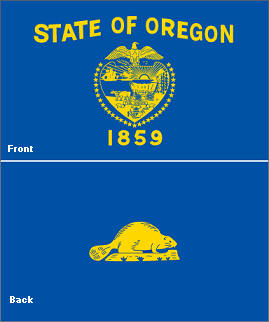
In 1849, the Oregon provincial government issued “beaver money” with an image of the American beaver, and the animal was included on the territorial seal and state flag, which is also the only US state flag with different images on either side.
Arcadia University is a private school in suburban Philadelphia. The school was founded in 1853 as Beaver Female Seminary, in the town of Beaver, Pennsylvania, and the name became Beaver College in 1907; in 1927, it moved east, to the Philadelphia area.
In 2001, Beaver College changed its name to Arcadia University, largely due to the name having become the subject of jokes (based on “beaver” having become a widely-known double entendre for female genitalia), and the school’s website being blocked by profanity and content filters.
NFL Hall of Fame quarterback Joe Namath was born in Beaver Falls, Pennsylvania, in Beaver County in the far western edge of the state and whose county seat is Beaver PA. The places were named after the 20 mile long Beaver River that flows over Beaver Falls. The river was named either for King Beaver (Tamaqua) of the Delaware nation that had migrated to the area in the late 1740s, or for the animal.
Broadway Joe played high school football for Beaver Falls High School before going to the University of Alabama, and then the New York Jets and the Los Angeles Rams of the NFL.
Namath was the first-ever quarterback to win both a college national championship and a major professional championship.
During the Watergate investigations in 1973, Joe Namath was the only athlete listed on the master list of Richard Nixon’s political opponents, and the reasons for this remain unclear to this day.
At a time when the NFL was just so deathly serious (moreso even than it is now), when it portrayed its games as the modern equivalent of gladitorial combat, and when its athletes were expected to play that role, Joe Namath broke the mold. He famously wore expensive fur suits, even on the sidelines; he grew a Fu Manchu and then took an absurd some of money (for the time) to shave it off for a commercial; he owned a night club; he did a pantyhose commercial. All of this earned him the nickname “Broadway Joe.”
In Jan 1965 Joe Namath made headlines when he signed a record-breaking NFL rookie contract with the New York Jets widely reported to be $400,000. The actual contract turned out to be approximately $427,000 over three years. Namath’s signing included a massive $200,000 upfront bonus, and his contract paid around $75,000 per season over three years.
Newspapers called it the “richest deal in sports”.

The largest rookie contract in NFL history is a six-year, $78 million deal signed by quarterback Sam Bradford with the St. Louis Rams in 2010.
In 2011 the NFL introduced a strict rookie wage scale to limit first-year salaries, so Bradford’s record will likely stand for a long time.
Here is “Broadway Joe” in 1965.

Following his win in Super Bowl III, Joe Namath announced he was retiring from football. The reason was that NFL commissioner Pete Rozelle had demanded Joe divest himself from the Manhattan nightclub, Bachelors III, that he co-owned with two friends (who were all bachelors; hence, the name). Rozelle was concerned that known mobsters were frequenting the club, and did not want his star player associating with them. When training camp opened in August, Joe realized that he had thrown away his source of fame and fortune, and he quickly recanted and rejoined the Jets in time to begin the 1969-1970 season.
Pete Rozelle was just 33 years old when he was elected to be NFL Commissioner in 1960.