Former NFL wide receiver and Hall-of-Famer Harold Carmichael was 6’8” during his playing days. He remains the Philadelphia Eagles’s all-time leader in receptions, receiving yards, and touchdowns.
The two-headed eagle was widely used as a heraldic symbol, including by the Habsburgs, the Holy Roman Empire, the Austro-Hungarian Empire,. Russia, Serbia, and Albania.
A double-headed red eagle with yellow legs and beaks, bearing scrolls reading “Aye” in one beak and “Nay” in the other, was also featured on the Coat of Arms of the fictional Duchy of Grand Fenwick
-“BB”-
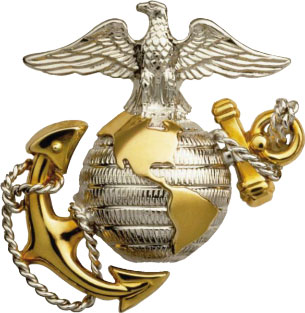
The ‘EGA’ of the Marine Corps, the Eagle, Globe, and Anchor emblem, has been the symbol of the US Marines for over 150 years. But its roots go back farther. From 1804, brass eagles adorned Marine uniforms, and from the War of 1812 the eagle was joined together with an anchor, drums, and flags. Then in November 1868 an Eagle, Globe, and Anchor ornament was prescribed and has been consistent ever since, although there have been minor changes in its design through the years.
The EGA for officers differs from that of enlisted Marines. The officers’ EGA is more ornate and shows more detail of the rope of the fouled anchor. Here is the officer EGA while my avatar is the enlisted EGA.
Anchors Aweigh, composed in 1906 by Charles A. Zimmermann with lyrics by Alfred Hart Miles, is the fight song of the United States Naval Academy. However, it is not the ‘official’ song of the United States Navy.
Weigh anchors is the order given for all ships to raise their anchors and be ready to move. Be ready to fight! When the anchors have been raised, the confirmation is given back, anchors weigh, and this means we are ready to go. We are ready to fight! We stand by for our next order.
The Army, Navy, and Marine Corps recently celebrated their 250th birthdays. Here are the founding dates of our service branches.
14 Jun 1775 — US Army
13 Oct 1775 — US Navy
10 Nov 1775 — US Marine Corps
04 Aug 1790 — US Coast Guard
18 Sep 1947 — US Air Force
20 Dec 2019 — US Space Force
At the annual Marine Corps Birthday Ball, we always play the Marine Corps Hymn. Immediately preceding the Marine Corps Hymn, Anchors Aweigh is played. We all stand at attention for both.
Here is a picture from this year’s birthday ball ceremony, and one of our birthday cake, and one of my wife and me.


The official song of the US Navy is “Eternal Father, Strong to Save” and it is often referred to as “The Navy Hymn”.
Happy 250th birthday to all Marines past, present, and future!
Semper Fidelis,
@Bullitt, Gunnery Sergeant, retired
Many thanks for your service to this great republic, Bullitt.
In play:
The insignia of the U.S. Marine Corps during the Civil War was not the justly-renowned but later-adopted Eagle, Globe and Anchor, but a hunting horn with a stylized “M.”
Captain America: Civil War was a 2016 film, part of the Marvel Cinematic Universe. Set in the aftermath of the film Avengers: Age of Ultron, the film pits two factions of the Avengers, and their allies, against each other, over the prospect of greater governmental control over superhero activities, while also depicting Steve Rogers’ (Captain America) efforts to help his childhood friend, Bucky Barnes (Winter Soldier) escape the brainwashing which had made him into an assassin for Hydra.
In Greek mythology, the Lernaean Hydra was a many-headed serpent which was destroyed by Heracles in the second of his Twelve Labors, assigned by Zeus for Heracles to accomplish for his crimes against humanity.
The constellation Hydra, the water snake, is the largest and longest of the 88 modern constellations. Its length is over 100°, whereas for comparison the length of the Big Dipper is about 25°. For us in the northern hemisphere, Hydra is low in the sky — it straddles the celestial equator and is near Virgo, Cancer, Libra, and Leo.
Thank you, sir.
Hydra was the second studio album by the American rock band Toto, released in October of 1979.
Though it was not as popular as the band’s eponymous first album, the single “99” – a love song inspired by George Lucas’s first film, THX 1138 – reached #26 on the Billboard Hot 100 chart.
In the early 1980s, members of the band Toto told the press that the band was named after Toto the dog from The Wizard of Oz.
In 1995, author Charles Savage wrote an article describing a purported connection between The Wizard of Oz and Pink Floyd’s The Dark Side of the Moon. Savage claimed if you watched the movie, sound off, and listened to the full album, the music and images would synchronize themselves.
Pink Floyd band members dismissed the claim, and the album’s engineer Alan Parsons swore there was no connection between the movie and the record. In a jest, drummer Nick Mason suggested that the band was actually trying to sync up with The Sound of Music.
In the early hours of February 3, 1959, a Beechcraft Bonanza aircraft carrying Buddy Holly, Ritchie Valens, and The Big Bopper, who had been performing at the Surf Ballroom in Clear Lake, Iowa took off from the local runway in nearby Mason City, on its way to the next show in Moorhead, Minnesota. The plane crashed soon after take off, killing everyone aboard including the 21-year old pilot Roger Peterson. The event was later eulogized by folk singer Don McLean in his 1971 song “American Pie”, which led to the crash being nicknamed “The Day the Music Died”.
The given name of The Big Bopper was Jiles Perry Richardson, Jr. Born in East Texas, Richardson began his show business career as a disc jockey, but soon discovered success as a songwriter. His most famous compositions include Chantilly Lace, Running Bear, and White Lightning.
Robert Weston Smith was an American disc jockey who began his career in Newport News, VA, in 1960. He called himself “Daddy Jules” before moving to a country music station in Shreveport, LA, and called himself “Big Smith with the Records.” After listening to Cleveland disc jockey Alan Freed, who was known as “Moon Dog”, Smith took the name “Wolfman Jack” as his on-air personality.
“Clap for the Wolfman” is a 1974 song by the Canadian rock group The Guess Who. It is an homage to the legendary radio DJ Wolfman Jack, who provided spoken-word patter, in his DJ persona, throughout the song. It was the final song by The Guess Who to reach the top 10 in the U.S. and in their native Canada.
Robert Weston Smith AKA Wolfman Jack was just 57 when he died of a heart attack at his home in Belvidere, North Carolina, on July 1, 1995.
Wolfman Jack died in 1995, just after returning from a promotional tour for his autobiography. Born Robert Weston Smith in Brooklyn NY in 1938, he began developing his famous persona as “Wolfman Jack” in Shreveport LA at the young age of 24. It was a nickname given to him because of his eyebrows. He was inspired by the “wolfman” character and the music of bluesman Howlin’ Wolf, Chester Arthur Burnett (from Mississippi, 1910 – 1976). In 1963 he moved to the Mexican border station XERF-AM in Ciudad Acuña, Coahuila MEX, a stone’s throw across the Rio Grande River from Del Rio TX, which allowed him to broadcast at high power and reach a massive audience across North America.
Wolfman Jack was only 57 when he died of a heart attack in his house in Belvidere NC. As @Elendil_s_Heir just posted. He is buried at a family cemetery in Belvidere NC.
His gravesite is marked on Google Maps, near Drinking Hole Road and about 50 yards north of the road spot at these DD coordinates ▲ 36.2683, -76.5473. Paste those numbers into the map and it should take you right there. Include the comma and minus sign. Or click this Google Maps link:
Wolfman Jack appeared as himself seven times in films and on TV, including, perhaps most notably, American Graffiti.