Accounts vary as to why Gene Roddenberry was forced to replace Majel Barrett in the role of the first officer in Star Trek after the production of the first pilot episode for the series.
Roddenberry usually claimed that NBC forced the issue, as they didn’t think that audiences would accept a female character in a leadership position.
However, Herb Solow and Robert H. Justman (other executives involved in the series) have indicated that this was not the truth: they related that NBC, which prided itself on being progressive, was, in fact, in favor of a female lead, and that Roddenberry fabricated his story to cover up the fact that Barrett was rejected because she wasn’t seen as a strong actress, and that the network believed that Roddenberry (who was married, but a very-well-known serial cheater) had given the large role to his then-mistress.
Roddenberry complied by removing Barrett from the show’s main cast, but then snuck her back into the series, by putting her in a blonde wig and recasting her as Christine Chapel. This nearly led to both Roddenberry and Barrett nearly being fired from the series by Desliu head Lucille Ball: not only did Ball dislike nepotism, but when she learned that Barrett was Roddenberry’s mistress, she was incensed (as her own marriage, to Desi Arnaz, had failed in large part due to his philandering). Solow and other members of the production team were able to dissuade Ball from firing the duo.
Actually, it’s opposite Christopher Pike, played by Jeffrey Hunter.
kenobi makes excellent points, fleshing out Barrett’s reasons for being dropped after appearing in the first pilot episode. I’ll add that Number One, in TOS, is also named Una Chin-Riley in canonical books; she is rumored to be enamored with, or crushing on, Captain Pike, although she never gives in to her desires (sorry shippers!). In Star Trek: Discovery Number One/Una Chan-Riley is played by Rebecca Romijn.
(Rebecca Romijn also currently plays Una on Star Trek: Strange New Worlds. )
In play:
In the Marvel Comics X-Men books, the character Mystique is a mutant shapeshifter, with the ability to perfectly mimic the appearance and voice of any human or humanoid, including their clothing. In her “natural” form, she appears as a humanoid female, with dark blue skin, yellow eyes, and red hair.
Mystique is a skilled terrorist, infiltrator, and assassin, which has typically put her at odds with the X-Men and other heroic mutants.
In the motion picture adaptations of the X-Men, Mystique has been played by Rebecca Romijn and Jennifer Lawrence.
Jennifer Lawrence is, apparenlty, quite the slob. She annoyed the Wardrobe Department during filming of American Hustle by snacking on Cool Ranch Doritos, getting dust all over her white dresses and forcing the producers to make several copies. She also earned the nickname “Katpiss Neverclean” on the set of the The Hunger Games, showing up to work in the same blood and scar makeup that she’d worn the day before.
In the early 1960s, the chips product that eventually became Doritos was initially made at Disneyland. As they became popular, Doritos were released nationwide in 1966 and became the very first tortilla chip to be launched nationally in the US.
Per Wiki, “Disneyland has had a larger cumulative attendance than any other theme park in the world, with 757 million visits since it opened (as of December 2021). In 2024, the park saw 17.33 million visitors, making it the second most visited amusement park in the world that year, behind Magic Kingdom, the very park it inspired.”
Club 33 is a private dining club located in various Disney locations. First opened at the Disneyland amusement park in California in 1967; in 2025 the initiation fee was $65,000, followed by an annual due of $20,625.
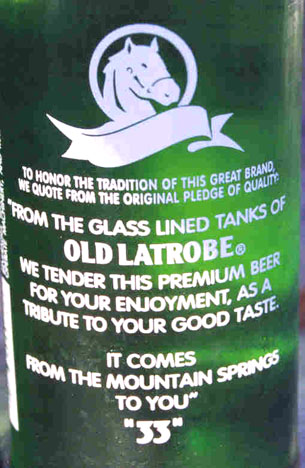
Bottles of Rolling Rock Beer feature the number 33 on the label; the reason for this has been shrouded in mystery, and the brewery itself has never provided a definitive explanation.
Popular theories include:
It symbolizes the year in which Prohibition ended in the United States (1933).
33 is the number of words in Rolling Rock’s “Pledge of Quality,” which also appears on every label: “Rolling Rock from glass lined tanks in the Laurel Highlands. We tender this premium beer for your enjoyment as a tribute to your good taste. It comes from the mountain springs to you.”
It was originally the result of a printer’s error, which the brewery decided to retain.
The topic was the subject of an early Straight Dope article, in October of 1986.
Henry Weinhard’s Private Reserve beer bottles had bottling numbers on their labels. They were brewed in Portland OR since the 1860s, until 1999 when the beer was sold to the Miller Brewing Company.
The first commercially successful beer can was produced by the American Can Company, which developed the technology for a pressurized can with a liner that prevented beer from reacting with the metal. The can was utilized by the Gottfried Krueger Brewing Company of Newark, New Jersey in a trial run in 1935, and was well received by consumers, with an approval rating of 91%.
Those first beer cans were made of heavy steel, required a special opener, and weighed about 4 ounces. Today, almost 100 years later, beer cans are made of aluminum and typically weigh about ½ ounce. A standard 12-ounce glass beer bottle typically weighs about 7 ounces.
The special opener (mentioned in previous post) is called a “church key.” Initially designed to open bottles by removing the cap, or crown, these tools resembled true church keys at the time. When steel cans of beer were sold, a different type of opener was manufactured for this purpose:
The church key name stuck, even though this looks nothing like a real key.
There once was a brewing company founded in Seattle in 2012 named the Churchkey Can Company. Churchkey beer was sold in 12 ounce steel cans (recyclable) that required a church key to open which, though gimmicky, did not endear themselves to potential customers. By 2018 the Churchkey Can Company was out of business.
Who in their infinite wisdom thought that was a good idea???
The phrase “poor as a church mouse” originated because churches have historically been associated with simplicity, modesty and humility; plus at one time churches were infested with rats and mice. Of course, when you think about it, a mouse that gets into a church is likely living high on the hog. It’s warm, he has access to fresh water, there are crumbs aplenty to be found, and if he’s lucky, he might get into the sacramental wine.
“Ben and Me”, an animated Disney short from 1953, paired historical figure Benjamin Franklin with a churchmouse names Amos. According to the cartoon, Amos was heavily involved in the rise of Franklin’s newspaper, the Pennsylvania Gazette, the invention of bifocals and the Franklin Stove, the discovery of electricity, and his own contract with Ben Franklin became the inspiration for Thomas Jefferson’s prose in the Declaration of Independence.
Robert Lawson was an American author and artist, who most notably worked in children’s literature. Books which he authored and illustrated included Ben and Me, They Were Good and Strong (a non-fiction book, about his family’s history), and Rabbit Hill. Lawson also illustrated children’s books by other authors, including The Story of Ferdinand and Mr. Popper’s Penguins.
Both Ben and Me and The Story of Ferdinand were adapted into animated shorts by Walt Disney. Lawson was one of the few creators to have won two of the most prestigious awards for children’s literature: the Newberry Medal (for writing) and the Caldecott Medal (for illustration).
Ben, a 1972 sequel to Willard, tells the story of the leader of a pack of rats who befriends a young boy. The movie was a box office flop but the title track reached number one on the Billboard Hot 100 chart. The song, written by Don Black, was first offered to Donny Osmond but he was on tour; Black then offered it to twelve-year old Michael Jackson, making it Jackson’s first number one single in the US as a solo artist.
Cilla Black was a British pop singer who was managed by Brian Epstein (at the urging of John Lennon). She eventually succeeded under the production of George Martin, and Lennon-McCartney wrote two hit songs for her.
Numerous people have been referred to by the informal title “the fifth Beatle,” including (but not limited to):
Stuart Sutcliffe, the band’s first bassist, who departed the group when they moved back to Liverpool from Hamburg in 1961
Pete Best, the band’s first drummer, who was fired from the group in 1962, and replaced by Ringo Starr
Brian Epstein, the band’s first manager, who helped them achieve their initial successes, until his sudden death in 1967
George Martin, who produced most of the band’s recordings
Neil Aspinall, the group’s road manager, replacement manager after Epstein’s death, and occasional backing musician
Billy Preston, who played keyboards on a number of tracks on the Abbey Road and Let it Be albums, including “Get Back”
Klaus Voorman, who played bass for the band after Sutcliffe’s departure, created the artwork for the Revolver album, and was considered for the band when Paul McCartney quit
Paul McCartney’s mother, Mary Patricia (née Mohin), died in 1956 of an embolism as a complication of surgery for breast cancer when Paul was only 14. Years later Paul would have a dream of her where she told him to ‘let it be’. This became the inspiration of the song by that name and its message of peace.
When I find myself in times of trouble, Mother Mary comes to me Speaking words of wisdom, let it be And in my hour of darkness she is standing right in front of me Speaking words of wisdom, let it be
 )
)