There is a Bob Ross Chia Pet. The first “Chia Pet” was a man, called “Chia Guy.” The “Chia Ram” was the first one to become popular on the TV ads. The chia plant is Salvia hispanica, and is from Mexico.
The Pet Rock was a novelty gift/toy: a small, actual rock, packaged in a cardboard box styled to look like a pet carrier (complete with ventilation holes), and with straw bedding. Invented by a California advertising copy editor, Gary Dahl, the humorous premise was that, unlike living pets, the Pet Rock did not need food, would never make a mess, and would never get sick or die. Dahl introduced the Pet Rock in August of 1975, and it immediately became a sensation; though the fad only lasted a few months, it was enough to make Dahl a millionaire.

In 1961 author Roald Dahl hosted “Way Out”, a sci/fi and horror anthology series on CBS. Dahl also wrote several episodes. The show was intended to be a companion to writer (and host) Rod Serling’s “The Twilight Zone” series (also on CBS), following the cancellation of a talk show hosted by Jackie Gleason.
From his Wiki bio:
[As a child,] Rod [Serling] would often ask [his parents and older brother] questions without waiting for their answers. On an hour trip from Binghamton to Syracuse, the rest of the family remained silent to see if Rod would notice their lack of participation. He did not, and he talked nonstop through the entire car ride.
The B.C. Open was a tournament on the PGA men’s tour, played in the Binghamton, New York area, from 1971 to 2006. The name came from Broome County (the county in which it was played), as well as from the newspaper comic strip B.C., which was drawn by local native Johnny Hart; characters from the comic strip were frequently used in promotional materials for the tournament.
In 2016 Berkeley Breathed, creator of the comic strip Bloom County revealed that Harper Lee, author of “To Kill a Mockingbird” had written him to plead never to kill off Opus the Penguin. Breathed had ended his daily strip in 1989, but continued to include infrequent appearances of both Opus and Bill the Cat in the Sunday Outland comic strip.
Harper Lee was able to write “To Kill a Mockingbird” thanks to the generosity of some friends, who pooled their money and gave her a Christmas gift that amounted to a year off from work so she could write her Great American Novel. As soon as “To Kill a Mockingbird” was published, she was loaded. However, her success brought immense pressure, and she fiercely guarded her privacy, and wrote very little. And despite being stupid rich, she lived modestly and gave most of her money to charity.
In the Forgotten Realms – a campaign setting for the Dungeons & Dragons fantasy role-playing game, as well as the setting for numerous fantasy novels – the Harpers are a semi-secret organization, which is dedicated to protecting the downtrodden, fighting against evil, maintaining peace, and preserving knowledge. They are seen by some as idealists, and by others as insufferable meddlers.
Prominent members of the Harpers have included the famous wizard Elminster, and several of the daughters of Mystra, the goddess of magic, including Storm Silverhand and Dove Falconhand.
Harper Islands is a small island group that is part of the Baffin Island group north of Quebec and near Baffin Bay and the Northwestern Passages, near the entrance to Hudson Strait which leads to Hudson Bay, and at the confluence of Frobisher Bay and the Labrador Sea, in Nunavut.
There was a fictional TV series called Harper’s Island that was set on a fictional Harper’s Island, but that was not the remote and very cold Harper Islands in Nunavut.
“Harper Valley PTA” is a country song written by Tom T. Hall and sung by Jeanie C. Riley in 1968. In it, the narrator (singer) tells of how the school’s PTA wrote a letter complaining about her daughter’s scandalous clothing, and how she should do a better job raising her; the narrator claps back, detailing the PTA’s own hypocrisies. The song was a huge hit, and inspired a movie and television series (both starring Barbara Eden as the main protagonist).
“Harper Valley PTA” is not the only song to inspire a movie; indeed, it’s not even the only Country & Western song to inspire a movie. Kenny Rogers’ “The Gambler” also became a movie a decade after “Harper Valley PTA.” “Alice’s Restaurant,” “Convoy,” and “The Night The Lights Went Out In Georgia” have all inspired movies as well.
One of the elements of Arlo Guthrie’s spoken-word song Alice’s Restaurant is a de-consecrated church in which Alice and her husband lived. As with many elements of the song, it was based in reality: Alice Brock and her husband Ray did, indeed, live in the former Trinity Church, in Great Barrington, Massachusetts.
Alice Brock sold the building shortly after the film adaptation, due to the amount of unwanted attention it was receiving; after passing through several owners, Guthrie himself purchased the building in 1991, and made it into the Guthrie Center, a non-denominational interfaith meeting place and music venue.
Arlo Guthrie’s City of New Orleans, a song released in 1972, describes a train ride from Chicago to New Orleans on the Illinois Central Railroad’s City of New Orleans in bittersweet and nostalgic terms. Willie Nelson also sang the song in 1984.
The song’s writer, Steve Goodman, randomly bumped into Guthrie in a Chicago bar and asked if he could play the song for him. Guthrie really didn’t want to hear it, but he grudgingly agreed only if Goodman bought him a beer, and Guthrie would only listen for as long as it took him to drink it.
Guthrie liked it enough and asked to record it. The song was a hit for Guthrie on his 1972 album Hobo’s Lullaby, reached #4 on the BillboardEasy Listening chart and #18 on the Hot 100; it would prove to be Guthrie’s only top-40 hit and one of only two he would have on the Hot 100.
Sometimes, you just gotta have a beer.
The USS Illinois and USS Kentucky would have been the fifth and sixth Iowa-class battleships, but their construction was halted before completion, as the U.S. Navy decided they were unneeded. They were broken up in 1958 and 1959, respectively.
The four Iowa-class battleships were reactivated and modernized in the 1980s. In 1991 during Operation Desert Storm the USS Missouri (BB-63) and USS Wisconsin (BB-64) both fired at Iraqi targets.
The USS Missouri (BB-63) sits at Pearl Harbor and has been a museum ship there since 1999. Its bell is in the Missouri State Museum in Jefferson City MO inside the state capitol on the ground floor of the building.
The Missouri town of Skidmore, a nothingburger town halfway between Kansas City and Nowhere, has been the site of some terrible tragedies. Back in the 1980s, a hateful and violent good ol’ boy named Ken McElroy terrorized the town, until one day when he was mysteriously shot dead. The mysterious murder happened in broad daylight in front of doznes of people, but nobody saw anything and the case remains unsolved. Then in 2004 a woman named Lisa Montgomery sliced open a pregnant woman to steal her baby, in the process killing her. She would later be the first Missouri woman to be executed in 70 years.
The Merchandise Mart Hall of Fame is a set of eight bronze busts, in front of the main (south) entrance to Chicago’s Merchandise Mart, which commemorate giants in the U.S. retail and merchandising industry.
The eight busts rest atop tall pillars, and were once jokingly referred to, by David Letterman, as the “PEZ Hall of Fame.” The men honored are:
- Marshall Field: founder of the Chicago department store chain which bore his name
- John Wanamaker: early advertising pioneer, and founder of Wanamaker’s, one of the first department stores
- Aaron Montgomery Ward: founder of Montgomery Ward & Co., a pioneering mail-order retailer
- Frank Winfield Woolworth: founder of the F.W. Woolworth “Five and Dime” variety-store chain
- Julius Rosenwald: longtime president of Sears, Roebuck & Company
- Robert E. Wood: longtime president and chairman of Sears, Roebuck & Company
- Edward Albert Filene: president of Filene’s department store
- George Huntington Hartford: longtime head of the Great Atlantic and Pacific Tea Company (A&P)

Lol they do look like giant PEZ dispensers!
In play:
PEZ was originally a peppermint candy, created in 1927 by Eduard Haas III in Austria. First introduced in small tins, the candy was not sold in dispensers until 1949.
The name PEZ comes from the German word for peppermint, “Pfefferminz” taking the P from the first letter, E from the middle letter and Z from the last letter to form the now iconic brand name PEZ; the German pronunciation sounds like “pets”.
The PEZ Museum in Burlingame CA was a quirky, privately owned attraction. Opened in 1995 by Gary and Nancy Doss who had been collecting dispensers for over 10 years, it featured nearly every PEZ dispenser ever sold. The collection featured a Wonder Woman dispenser autographed by Lynda Carter and a Garfield dispenser autographed by Jim Davis. However, from just before COVID hit the museum has been permanently closed.
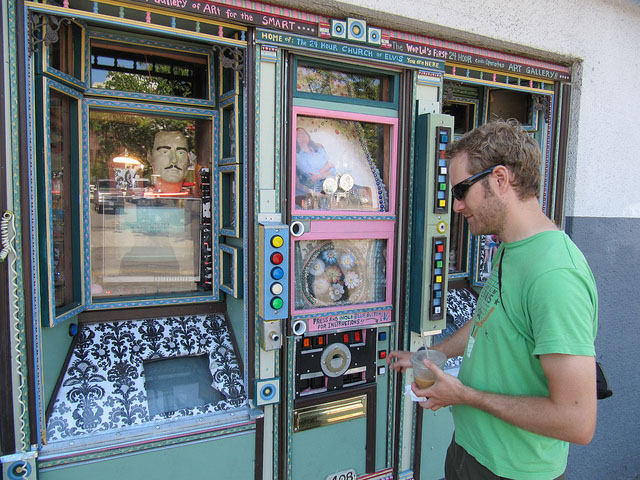
The 24 Hour Church of Elvis was a coin-operated storefront museum attraction operated by Stephanie Pierce and located in downtown Portland, Ore, from 1985 until 2013. For a quarter, visitors could hear a sermon by Elvis, confess their sins, receive the Elvis catechism, or get a photo with the King of Rock and Roll. Pierce also offered Elvis-themed wedding services, including legal weddings for $25, novelty weddings for $5, and coin-operated weddings for $1. In 1990, an Illinois radio station awarded an all-expenses paid trip to a Chicago couple to be married at the 24 Hour Church of Elvis. The ceremony was broadcast live to thousands of drive-time Chicago listeners.