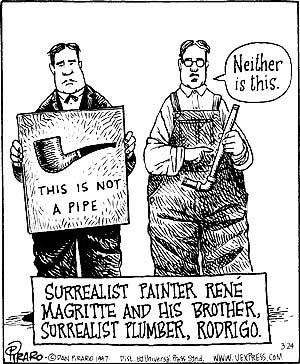
[QUOTE=wolf in second hand clothing]
Ceci n’est pas une pipe.
[/QUOTE]
What I came here to say.
But really, whether you’re staring at the real Scarlett or just an image of her, all that conceivably exists as far as you are concerned is a picture of her in your mind.
Plus, the computer screen won’t get upset at your ogling.
[QUOTE=Indistinguishable]
I don’t see fiat currency as particularly prone to worries about unreliable beliefs here.
[/QUOTE]
Even, I should say, of the intangible sort.
[QUOTE=Koxinga]
I think money is the most fantastic illusion of all. A medieval pope couldn’t dream of the incredible things that people would do in pursuit of something so wholly intangible. Not gold, and in 99% of cases not even anything as tangible as paper. There is nothing to justify any financial transaction you engage in, except shared belief.
[/QUOTE]
Actually, I doubt he’d find any difficulty understanding it. Money is valuable because people believe it’s valuable; just as gold is only valuable because people say it’s valuable. For that matter, given the kind of people who were often Popes, I suspect he’d really laugh at the idea of him not understanding the “incredible things that people would do in pursuit of something so wholly intangible”; since that’s how he got into power and made an awful lot of money.
[QUOTE=Indistinguishable]
Whether it’s cows or coins I’m forking over or being given, the question to me is the same: “Will I be able to use this to get the things I want?”. I don’t see fiat currency as particularly prone to worries about unreliable beliefs here.
[/QUOTE]
If you were forking over a cow, well, a cow’s a cow. But the thing about fiat currency is that shared belief is the only thing being transacted.
Imagine I’m a shopowner receiving your cow, and immediately after you leave, an electro-magnetic pulse hits my shop and causes me to fall down and bump my head so that I lose my memory and all my accounting software is fried. As I woozily get up and dust myself off, gee, I can’t seem to remember anything from the past half hour and look at my computer! But hey, here’s this cow, at least I can take it home.
Now imagine the same thing happens after I swipe your credit card. If the only value that has been transacted is stored in my memory and in the computer’s memory, then erasure of those memories means I no longer have faith that I’ve ended the day with more purchasing power than when I began.
And that’s just at the micro level. At the macro level, the only reason you and I have that purchasing power to begin with is that central banks and commercial banks have created it out of thin air.
I’m not worried at the moment about whether the money in my bank account will enable me to purchase the goods I need for the month. But I recognize that the only thing enabling me in this case is an exercise in shared belief.
Sure, if there were a massive computer failure, then currency stored in computers would suffer. So what? If there were a massive cow epidemic, then the computer currency would stay safe while the cows fell to pieces. Nothing’s safe from the specific stipulation that it’s somehow catastrophically destroyed. I don’t consider this a significant difference.
[QUOTE=Der Trihs]
Actually, I doubt he’d find any difficulty understanding it. Money is valuable because people believe it’s valuable; just as gold is only valuable because people say it’s valuable. For that matter, given the kind of people who were often Popes, I suspect he’d really laugh at the idea of him not understanding the “incredible things that people would do in pursuit of something so wholly intangible”; since that’s how he got into power and made an awful lot of money.
[/QUOTE]
But he could hardly tell everyone, “I can now use a bunch of money I didn’t have yesterday for no other reason than because I say so”, which is essentially what the Fed and commercial banks do every day (or at least every quarter).
[QUOTE=Indistinguishable]
Sure, if there were a massive computer failure, then currency stored in computers would suffer. So what? If there were a massive cow virus, then the computer currency would stay safe while the cows fell to pieces. Nothing’s safe from the specific stipulation that it’s somehow catastrophically destroyed.
[/QUOTE]
But the only thing about fiat currency is what’s contained in our minds, collectively and individually, and aided by computers to keep track of what we believe to be true.
[QUOTE=Indistinguishable]
Sure, if there were a massive computer failure, then currency stored in computers would suffer. So what? If there were a massive cow epidemic, then the computer currency would stay safe while the cows fell to pieces. Nothing’s safe from the specific stipulation that it’s somehow catastrophically destroyed. I don’t consider this a significant difference.
[/QUOTE]
Let me put it another way. If, say, there was some massive crisis of confidence in American currency, it’s value could crash and it would be worth little or nothing. Regardless of other people’s opinions of cows, you can still eat them and drink their milk. Steel will still be useful for making stuff, regardless of the market value of steel at the moment. Farmland will still grow crops even if there’s a depressed real estate market. And so on. Currency is just money; the other stuff is wealth.
Sure. But if I don’t personally particularly care for milk or beef, so cows are only good to me as a means to other ends, then I’ll still need confidence that other people will continue to exchange goods for my cows (some few souls may want cows for intrinsic worth, but most will, like me, just want them as means to another end). If I ever trade for something, not because I actually want it intrinsically, but because I want to be able to trade it off in turn for other things, then I’m still going to have this sort of problem. You might think it’s unlikely that currency which has some intrinsic worth to some few folks is unlikely to lose its trading worth to the rest of them; perhaps, I’m not sure. [Of course, I shouldn’t speak of “unlikely”, since “unlikely” clearly isn’t the metric of concern here, given that it’s also unlikely that American currency will turn worthless anytime soon]
Anyway, there’s no point arguing; it’s not as though we differ about the facts, just the perspective. So, whatever.
[QUOTE=Faruiza]
If I were Scarlett Johansson, I would probably get the willies from this thread.
[/QUOTE]
I may not be able to touch Scarlett Johansson, but I can certainly touch my willy.
[QUOTE=Koxinga]
I’m not worried at the moment about whether the money in my bank account will enable me to purchase the goods I need for the month. But I recognize that the only thing enabling me in this case is an exercise in shared belief.
[/QUOTE]
But this isn’t anything more fantastic than borrowing a book from your buddy and telling him you’ll pay him $10 for it next week. You’ve created that $10 out of thin air, on nothing more substantial than your promise to pay later.
Surely a Medieval Pope is familiar with the concept of “I do this favor for you. And someday, you will do a favor for me.”
[QUOTE=Lemur866]
But this isn’t anything more fantastic than borrowing a book from your buddy and telling him you’ll pay him $10 for it next week. You’ve created that $10 out of thin air, on nothing more substantial than your promise to pay later.
[/QUOTE]
No, I am not creating it out of thin air, because I have at least $10 in my bank account at the time (or my employer does). There is no net creation of money in this scenario. Fair enough, the medieval pope could promise gold or whatever, knowing that he has that much gold in his treasury (or his peasants do).
But at the macro level there is a very common net creation of “new” money, money that literally wasn’t there before, via the banking system. If there was any such system in place in medieval times, I’d be very interested to learn of it. And that’s what I mean when the pope would be flabbergasted by this exercise in collective faith in action–he would never have seen such a thing in his own times.
[QUOTE=Koxinga]
No, I am not creating it out of thin air, because I have at least $10 in my bank account at the time (or my employer does).
[/QUOTE]
Who says? Maybe you make the promise without having the money around yet, or even anyone already indebted to giving you that money. Maybe you make the promise just confident you’ll be able to get the money in time somehow, without actually having the source of such income fixed yet. Now your book-lending buddy thinks he has $10 coming to him, while simultaneously, whoever it is that will end up paying you in the future thinks he has $10 free to spend as he chooses; presto, you’ve created $20 out of $10.
[QUOTE=Indistinguishable]
Who says? Maybe you make the promise without having the money around yet, or even anyone already indebted to giving you that money. Maybe you make the promise just confident you’ll be able to get the money in time somehow, without actually having the source of such income fixed yet. Now your book-lending buddy thinks he has $10 coming to him, while simultaneously, whoever it is that will end up paying you in the future thinks he has $10 free to spend as he chooses; presto, you’ve created $20 out of $10.
[/QUOTE]
You’re really being whooshed by the point I’m making about the macroeconomy. Maybe somebody else can explain it to you better than I can. :shrug:
Well, I’m trying to say, and I think this is what Lemur866 was getting at too, that fractional reserve banking is something which is in line with, and naturally arises from, simply promising money you don’t have concretely “backed up”. It’s not some fundamentally different practice.
[QUOTE=Cervaise]
I may not be able to touch Scarlett Johansson, but I can certainly touch my willy.
[/QUOTE]
Nay, not even that… all you feel is willy’s outer-orbital electron repulsion. Yes, you repulse yourself. 
Now, Lobsang, what you should do is find yourself a group of first year of university students, and after softening them up with a few pints or tokes, lay this thread on them, specially your, Mangetout’s and AHunter3’s first posts. Watch them stare at the screen. 
And we start with Scarlett Johanssen and illusion v. reality and you people are going into monetary macroeconomics? Man, I love this place