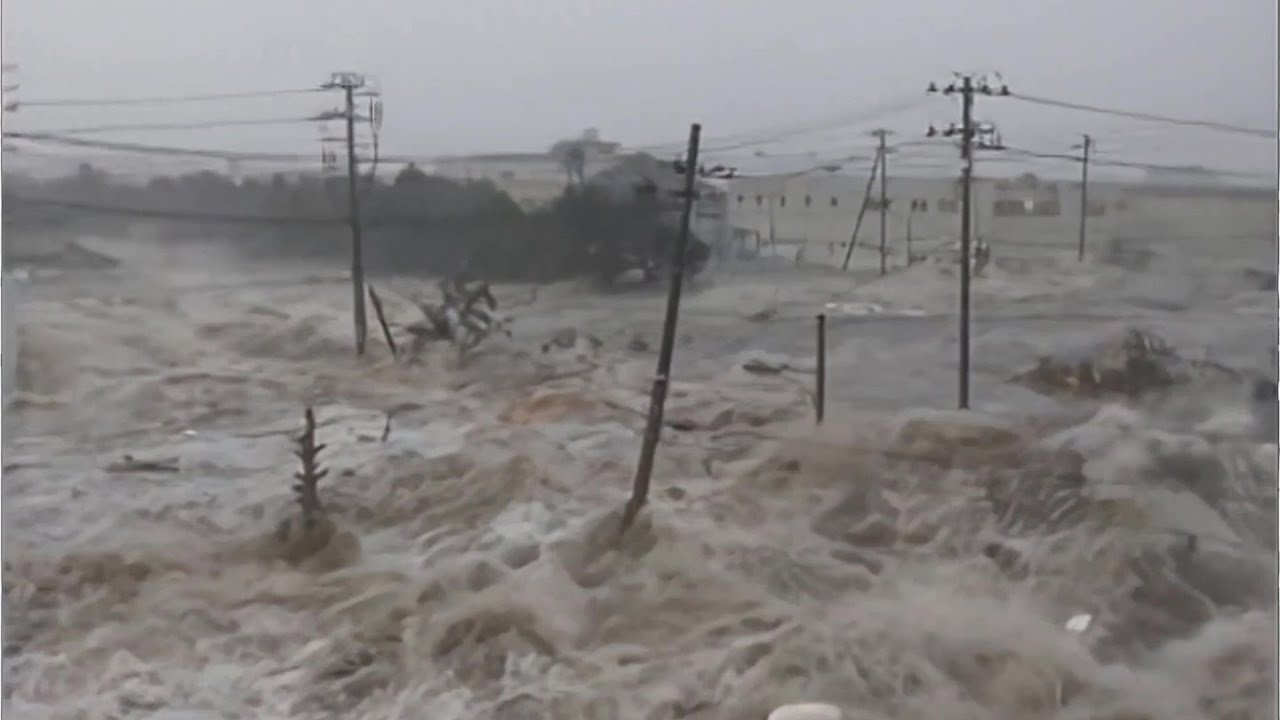
I’m no expert on tsunamis but its my understanding that they are a fast moving wave caused by an earthquake that passes through the ocean and then results in a huge powerful wall of water that is created and breaks when it gets close to shore.
Say you are a scuba diver far out in the ocean and are underwater when a tsunami wave passes. What would the diver experience? Would it be noticed? Would the wave cause physical damage? What about boats and ship on the surface? What is the effect on them?
There’s video from a Japanese ship riding over a tsunami from several years ago. It’s clear there’s something major going on, but it’s not nearly as dramatic as you might expect.
The tsunami only becomes a wall of water as the wave starts dragging the bottom - the bottom slows the wave down and it’s energy pushes the water higher than normal. The same effect is seen with regular ocean waves, but with a tsunami it’s much more water being displaced by a much stronger force. As with normal waves, a tsunami pulls water out before coming ashore - just watch any beach cam. Also, a tsunami is not necessarily one wave, but essentially the surface of the ocean rising temporarily in a specific location, then retreating.
As already said, the answer to both is “nothing”. Tsunami waves are extremely fast-moving but also extremely low amplitude and have a very large wavelength (potentially up to hundreds of miles) until they hit shallow water. Only then do they become a dangerous, mighty force.
Based on that video - a scuba diver might notice going up and down a bit.
Like mentioned, tsunamis like regular waves start to crest (rise and go tubular, etc) when they hit shallow water. If you recall the videos of damage in the Japanese massive earthquake, those waves mostly did not even break in the harbours like the classic movie giant wall of water with foam on top. It was more like a series of successive surges, often aggravated by the surge coming into a progressively narrower bay, and flowing over the sea walls.
as far as I understand it, a tsunami on a very shallow beach would just peter out (still flooding inland, but no parafernalic waves or so).
Since water cant compress, think of a tsunami as a huge sheetmetal plate that get pushed hard on one end, and eventually the push will come out at the other end of the sheetmetal (but delayed) … also, since there is a radiant component (potentially 360°), their force might (or might not) get spread out over a huge milage at the receiving end, e.g. the 4000km of Chile’s coast. The last 2 or so tsunami warnings we had, produced waves of 50cm, so well within “normal noise”.
You guys are ruining one of my favorite episodes of Xena. It’s actually called “Tsunami,” and it’s a riff on The Poseidon Adventure.
Xena and Gabrielle are on a medium-sized passenger/cargo vessel, and the eruption of Mt. Aetna causes a HUGE wall of water, which flips the boat over. It stays buoyant because of trapped air, but is sinking very slowly. Xena has to figure out how to get everyone back to the surface.
Great episode-- great visuals, great acting…you can suspend your disbelief.
It’s actually part of the plot that they had turned around and were heading for the nearest port, and when the boat is sinking, Xena does something to anchor it in one place.
They’re not suppose to be right by the shore-- they’re too far down to just lave the boat (or ship-- not sure), but not too far down for a MacGiver escape, and a swim to shore that leaves everyone alive, but a few of them passsed out, and everyone is breathing hard.
It’s not a spoiler to say that Xena and Gabrielle live, because you can infer that, but telling you Xena’s solution would be a spoiler.
I take it that a colossal wave like that near enough to the shore for an albeit-very-athletic person to swim in, still wouldn’t be quite that close.
But I don’t really know how seas and oceans drop off-- I don’t know whether someone could sink too far down to make it back up with out rigging something, and still rise up close enough to shore to swim for it.
As I.mentioned in another thread, I have a daughter who works on a cruise ship in Hawaii. She was working during the tsunami last August. The protocol is that ships in port head out to sea and ride it out away from shore. On that occasion, they knew approximately what time the waves would arrive and the Coast Guard ordered all ships out of port beforehand. They sailed at top speed out to sea in a direction away from the approaching waves and hung out there until the wave train had passed and they got the all-clear signal.
According to her it was a little rough but not unusually so.
In deep water, the wave is small but fast. In shallow water, it is slow but big. The really big ones are created by nine something earthquakes under water. The way the plates are interacting makes a big difference too.
After that 2004(?) boxing day Andaman tsunami, a scientist said “imagine when youre in a tub and you move or slink down, and the water gets pushed just the same… thats sort-of like the motion of a tsunami”. I’m paraphrasing but it was a good analogy.
When you have enormous scales in multiple measurements, volume, energy, motion, etc.. When scales meet….
If the earth scale is 1, the the human scale is -pico or femto.
A tsunami can also be caused by a large meteor strike. The potential size of such a tsunami is much larger than the ones caused by earthquakes, although such an event has not occurred in human history.
Tsunamis are also sometimes referred to as “tidal waves”, which is (IMHO) a better description. Instead of a wall of water, think of it as a HUGE tide that just keeps coming and coming and coming. Out in the ocean it’s barely noticeable, but when it gets in close to shore all of that water has to go somewhere, and the only way it can go is up, so it creates a huge wall of water.
Watch this video:
The video starts a bit inland, so you don’t see the huge wave at the shoreline, but notice how the water just slowly builds but keeps coming. It’s not a “big wave” with a short duration. It’s just a massive amount of water.