But at least in the PC gaming space, the public reception towards AI in games has generally been overwhelmingly negative, and that’s just when it’s used for inconsequential background textures and the such. Using them for NPCs would be technically relatively easy (if the situation allows a few seconds of lag) but culturally a pretty big faux pas that would probably piss off a lot of gamers and game devs/writers too.
In a homebrew D&D game, though? Sure, why not. I think many DMs are already using them flesh out backstories, create battlemats and avatars and such, etc.
This exists, Friends and Fables is an example of one. There are others, but that’s the one I used for a bit. It’s game ruleset aware (many support more than just D&D), handles movement on a virtual map, stores facts away in a long term memory system. Users can design their own campaigns and give worldbuilding lore, build character sheets with attributes, motivations, styles, etc. and the virtual AI DM will try to bring it all to life. And people can share them so you can in someone else’s world, use their characters, play their adventure, etc.
With some you can play either alone, with the AI playing all the other characters, or you can have multiple human players in a campaign.
It works pretty well over the short term but you can run into long term issues with memory / context window in a long campaign. It’s pretty excellent for a one shot and it’s way more creative and dynamic than something like an old style text adventure game.
I mean, what exactly is an .ASX file? Is it a different kind of slideshow (for which app to open)?
I’m just trying to understand what the AI is generating for you. I have never heard of this file format, and I can’t seem to find any information about it online?
A quick Google is telling me that it’s an XML file that acts as a container for images, video, or other media. Which sounds like a reasonable thing for an AI to create, and a good way to make infographics or the like.
If you mean the Windows Media container format (ASX Files), I don’t think that would make sense… it’s a metadata container, like a m3u8, that references other files. Even if the AI generated such a file, it would still have to point to the actual data somewhere else, or that the AI generated. I don’t think any of the modern, common presentation or graphics formats would fit in such a container, either.
It’s also ancient and obsolete, and unlikely to be used on an iPhone to begin with…?
So I’m pretty confused about whether @Dr_Paprika meant some other, lesser-known .ASX format, or if it was a typo, or if I’m just misunderstanding the whole thing…
My computer knowledge is not current. So let me give an example.
“Claude, tell me about the Zeitgeist of the United States. Include 100 bullet points including trends, socioeconomics, concisely why this is relevant ten years from now, relevant consequences as you deem fit. Organize into smaller groups. Make a scrollable .asx file, adding buttons so I can scroll forwards and backwards, and switch between your groups (such as “politics”, “environment”, “what no one is talking about”, etc. ). (Lets me run this data as “slide presentation” from my iPhone with no further downloads or actions
Huh, interesting… I entirely believe you (that it can do all that and generate a slideshow for you to view on an iPhone).
My guess is that it just goes “what the hell is an .ASX… I have no idea, but I can still follow the rest of the user’s instructions and make them a slideshow”. Then it outputs either a Claude artifact (a small webpage it publishes) or a Powerpoint/Keynote file.
That’s what it does for me, at least:
Then it actually does all that work and produces this artifact (which is pretty cool, granted!):
BTW, sorry, I wasn’t trying to nitpick you unnecessarily… I was just trying to understand what the heck .ASX was, thinking it was some newfangled presentation interchange format for AIs (which would be really cool, actually).
I guess. It organized my data with far more complexity and wisdom than that. But no graphics apart from simple things. Scrolling forward was built in without prompting.
Another time, it did an html file. Didn’t run; asked me to download to a separate folder and use browser. I said no, do it as an .asx file; then could run everything from within Claude with no additional work on my end.
(I didn’t ask it to build the .asx file, with each statistic in a different box, an intelligent colour scheme, etc. — it just did it once. And when it did other things for other data, I asked it to do that again, (including the prompt to split the file into smaller segments if it exceeds what my IPhone could run.)
Maybe your Claude learned a memory where “ASX” to you means that particular kind of slideshow, even though (as far as I can tell) it doesn’t correspond to anything in the real world. That’s cool… your own secret language with your AI!
Edit: In fact, what happens if you just ask it directly what an ASX file is, and where it learned that? Like “Claude, what is an ASX file? Is this part of your memory with me, or did you learn it elsewhere?”
(Or we can just drop this whole side thread if you prefer! No need to go down this rabbit hole unless you’re curious about it too. If not, let’s move on )
Sure, no rush, and no big deal. I did ask my Claude, but it doesn’t know either. It’s vaguely fascinating* because it might be some secret shared vocabulary you have with your local Claude that the other instances don’t know about. (just a hypothesis).
(* Edit: For context, it’s potentially fascinating/funny because in line with the OP, you might have discovered a way to force an unintentional shared belief upon your own Claude, like “When I say ASX, you make me an iPhone slideshow” — even though it’s prob not a real format, and doesn’t mean anything to anyone else’s Claude. Pretty cool if that’s actually what happened!)

 I entirely believe you (that it can do all that and generate a slideshow for you to view on an iPhone).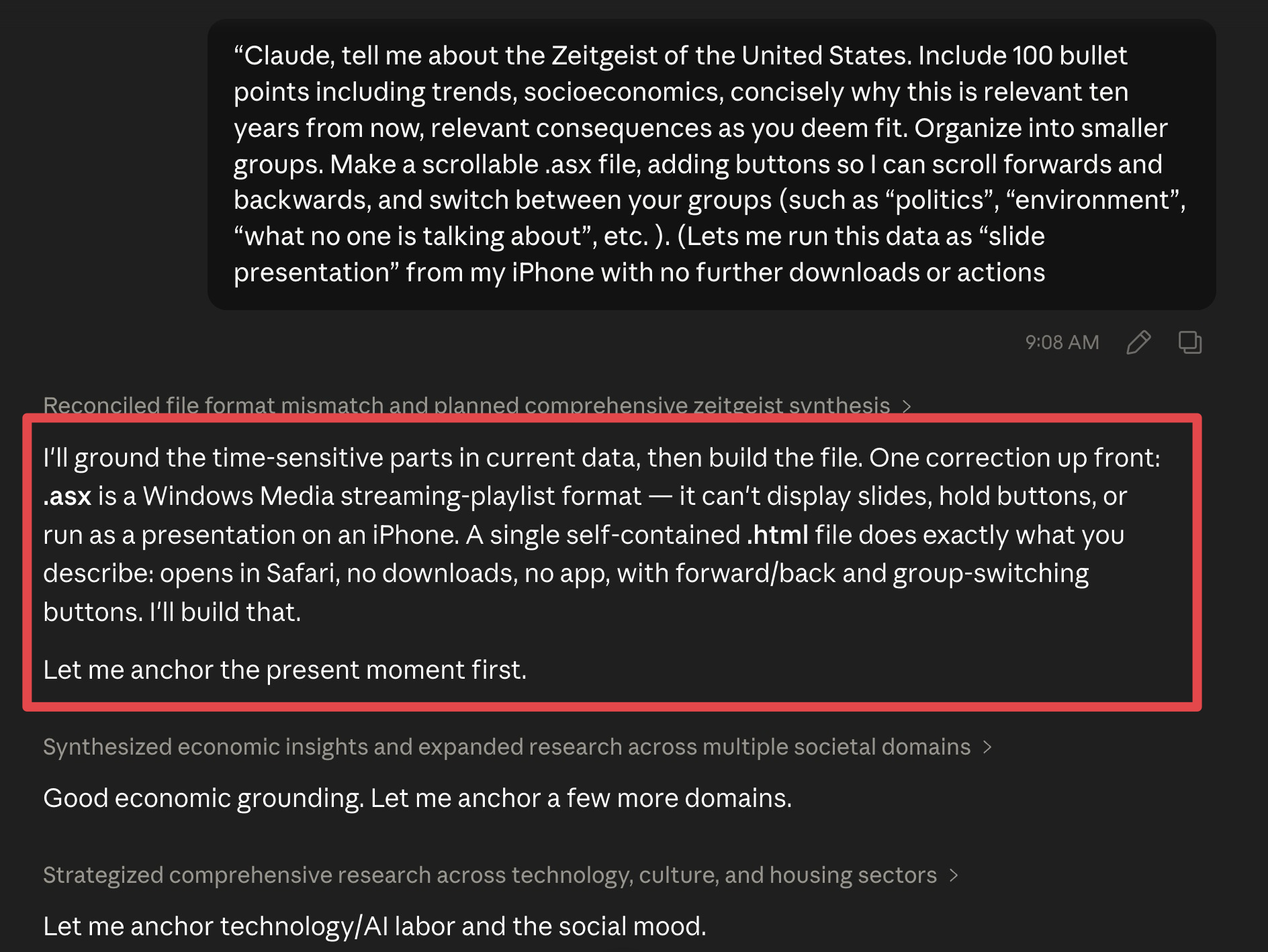
 )
)