It looks like someone has poked the wood with a nail. The hole is very clean and clear, if there was any steaming, soaking, bending, etc done, the dent was put there after all of that.
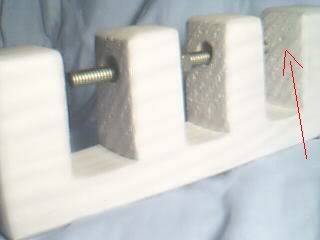
It looks like someone has poked the wood with a nail. The hole is very clean and clear, if there was any steaming, soaking, bending, etc done, the dent was put there after all of that.
In the same shop there were others with a pencil in place of the nut and bolt… In case that helps your train of thought 
If the puzzle is how was the contraption constructed, then it has essentially been answered. The wood was softened by soaking in water or by steaming. After the wood is pliable, the other parts of the puzzle are inserted. Then the wood is allowed to dry. This is definitely the answer because I knew a guy who made these puzzles and sold them on eBay. I have one of his puzzles in front of me right now.
You are now the third person to say that you know the answer because you’ve seen them made, or know someone who makes them… All three of those answers have been totally different.
If you are allowed to “break the rules” then there are many answers, and so far no one has given me one I hadn’t already thought of while it was sitting on my desk.
Your answer was the 2nd, of the 5 answers I came up with on the day I was given the puzzle.
All 5 could work, there are a lot of ways you could make this, if the problem was simply “how was this made” it would be easy to the point that there wouldn’t be much point thinking about it.
I can’t see how, “It takes 12 hours to make” is compatible with “any solid material”.
What part is “not bent, cut, glued, steamed, etc.”? And what is meant by, ‘etc.’? Was absolutely nothing done to it and it assembled itself by tidal forces?
I get the feeling you weren’t told the proper set-up, or you were outright lied to in order to make you think about it.
The “etc” was… what you see is what you get, the is nothing done to the materials that you can’t see (I think those were her words, if not it was something very much like that).
As logical as it would seem to agree with you, I want to be damn sure I can’t solve it before I will. Then, I’m not going to say “it’s a trick, you’ve told me something about it that can’t be true”, I’m going to say “I give up, I can’t solve the problem (that being, the pysical object plus the information you’ve given)”
Maybe the puzzle I was given, the object and the information, actually has no answer and cannot be solved, but if it does have an answer, I want to find it (and I thought you guys might enjoy doing the same).
A wizard did it.
Seriously, I give up, and demand the answer, NOW!
I believe it’s done in the same way you give an injection to someone who’s scared of needles.
You put the wood on the bench, and hide the bolt behind your back. With your other hand, point and say “whoa, check out the knotholes on that sexy little bit of pine”. While the wood is distracted, jam the bolt in. Voila.
Tevildo asked, "What’s the actual puzzle? “How do they get the bolt in there without cutting the ends off?”
You replied, “Yep, that’s pretty much it.”
You then say, in the post above, “All 5 could work, there are a lot of ways you could make this, if the problem was simply “how was this made” it would be easy to the point that there wouldn’t be much point thinking about it.”
Now, since how it is made cleary includes and subsumes “how do they get the bolt in there without cutting the ends off”, I’m feeling rather confused.
Could you restate just exactly what it is that you wish ‘solved’ here?
my only thought, which breaks the rules, is that the bolt is what is bent, inserted and then bent back. ok, lame idea since that wouldn’t work with a pencil, would it?
Yep, you’re right, I need to think more before I write.
Ok, if the things I have been told about it are true, then getting the bolt out without breaking anything is the aim.
If I was lied to and that is not possible, then they must have made it somehow. But if it doesn’t keep to the rules, it’s a pretty lame puzzle anyway.
What I want is a way to get the bolt out, without breaking anything, or changing the shape. That may or may not possible.
I believe it’s not possible, Jessica, as you phrase it. You say that three people have give three totally different answers as to how it’s made, but that’s not true: we’ve all said the same thing, only used slightly different words to say it.
How these puzzles are made is an established fact: This book looks like it’ll teach you. The question you appear to be asking is: what if these puzzles weren’t made in the way they were made?
Daniel
Gotta go with Lefty on this one. This is a red flag to me–
If it is not a physical problem, then the question of how it is done is meaningless.
After struggling for several hours with the puzzle as originally stated, I have concluded it’s a hoax. Several reasons:
If at first something looks impossible, that’s a puzzle. If after careful systematic study, jiggling around the bolt every which way, etc. it still looks impossible, well maybe it is. Geometry is geometry, and physics is physics.
That nut still bugs me. As stated above, smacks of magician’s misdirection. You’ve seen (or heard of) puzzles using pencils. Fair enough, but those aren’t mutually exclusive. And in any event doesn’t explain the nut.
The two middle “teeth” are almost exactly the width required to disable inspection of the entire length of the bolt. B - 2E = 12.2 cm, leaving 2.2 cm play for the 10 cm bolt. Thus, a two-piece bolt might have been glued or screwed together within the hole running through said 2.3 cm teeth and you wouldn’t be able to see the seam. Only reason this isn’t clinching is that I can’t tell without seeing it whether angling overcomes the handicap. OTOH, seeing a seam in a bolt right at the opening would be difficult. Especially if the two pieces screw together and were tool-and-died as part of the construction.
The twelve hour time estimate is fishy. Something this simple might take an hour in a woodworking shop. Twelve hours is either more magician’s banter or cloaks some violation of the rules. Or both.
Could I be wrong? Yup. But if I were gonna wager on it, that’s the side I’d take.
BTW, cain’t make nuthin’ out of the dent, either way.
I can think of an easy way to do it that doesn’t violate any of the stated rules, but it’s still a bit deceptive and doesn’t address the 12 hour time statement.
Just drill a hole in either of the ends, insert the threaded rod, including the nut, and plug the hole w/ a dowel. Done carefully, it could be nearly invisible and difficult to detect.
I don’t necessarily like my solution, but it’s viable.
BTW, I reject the steaming/soaking methods. The piece seems too short and thick for this, plus it would be extremely difficult to return it to it’s original shape w/o some sign of warping, or misalignment. To use these methods to repeatedly duplicate the puzzle seems highly impractical.
How about this rule–
Wouldn’t you have to cut it and glue it in order to place a dowel?
Steaming would not work with metal, ceramic, PVC, etc., and supposedly
Yeah, like I said, I don’t particularly like my solution. I guess you could make the case that drilling is not cutting and the dowel could be fit w/o glue, but you’d have to be very good at woodworking. Plugging the hole using other materials would be much more of a challenge. I was just trying to think of a simple way to do it deceptively, w/o actually lying.