I’m curious about the size of a vacuum we can currently maintain on earth. A 100’ by 100’ by 100’ room is a big room–a million cubic feet. Let’s compare to that. OK dopers,
what are some of the biggest rooms that we can maintain a vacuum in (that we can speak about, of course)?
I believe the biggest room in which we can maintain a vacuum will be a sphere.
This is alleged to be the world’s biggest vacuum chamber.
Wow, 800,000 cubic feet is huge! And what a great demonstration. Thanks much.
Not alleged; it is the largest thermal vacuum chamber in the world that can pull a vacuum to 10[SUP]-6[/SUP] torr (about 1.3x10[SUP]-9[/SUP] atm). You can see the facility in detail as the set of the opening (pre-title) sequence of the 2012 film The Avengers where the Tesseract is being examined when Loki shows up. (Actually most of the action takes place out in the high bay adjacent to the chamber, but you get a good view of the chamber as the ceiling starts to implode.) The “Joint Dark Energy Mission” banners hanging on the walls weren’t set dressing for the film, by the way; that is a real program, a joint effort between the Department of Defense and NASA. Alas, there is no helicopter pad or array of radiotelescopes just outside.
The same station (NASA Plum Brook Station, an adjunct of Glenn Reasearch Center) also has the world’s largest hypersonic wind tunnel (Hypersonic Tunnel Facility) and largest high altitude engine static fire chamber (in the Spacecraft Propulsion Facility) in which upper stage engines such as the Centaur and Delta Cryogenic Upper Stage are tested.
Stranger
Certainly alleged. And as it happens, those allegations are accurate. #Pedant 
“Vacuum” is relative, and depending on the application, 100 torr might be vacuum or 10[sup]-12[/sup] torr might be vacuum. There’s a huge range. The 10[sup]-6[/sup] torr of the SPF could be compared to the 10[sup]-11[/sup] torr – five orders of magnitude better – of the KATRIN experiment. (I don’t know if its 50,000 cubic feet is the largest volume at that pressure level, but it might be.)
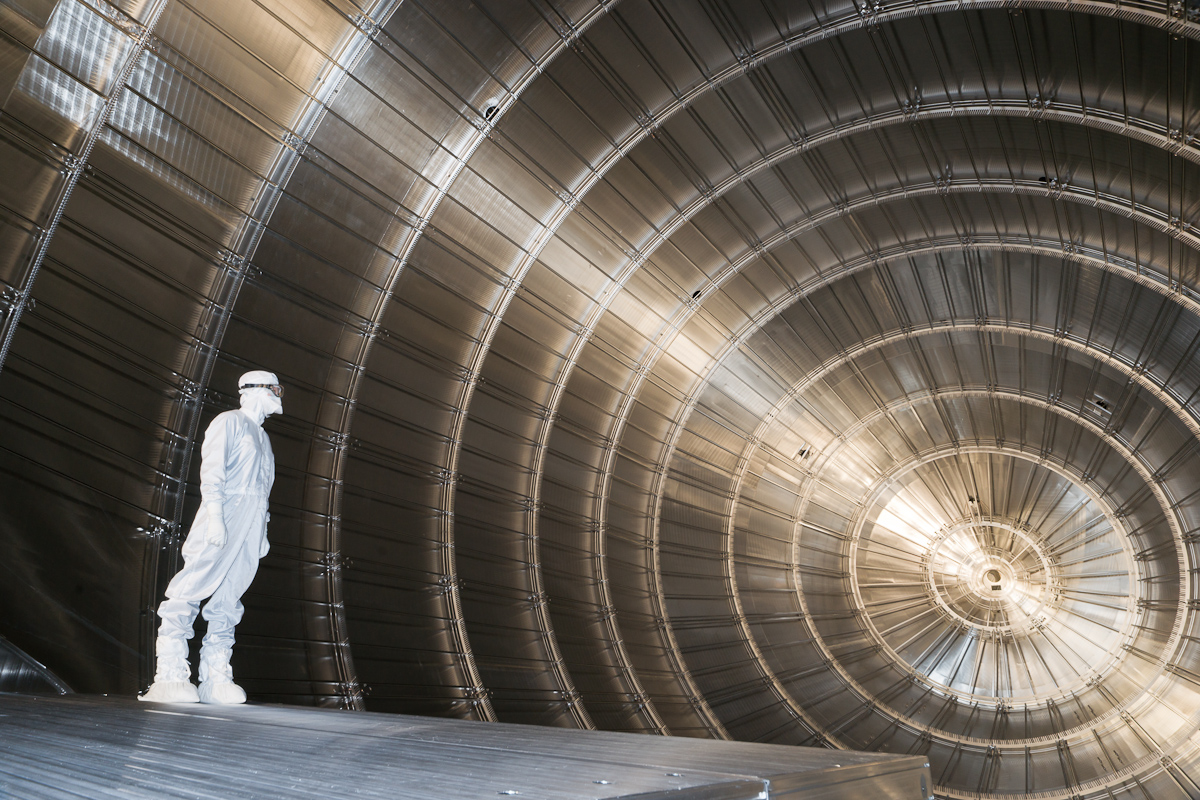
Notice that Brian Cox would not be allowed to walk around in the KATRIN spectrometer. The highest vacuums require very careful materials selection and treatment. As much as a hand smudge on the wall would destroy one’s ability to achieve desired pressure. To drive volatile chemicals out of the already very clean materials, the whole system must be baked-out at 350 degrees C. While baking out a vacuum chamber is standard practice when shooting for high vacuums, doing it for something this large is a challenge. For example, the axial length of the chamber grows by 8 inches when heated, so all of the systems connected on one end are designed to slide to and fro.
For reference, the pressure in deep space is 10[sup]-17[/sup] torr. In geosynchronous orbit around the Earth, it’s 10[sup]-11[/sup] torr.