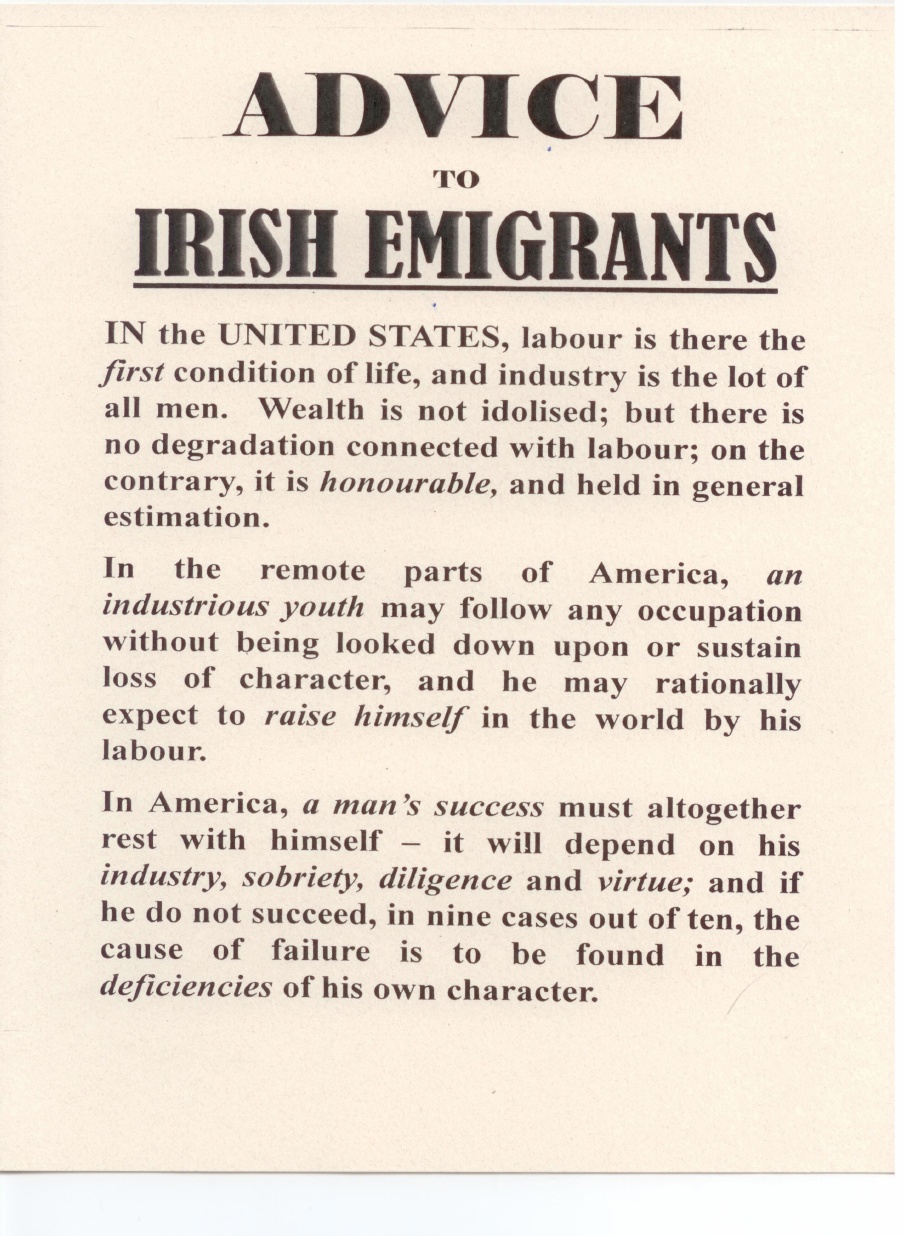
First off I assume the document as presented is at the very least a reproduction, it looks too clean to be a scan of a document from that era. However, I also feel the text has too modern a feel to it. Can anyone shed light on this? Is it a reproduced/reset version of a real historical document? From googling I’ve found references to the poster from as far back as 2003.
Cool, someone else gave me that Dublin Weekly Register cite but hadn’t found anything more yet. With that preamble, it takes on more of an air of what I’d expect from that period. Thanks Giles.
The big robber-baron corporations of that day (generally, less regulated and far more crooked than the worst scumbag corporations of today) loved to print glowing advertisements to attract as many immigrants as possible, the better to bulk up the labor market and drive down wages. Sinclair tells of the fraudulent advertisements that big agricultural growers placed, to attract farm workers to California. The OP’s document looks like something that would fit into that mold.
ETA: OOPS! I’m conflating that in my mind with Grapes of Wrath by Steinbeck, which told of the come-to-California ads. I suggest that BOTH of these books are MUST READS for every American. They are the response to the likes of Rand Paul.
The railroads did the same thing in the 19th century. The government rewarded them with large amounts of land next to their routes that they could sell off. The problem was that these routes went through the middle of literal nowhere, and nobody wanted to buy the land. So they advertised the bountiful largess of the land throughout Europe. The ads became colored brochures with extravagant prose. They’d sell the immigrant a wildly cheap one-way ticket to the middle of Nebraskaor somesuch. A whole train would get to a station and see nothingness in all directions, but the ticket to return would be more than their life’s savings. So they’d start a village and farms and dig up the sod. And die off in the winter. But most survived.
It wasn’t original to the railroads either - you can find colonial examples - but they had more land and more money than anybody else and invented many of the techniques used later on.
The railroads, of course, being among the big crooked robber-baron corporations I alluded to above, along with the oil barons, steel barons, and agricultural barons. Among all the others too.
Suggested reading: Iron Wheels and Broken Men by Richard O’Connor. With any luck, maybe you can find it in your library, or the librarian can find a library to order it from. It tells all those stories that Exapno Mapcase mentions, and many others.
Here was a goody: Most people in the East, including Congresscritters, didn’t know much about Western Geography in those days. But they knew there were big mountains in the way. So they granted the railroads more land (that is, more money they could make) for the miles that they had to build rails through the mountains, versus miles on the plains. So the Western Pacific railroad (which build the Western extents of the transcontinental railroad; forerunner to the Southern Pacific R.R.) provided false maps, showing the western slopes of the Sierras farther west toward Sacramento than they really were, so they got more mountain-building benefits. Thus, they became known as The Men Who Could Move Mountains.
ETA: Those hordes of immigrants and Easterners who got dropped off in the middle of nowhere were really up shit creek too. With nary a tree in sight from horizon to horizon, what were they going to build houses out of before winter? They had to build “sod houses” from mud to live in, that’s what.
I singled out the railroads because they were a generation earlier than most of the others, and got to pioneer most of the techniques that the others [del]adopted[/del] stole.
The Great Plains were hell for men but heaven for railroads because of their endless flatness. Railroads mostly couldn’t handle a grade of more than 3% in those days, so even a small hill required more track over much worse conditions. The Rockies were thought to be impossible to cross – and that was without the 30 feet of snow that piled up in storms. (They worked all year long. Think about that.) Getting extra money for mountains is the one thing I don’t blame the railroads for. Not giving it proportionally to their workers, though, was a major crime. Although almost everything to do with their workers was a major crime.
That review certainly doesn’t say much of anything at all. But it sounds like he expects the book to glorify the railroads and the brave pioneering men who built them, as books by and for railroad buffs often do. He’s probably going to find the book isn’t what he expected. O’Connor definitely doesn’t glorify anything there. BTW, it’s an old book – I found it in a public library and read it about 25 years ago.
They also screwed over their investors. Here’s another classic corporate technique they used (and possibly developed): Creating allegedly independent corporations that they then hired to do the actual construction work. Did you know that the railroad companies didn’t actually build the railroads?
The directors owned only enough stock in their RR companies to maintain total corporate control. They created separate construction companies (with many of themselves, or their relatives and friends) as their directors, to do much of the actual work. Then they “negotiated” with these construction companies, and hired them to do the work at inflated rates. This siphoned profits away from the RR companies (and their investors) and towards the construction companies. Of course, the RR directors (or their cronies) were the major investors there too, so they got a big share of those profits, while the general public investors in the RR companies got the shaft.
FWIW someone at the National Library of Ireland confirmed earlier that it was a real contemporary article. Although the version that Ryan cited leaves out that the article is comparing prospects between the Canadas and the Western US for prospective immigrants.