In my town, they deliver it to your post office box and you have to go to the post office to pick it up. If it’s a parcel that is too big for the box, you have to go to to the window to pick it up. If the parcel is for someone else, you could just refuse to accept it and let the postmaster figure out what to do with it.
I have known people who can go six months to a year between trips to the mailbox. When one guy I know in one small town in New Mexico gets a jury notice, the postmaster calls him on the telephone to tell him so that he can come pick it up.
You used to be able to be able to get the full zip code and zip+4 directories on 9-track reels of magnetic tape to load in your own computers to do your own validation. The data set was free.
The zip code directory was on one tape and I could handle that. On the other hand, the entire zip+4 code directory took something like 95 9 track tapes.
I know that this system has caused some miss-deliveries to my address, because I was able to recreate the error. What happens is the person starts entering their address, but with a typo, and the autocomplete provides my address, which they uncritically accept.
On the whole, I think the automatic address completion is good, but the error condition is replacing a nonsense address with a perfectly valid, but incorrect, address.
95 9-track tapes from back in the day will hold about 8GB. The smallest thumbdrive Amazon sells will hold that. For $8.00 delivered tomorrow.
The modern API is a heck of a lot better because USPS is responsible for keeping the backing data up to date. You’re always querying the good stuff, not last year’s stale stuff.
We once lived in a two-mile square suburb with a Dogwood Lane, a Dogwood Terrace and a Dogwood Court. They were not adjacent; actually on opposite sides of the town. I have no idea what the developers (I’m told they get to pick the street names for new developments) were thinking. The regular mail carrier knew what went where but if he was out, there was no telling who got whose mail.
My husband ordered me a new bowling ball for Christmas. It got delivered to the wrong Dogwood address. The very nice people who lived there brought it by and dropped it off. Regular mail is one thing but personal delivery of a bowling ball was going above and beyond IMO.
We had a PDP-11/34 at the time. I don’t think the disk drive was larger than 100 or 150 megabytes.
There were different tape densities. On the PDP-11, there were 800 bits per inch and 1600 bits per inch. I am pretty sure that ours was 800 bits per inch. Total capacity of one tape was around 20 megabytes.
By the way, have you ever heard the term “bit juice”?
One interesting thing about the magnetic tapes was that you could read past the end of the tape, but it seemed like hardly anyone knew that.
At an engineering company I was working at, someone handed me a tape of a sample output set from a company that provided a service to several companies alike in the region. We were considering having them do the same service at the engineering company.
So one evening, I mounted the tape and read the tape to get the data and save it. Then, instead of rewinding and unmounting the tape, I read past the end of tape marks and found a list (the first part was obvoiusly cut out, but not a much of it) of every customer they had in the region including the business name, the manager’s name, the business address, the business telephone number, and the number of employees at the business.
From then on, when I needed to send a tape to someone, I would first write over the entire tape with random patterns, rewind it, and then copy the files to the tape that I needed to send.
Oh yeah, tape reuse was a thing. As was inadvertent data disclosure.
I was assuming the 9-track takes you were talking about were IBM mainframe tapes. Which I worked with back in the day.
These improved from 200-ish BPI to 800 to 1600 to eventually a whopping 6250 bytes per inch! 75KB per foot of tape! Woot!1!
And came in a 1600 foot length on a single reel that could theoretically hold 120MB. But the inter-record and inter-dataset gaps wasted a good 20%-30% of the length of every tape; the shorter the records the worse the wastage. So 100MB was a decent but optimisitc rule of thumb for per-tape capacity.
I ordered some Firefly memorabilia and got two of them about a week apart. Since it was $75 I emailed them what happened and got an “Eh, keep it” reply. I sent back I didn’t really need two of them then added we were going to have our CSTS in a month and we have a raffle. I can add it as a raffle prize. Here is our 501c certification, perhaps you can get a tax write-off. They said that would be wonderful.
Whoever named the housing estate I live in should be forced to personally redeliver or compensate for all the misdelivered parcels.
Every single street begins with the same 3 letters, including a whole lot of duplicated variants with [name] court, [name] drive, [name] road, [name] crescent for multiple [name]s. The actual posties have it sorted, but I get lots of random delivery attempts for food and things.
On the plus side, as they had to make up some of the names to fit the silly concept, many of the street names are nationally or globally unique, so very easy to find on pretty much any database.
When my oldest brother was in college in the early 60s, they had these record clubs you could join. You would get some of them free in exchange for promising to buy some additional number during the next year.
I don’t know if there was a dorm post office or if they got together and rented a box for that purpose, but using fake names they signed up for all the record clubs they could and got the free records. Then they just ignored the box. I remember someone saying that some employee got tired of the overflowing mailbox so they started stamping everything to that mailbox with a stamp that read “Deceased. Return to sender”.
I guess it’s safe to tell that now since the employee involved, if alive, would have to be well over 100 by now.
Filling out a form that says, “i moved” for someone else is fraud. But saying, “not at this address” is routine, legal, and what the post office wants when something is misdelivered. There ought to be a way to file a persistent note at the post office that says, “not at this address” and maybe even “(at that address)”.
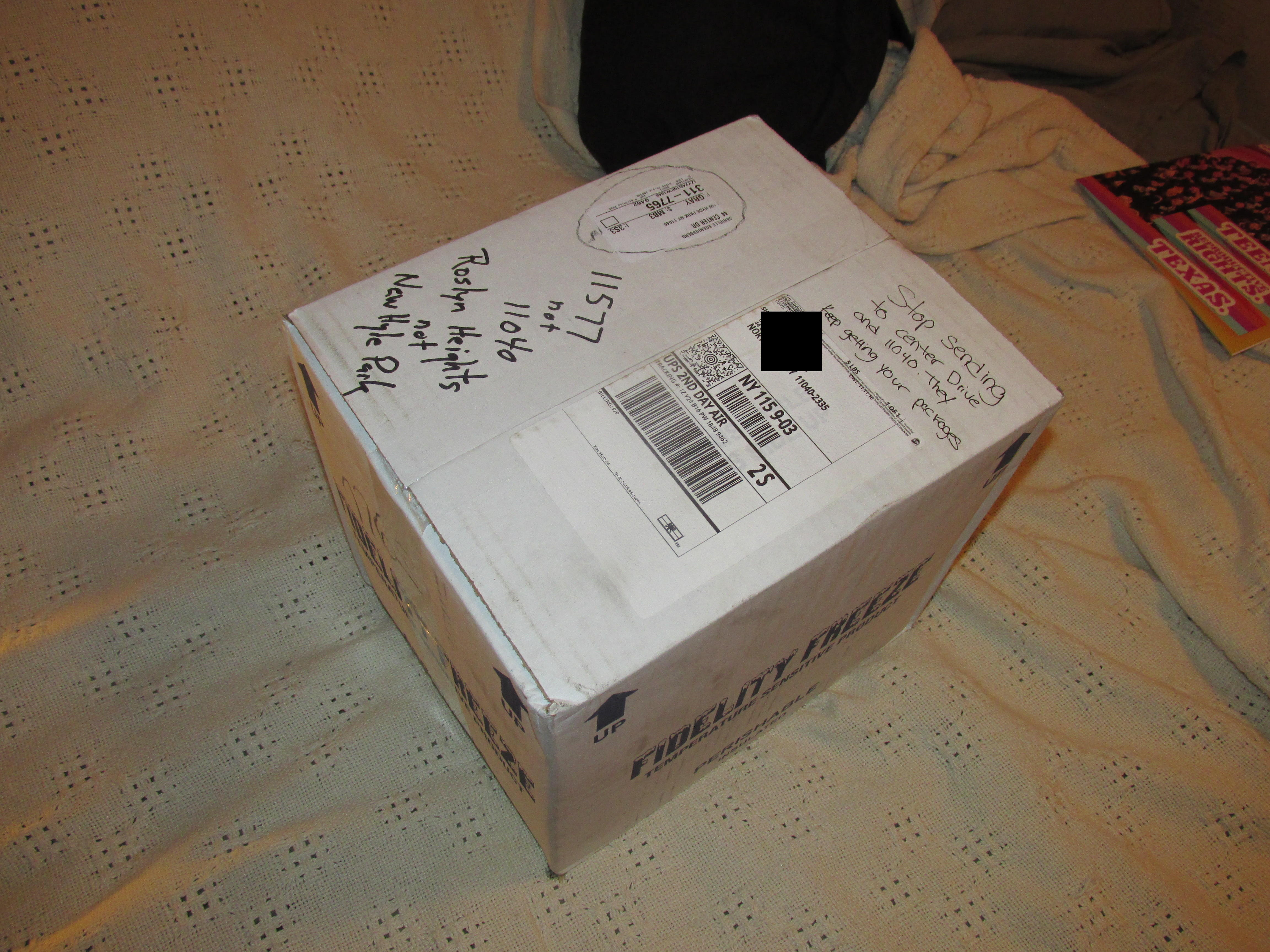
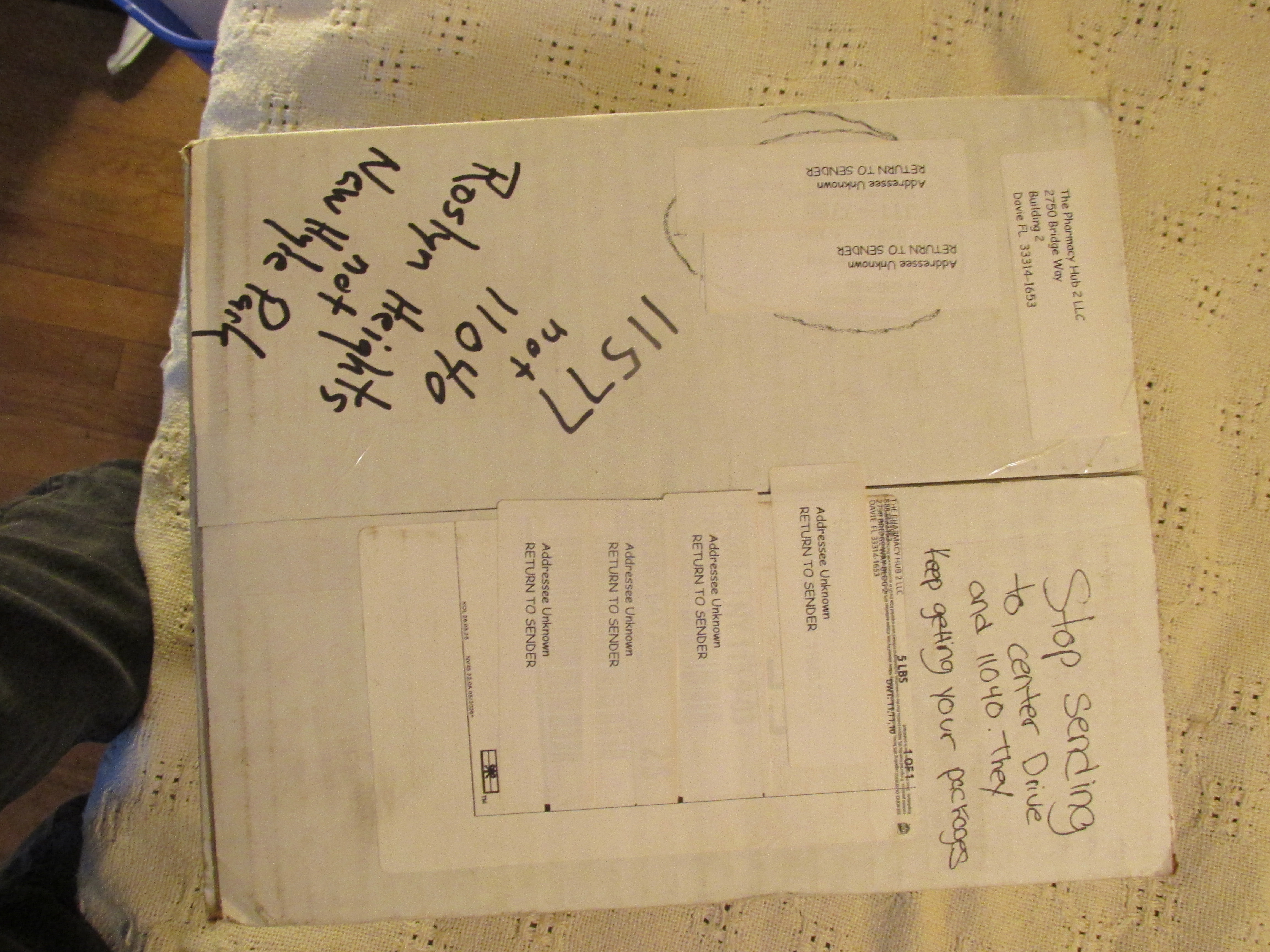
Goddam temp-sensitive medical supplies box back on our doorstep this morning for the THIRD TIME.
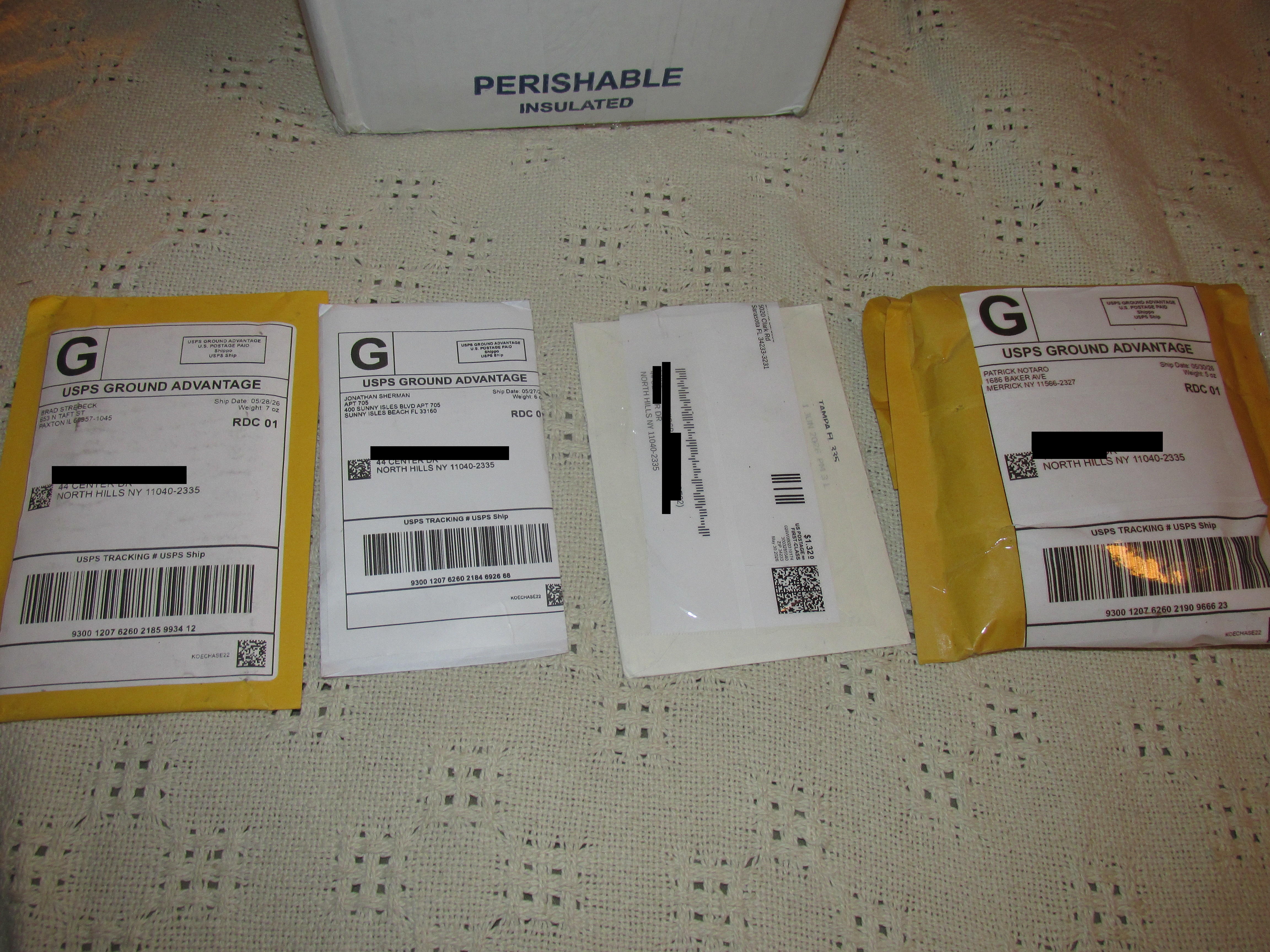
Two more parcels for these folks landed via USPS since I started this thread, so by now I’d accumulated four of them:
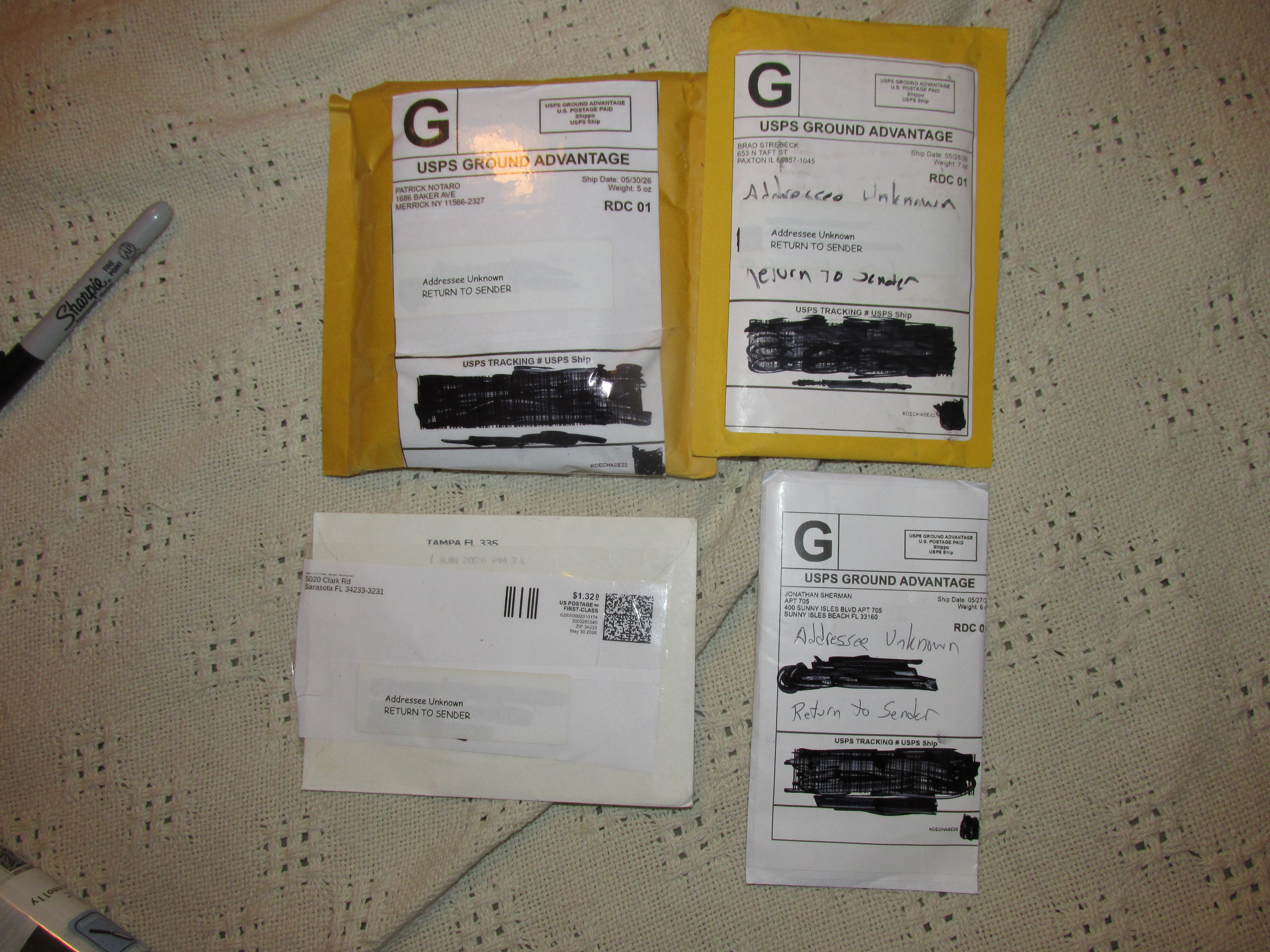
Sufficiently annoyed at this point, I deployed a combo of wide-point Sharpie and trusty Dymo label-maker and covered up all traces of the destination address including any and all bar codes and qrcodes:
The USPS parcels were all small enough that I was able to fit them into the mail slot at the local post office without interacting with the clerk. The temp-sensitive medical box went to the UPS Store, which is a franchise and where the personnel have told me in the past they have limited control over what the drivers do, but they accepted it yet again.
I did contemplate dousing them in lighter fluid and recording video of them burning in my grill, but there’s probably a lot of plastic involved, might be other problematic substances (metal? glass? chemical compounds?) that would not benefit the air or our barbecue grill, and I don’t want to leave us open to any retaliation actions.
You’re still doing more than you need to IMHO. Call UPS and tell them there’s a misdelivered package, and they have to pick it up. Leave it in front of your house. Either UPS will pick it up, or it’ll get stolen, not your problem either way.
Do you have any way of contacting the intended recipients, perhaps to tell them to come and get their own packages, rather than driving them over there yourself?
Three days ago I sent them a letter, registered mail, certified w the green “return requested” tag on it, explaining to them that, no, their real address is XXX not YYY, and that when they tell shippers they live at YYY the parcels come to us, not to them, so please stop doing that.
USPS Tracking says it was delivered to an individual at the address at 3:47 PM on June 3.
We used to have a UPS driver who was a complete piece of crap. He didn’t want to drive out to the farm at all because it was on the most remote edge of his area.
So he would misdeliver packages.
Our office is in town. One day week after they were supposed to have been delivered to his wife, my younger brother found a large overnight UPS envelope containing very important time sensitive documents the UPS driver left under the seat of his his pickup.
Another time, my oldest brother won an auction on eBay for an item and instead of taking it to his house, the driver tossed it into his fuel trailer parked on the edge of a half section about seven miles from his house. It sat there for a couple of months before my oldest brother found it. Fortunately, it was pretty much weather proof and none the worse for sitting out in the open.
Because of all the complaints from everyone (some women in some local offices were very scared of him and would go hide whenever they saw him drive up and park), he was transferred to another route about fifty miles away. He got into trouble once there for luring a woman into the back of his truck to get a package and then attacking her. He eventually died from cancer. Good riddance to that worthless piece of crap.
Sometimes Fed Ex is not real good about delivering items. Years ago, I ordered a very heavy 26 inch monitor. The driver didn’t even attempt to deliver it – he just let it ride around in his truck claiming that the address didn’t exist. I could see the tracking that it was out for delivery. I contacted the Fed Ex office and a manager made a special hundred mile trip up to deliver the monitor at about 11 pm.