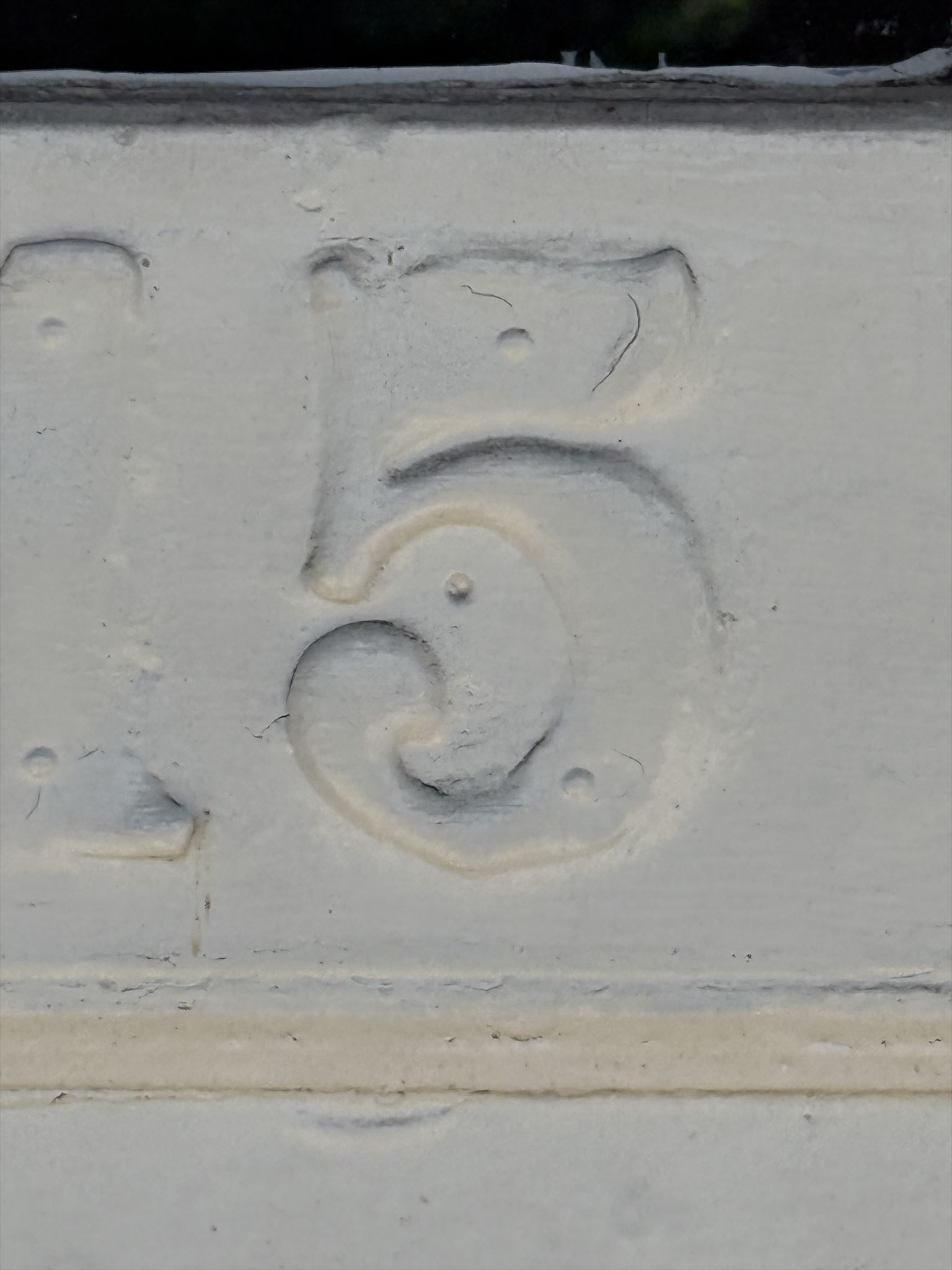
This photo was taken by me a day or so ago. I liked the font and wanted a memory of it.
Here’s the weird part. That 5 is projecting out from the door. It was taken in bright sunlight, and it’s on a vertical surface. But it looks, to my eye anyway, like it is recessed into the door.
It didn’t appear to me that way in real life. And even though I know the 5 is proud of the door, I can’t see it that way unless I look at the picture upside down first. Once turned back around, the effect only lasts a few moments then it looks like it’s sunk in again.
Oh that’s cool. I could not get my eyes to see it as anything but recessed until I did what you did and turned it upside down, then could only see it coming out from the door!
The 5 for whatever reason looks to be shadowed at the top of the curves and lit at the bottom, and our brains expect lightning to come from above, which would indicate the letter being sunken in. There are other similar optical illusions.
Yes, confusing. That number is stamped aluminum. There was no light below it and nothing casting a shadow on it from above. Honestly I’m not sure what’s causing the effect.
Some manner of weathering that has a gravity-driven component, so different at top and bottom. Or some photo-sensitive weathering process that darkens the better lit upper areas and preserves the shaded lower areas.
The end result being paradoxical coloring that resembles inverted shadows. Which in turn the brain takes as cues about the 3rd dimension of indented or raised. But takes wrongly.
Having looked at it right side up for a minute or so, I turned the image upside down. And it remained indented … for about 15-20 seconds. Then suddenly became raised with no sensation of motion; it was just abruptly different and very obviously raised. After watching it inverted and raised for a minute, I turned the image rightside up. It remained raised for a few seconds then suddenly was indented again. Such fun.
The human visual system is pretty capable but it’s fun to provoke it into screwups. Despite having now seen it both ways, I can’t trigger the flipflop at will; if I come back to the image it looks indented if upright or raised if inverted and I can’t force it into the opposite perception.
Which itself is interesting. A lot of visual illusions loose their power once your consciousness is aware of it and can override the default processing. Not this one.
I can flip it from recessed to convex with just my mind, by remembering that the light source is from the lower right.
Conventionally, our brains have all been trained to see lighting from the upper left. As a rule, technical illustrators and commercial artists always put the light source at the upper left. Lucas must have taken the picture early in the morning or late in the afternoon with the sun low to the right. Our brains are so trained by upper-left lighting that the illusion of recession of the image is truly hard to shake. You have to break the illusion by realizing that the light source is lower right. This is why turning it upside down helps.
So if the dark parts are dirt rather than shadow, if you were to wash it clean, it might make it easier to see it as embossed? (I can’t make myself see the photo that way no matter how hard I try.)
The first thing I noticed was the nail heads, which I knew to be domes so it all appeared “correctly” raised to my eyes and I had a little bit of difficulty getting it to pop down.
As an old school draftsman I learned to draw letters and numbers by drawing only their shadows, a technique intended to give a raised appearance. But later as a classroom teacher when I’d write that way on the whiteboard, about half the students claimed to see it one way and the other have the other.