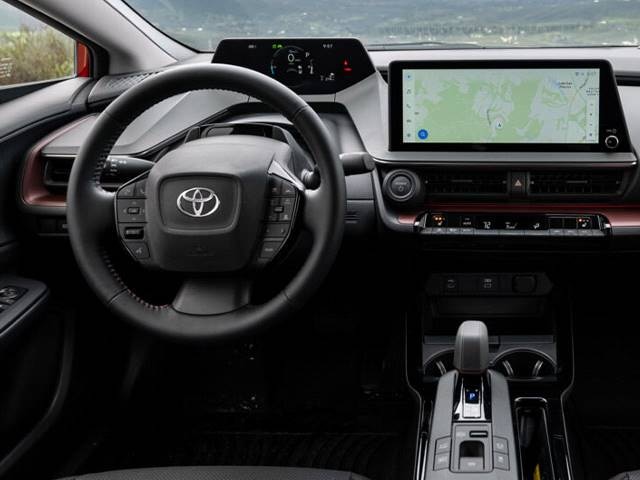
Oh, I forgot to followup on @echoreply’s suggestion. I did do a new review on the local used BEV market. Sadly, while there were a few good condition recent year Leaf’s for sale, they were asking $20-25k for lowish miles with good battery condition and no accidents. Which means I wouldn’t be saving much money to put to a new panel compared to base model Prius PHEV I mentioned last post. It would be far more noticeable if I did get the full CO used EV credit but a couple of the adds were kinda cagey on their language which did not inspire trust.
I know I could easily do better with an online vendor that pulled from a larger pool, many of which are reputable. But I’m just a bit uncomfortable buying online sight unseen.
For a $30+K purchase a couple hundred dollars to fly to wherever to look at a promising example isn’t a nutty-level expenditure. I also know that outfits like Carmax will ship a car to your local store at your expense with no obligation for you to buy it. I’ve done it. Depending on distance that might be $150 or might be $500. If you buy the car the shipping is just one more line item on the total invoice. If you don’t buy it, you owe them for the shipping.
I live in greater Miami. My last two cars came from Wichita and Las Vegas respectively. The previous two were from clean across Florida, 350-to-400 miles away from home.
I’d not be inclined to have a dozen examples shipped in from all over the country for me to browse over. But IMO/IME there’s no reason not to make a nationwide search if you’re looking for something a bit rare or with an unusual options package. Dealers are now quite used to working with long-distance buyers. They can send detailed pix, do Zoom inspections with you, etc.
For my cars, whether fancy or ordinary, the shipping cost was pretty much lost in the sauce of the rest of the fees and whatnot. And I got what I wanted, not what happened to be for sale in my county.
I do also see some 2019 models with the cluster in the center, above the screen. That, IMO, would be annoying. I remember driving one car with the cluster (in the 90’s, so a ‘normal’ cluster) in the center. It was clearly made to be go in facing a driver either on the left or right side with minimal changes, but it felt like a really stupid place for things you need to glance at regularly.
Does that car have any kind of self driving/hands free driving? That black shiny thing above the wheel, on the column, looks like it’s holding some IR cameras that track your eyes to make sure you’re awake and kinda paying attention. You can probably see them with the camera on your phone.
@Joey_P got it in one. I’m average in height at 5’10 silly units. I can see 90 percent of the cluster with the steering wheel in a comfortable position. All of it by sitting up straight and stretching the neck a bit.
My wife is 5’1. She’s mostly looking through the wheel which is awkward but she wouldn’t be driving this much - her car has more space power and comfort!
It has a lot of safety features on all trim levels:
But I don’t think it has any self driving features on any trim level. I DO think the higher end trims have some inattentive driver warning system but never got to see them. It’s a popular enough model and produced or sold in low enough numbers that the last 5 going to our dealership sold 4/5 in three days or less. 2 of the 5 the same day they got to the dealership.
Though I’m sure the imminent gutting of Fed EV credits is ALSO pushing the pedal on BUY NOW.
That arrangement goes way back. My mother’s '02 has a compact display right in the center, at the base of the windshield. My take on that is, as you say, to be common to Japanese/UK models and everywhere-else models, and also as an almost-HUD that keeps your vision near the road.
An interesting article on newer electric vehicles which use enough conventional gas to recharge the battery, but not to drive. The giftlink says that a Ford 150 might go 700 miles…
Interesting variation. It apparently will come with a 27-gallon tank, and if those 27 gallons would power the car for (700 - 150 = 550) miles, that’s a gigantic 20.37 miles per gallon (did I do the math right? 150 miles on wall-charged electric battery, so 550 on gas-charged electric battery?). Not bad for a full size, light duty pickup, I guess. Maybe this sort of application (pickups) is best for this solution, because of the size and weight; I would prefer a hybrid small SUV that can go 400 miles or so between fill-ups, even if it’s always using gas to power the car.
I didn’t take the survey because I’m sort of torn between waiting for the Slate EV truck, or buying a small hybrid SUV, if I can find one that I can fit into. In the meantime, I’m driving my beater 12-year-old Subaru Impreza. Very mediocre mileage too.
The Chevy Volt was doing that over 15 years ago. Maybe it’s “new” in the sense that the approach fell out of favor for a while, but it’s not a new idea.
Key point there is locomotives, like high altitude aircraft, cruise at a fairly high fraction of max power output. Cars have much greater acceleration needs and as such cruise at a much lower fraction of max power output. At the same time, fuel-burning engines are, to a first approximation, at their most volumetric and fuel efficient when running flat out. Running an ICE (or diesel) at half power is very inefficient.
This leads to a situation where in basic ICE cars, the engines have to be much oversized versus cruise performance. Leading to overall system inefficiency.
If you have an appropriate-sized battery you can “timeshift” engine output to later in the driving. So you can size the engine for the average, operate it flat out most of the time for max efficiency, and let the battery charge when power needs to propel the car are below average = max engine output and discharge when power needs are above average = max power output. High altitude airplanes and locos don’t have enough of that to “pay” for an intermediate battery system.
They’re experimenting with battery locomotives, too. The link is to a BNSF article but UP and CSX are also trying it out. They’ve used slugs for years – no prime-mover, no battery, just motors – but putting a battery in to charge is new.
Tempe put in a trolley to serve parts of downtown not served by the light rail. It crosses the light rail twice so to make the overhead simpler has a battery so it can lower the pan and trundle fifty yards, then raise it again. The part in the southeast corner it runs parallel to the LR but doen’t touch it.
Probably the best thread to put this in - we are the proud owners of a new BYD Dolphin Surf which is the cheapest EV in our country yet the specs are amazing.
I plan on getting a BYD Sealion 5 in a few months.
BYD is making a major push in South Africa right now, they can’t ship them here fast enough.
I’ll be interested to hear what you think of both the BYDs. I looked at them at was tempted… went for a used BMW iX2 instead in the end, for various reasons. The BYDs looked very attractive though, and they seemed to have all the features I could think of. Build quality seemed very good - I didn’t drive one though.