What bottlenecks would you consider for the drake equation that prevent the development of intelligent, technologically advanced life

That’s no more plausible – and in fact, I would suggest is much less plausible – than saying that the chances of life arising spontaneously is 100% if conditions are right and enough time is allowed. And given the likely number of planets in our galaxy alone, there are probably millions with the right conditions.

I think some of the pessimism about extraterrestrial life is driven by the fact that in exploring our own solar system, over and over again we’ve found barren worlds that are overtly hostile to life. The only possible exception is Mars, which today is a dead world with an unbreatheable, thin and toxic atmosphere, but which may once have harbored primitive life. It’s also possible – though I think extremely unlikely – that there may be primitive life in the oceans of Europa or Enceladus.

It would be exciting in an academic sense to discover that Mars once had life, however primitive it may have been, but the really exciting discoveries of extraterrestrial multi-cellular and possibly even intelligent life are most likely going to be made very far away and in the very distant future. Unless one of the Great Filters wipes out humanity before we can manage it.

This might be a development unique to Earth; the taxonomic division between prokaryotes and eukaryotes may be a division specific to our evolutionary tree, and would be replaced by a completely different division on a different world.

Having said that, the inclusion of endoparasitic organelles seems to have happened at least twice in Earth’s evolutionary history; once for mitochondria, once for chloroplasts; there also seems to have been horizontal transfer between early plants and other eukaryotes, as shown here.

So that is three events - there may have been more, and indeed some other organelles show some indications of endoparasitism. That suggests that the emergence of eukaryote-analogs might not be that rare.

Here’s one example of an obligate endoparasite that may evolve into an organelle; there are more, IIRC…

I don’t get why people have this need to slap down the fermi paradox. (Apart from just that the use of the word “paradox” is provocative)

It’s just highlighting that there’s a set of known unknowns here, and we can only speculate about which factors are the reason why we see no evidence yet of ETIs.

And yet always at least half of the responses are basically “The fermi paradox is stupid, because I speculate that…”

I’ve long thought that the filter or bottleneck is an extraterrestrial species evolving to be intelligent and technologically capable. There’s nothing about natural selection that mandates a species will evolve to become ever more intelligent, just more adapted to its environment.

I read an anthropological theory years ago that posited that our evolved intelligence was actually kind of an accident, or at least secondary to our evolving, increasingly dexterous hands. A large part of our brains are dedicated to the senses and control of our hands. So, the theory goes, our emerging intelligence, as well as our ability to build complicated things, is a secondary effect of our evolving tool use. Yes, there are other creatures like dolphins and whales that are intelligent, maybe almost as intelligent as us in some ways, and they may make use of simple tools, but they’re not going to be building satellite dishes or spacecraft anytime soon.

Possibly but that’s the point it’s still a perfectly plausible number, so no paradox. For it to be anything like a paradox a component number that sees the final result equal to 1 would have to be impossible.

Also I’d argue those to numbers are not equally plausible given all we know about how complex even the simplest first life would have to be, the actual odds of it occuring are likely very low, the odds of a specific arrangement of a deck of cards seems like a reasonable finger in the air estimate IMO.

Not to mention a number of 1.0 means you do need to come up with a reason the final result of Drake’s Equation appears, as we can measure it, to be just 1.

We don’t know if the initial formation of life is the crucial bottleneck or not, hence why the paradox *is* valid.

It’s not making an affirmative claim, it’s just pointing out what we don’t know right now.

Anyway though, IMO, the initial formation of a simple* cell doesn’t look very promising as the main filter right now. That’s because of how (comparatively) quickly it happened on Earth, and because the set of protocell constituents that we can detect forming spontaneously in experiments or in nature is expanding all the time.
(Yes, in a sense detecting amino acid formation, say, doesn’t tell us anything because we already know it happened once. But the point is, we’re seeing them form trivially in environments that would be pretty common. The fewer materials that need freak events, the less this appears to be a crazy unlikely event).

* Worth keeping in mind that the first cells would have been a heck of a lot simpler than modern cells. Cells have evolved too, in fact they’ve spent longer evolving than multicellular life has.

Leading to the saying “the probability of life existing on a planet is inversely proportional to our knowledge of that planet”.

I dunno, abiogenesis seems to go something like:

  • starter molecules- water, methane, ammonia, etc.
  • organic molecules
  • polymers of organic molecules
  • ? some sort of specialized environment or catalyst?
  • ???
  • cells

Which to me sounds like:

  • iron ore
  • steel
  • nuts and bolts
  • ?electromagnetism?
  • ???
  • robots

I’ve said it before, but I expect that there are many different pathways between ‘polymers of organic molecules’ and ‘complex biological organisms’, and it may even be the case that every life-bearing planet (if there is more than one) will have a different pathway and a different form of abiogenesis process. If so the possibility space of biological lifeforms may be very large, and the environments that result will also be very diverse. Our single example of Earth life may be the only one that has followed our particular pathway, and the other worlds with life could be very different indeed. Many will only support simple lifeforms, but some may be even more complex and bizarre.

More recently Max Telford, an evolutionary biologist, released The Tree of Life. He starts at the absolute beginning and shows how genes passed down some traits which can still be found, and others that developed into new ones and newer ones, that produced the separations of each domain, kingdom, phylum, order, family, genus, and species that led to humanity. And in readable language. Highly recommended.

He makes the point over and over, covertly and overtly, that none of these had to happen. Each was a reaction to contemporary world and local environments and competitors. Any differences in those could have resulted in different descendants or none at all.

What are the odds of all those individual reactions happening? One in a trillion? One in a quintillion? One in ten septillion? That’s the number that gets plugged into the fi = the fraction of planets with life that go on to develop intelligent life (civilizations). Ten septillion is 1025, more than the number of planets given by the OP. That brings the Drake* equation down to one all by itself. If the odds are shorter, then the next two numbers could reduce whatever trillions are left down to one.

The objection to this line of reasoning is that we don’t know whether intelligence would develop even with a different set of inputs into the tree of life. But giving that possibility a number is merest speculation and all guesses are equally valid or invalid. All we can work with is the one data point we are given.

The more we learn about evolution, the more likely it seems to me that our state of humanity is an absolutely freakish outcome. I wouldn’t have said this a few decades ago, and in 1961 Drake could hardly be expected to have a glimpse of modern genetics. That we’re alone in the universe - at least at this moment is time - appears to be the only scientifically respectable statement.

* I keep reminding people that science writer Willy Ley set down a nearly identical equation a decade before Drake. He was possibly the most famous science writer in America in the 1950s. Speaking of odds, what are the odds that the otherwise completely unknown Frank Drake should get the credit for codifying his work?

Well who knows? Remember, we aren’t talking about modern cells.
Just last week was another breakthrough in the concept of synthetic cells, protocells are not looking to be that complex.

Anyway, in terms of the Fermi paradox, like I say, the fact remains that simple life started on this planet not long after it formed a solid surface. We can’t know of course, but on the basis of our data right now, it seems the bottleneck is more likely to be the development of complex cells, rather than the spontaneous forming of the first cells.

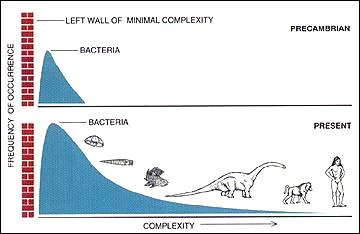
Stephen Jay Gould described a concept he called the ‘drunkard’s walk’; organisms might evolve to become more complex and less complex at random over time, but they can’t get less complex than zero, so the tendency is for complexity to increase (on average) over time.

This is probably an oversimplification, but in an environment that persists for many hundreds of billions of years one might expect more complex organisms to evolve. Would this always lead to sentience, given enough time? I doubt it, but given enough locations, something of the sort may evolve. Certainy birds are very clever, despite have only a distant relationship tohumans.

My understanding is that symbiosis and complexity has evolved over time with some life forms.

Life may have started as independent replicators, cell membranes and metabolisms all existing independently. Those may have combined to become the first prokaryotic cells.

Some of those prokaryotes eventually combined to become eukaryotes

Some of those Eukaryotes combined to become animals

Some of those animals evolved to become social animals that existed in groups

Human are a group of social animals evolved to create a global technological civilization

In order to have things like intelligence, you need a large neocortex (at least among animals on earth). this seems to only occur in social animals. Intelligence seems to evolve to help social animals navigate complex social systems. Everyone in the social group is trying to extract more resources from the group than they provide to it, while also preventing others from doing the same. They are also all trying to outsmart each other and climb the social ladder and stop others from climbing the ladder. This creates a selection pressure for intelligence.

But like I mentioned in the OP, intelligence isn’t enough. You also need endless other things like land to live on, hands to make tools, the ability to communicate and record information, large scale cooperation, a planet with easily extractable energy and raw materials, a stable climate, etc etc. to lead to a technologically advanced intelligent species.

Yeah, it’d be really, really tough to get life without carbon or water: Those both seem to be pretty fundamental. But while a couple of molecules essential to Life As We Know It (ATP and DNA) happen to include phosphorus, it’s not so integral that it’s impossible to imagine equivalent molecules without it: Those are just the ones chosen by our path.

I tend to think that anything that happened twice in our planet’s history probably isn’t the Great Filter. Eukaryotes, though, didn’t quite happen twice, but it was more than once. More or less the same thing that happened with mitochondria also happened with chlorophytes. Is that one instance or two? It’s one instance of a host cell evolving to tolerate other cells inside of it, because the cells that absorbed the chlorophytes already had mitochondria, but it’s two instances of cells evolving to live in other cells. Which evolution was the more significant one?

To human levels, maybe? But both humans and octopuses are a lot more intelligent than our common ancestor, so at least that much intelligence has evolved independently at least twice.

It’s possible, indeed almost certain, that all higher species on earth are more “intelligent” than the common ancestor of octopus and human from 750,000,000 years ago, which predates the phylum Chordata. If that’s the bar for intelligence, then either it is an extremely low one or the word intelligence has no meaning in this context.

It’s the latter. Animal intelligence has been a hot topic this century, with various advocates competing to claim ever higher amounts of intelligence for their favored animal. Does that have any relevance for the Drake equation?

I think not. The octopus has been around for 150 million years. I doubt we have any indication how intelligent octopuses were back then or how much more they are today, but they certainly have not done anything in those 150 million years that gives any trace of what would normally be termed civilization outside a few habitats no more advanced than dozens of other species. (I’ll also note that there are more than 300 known species of octopus. Speaking about the intelligence of “the” octopus is at best overbroad.)

If the octopus is on the road to a fi Drake civilization, perhaps the evolutionary time period needed is on the order of a billion years, not the few millions that Homo needed. And perhaps that is more typical. Or perhaps that is evidence that no water-based intelligence is capable of civilization. Many water-based species are considered intelligent and all are far older than Homo, therefore none can be considered to have been out-competed by our species. And as long as humans continue to rule the earth no current “intelligent” animal has a natural selection hope of rising to civilization.

In other words, it could be that it’s not intelligence per se that’s the bottleneck, but getting from intelligence to tool use, or from tool use to the sort of advanced tool use that’s needed for spacefaring.

That’s a fair summary of our experience. Again, we’re all extrapolating off of one data point. What that data point tells us now is that multiple factors enter into both mere survival and domination of a niche, and that while they may overlap they are quite distinct.

The Ley/Drake considerations match up well with those march of progress/ascent of man cartoons that start with bent-over hairy apes and wind up with clean-shaven erect male engineers, Homo faber.

You’d think they’d go back to Darwin, but they were invented for a Time-Life book in 1965.

It happens that on this planet the most intelligent species is also the most successful. We’re collectively the apex predator to the point we’re busy inadvertently destroying species all over the place.

But is intelligence necessarily the cheat code leading inevitably to apex predator status?

I could imagine an alternate history where things like alligators, velociraptors, and sharks are each more numerous and fierce in their respective domains; apex predators of swamp, dry land, and sea respectively. They have no great need of greater intelligence, and whenever at random some prey species shows some spark of extra brains, they all get eaten before it confers enough survival advantage to propagate.

That might be a stable quasi-equilibrium lasting most of the habitable life cycle of an Earthlike planet.

IOW, there’s lots of ways to stall the progress that seems, looking back along our own timeline, to have had a certain inevitability. Nope. IMO YMMV.


ETA: I didn’t quite say it, but implicit in my thoughts above is that any technological species, even say like humanity of the late stone age, pretty well has to be the apex predator at least locally. Yes, even today some humans get eaten by some wildlife somewhere sometimes.

But those stone age humans used their limited tech of spears and teamwork to largely clear their area of truly dangerous predators so they had the safety needed do develop permanent settlements and all the future that flows from them. If they could not decisively defeat the local predators, they’d be screwed and never advance.

And also, implicitly, you’ve got to be the planetary apex predator to be able to build a more advanced planet-scale techno society. Which in turn is a prereq for significant astronomy and later space exploraiton.


Separately …
A planet with multiple species of evolving intelligent local apex predators is setting up for an epic collision. I don’t think two intelligent species can really share a planet. Somebody is going to be extinctified pretty quickly after they collide.

Really? What species is that? I’d have guessed that we were the most intelligent, but I can think of a bunch of species more successful than us.