That was partly my motivation for a thread I started last year asking just how much more dangerous the Cretaceous would be for humans than any period during the Age of Mammals (alas people misconstrued what I wanted to focus on and the thread went off in different tangents-my search-fu wasn’t able to find it alas). Mammals of course have hard limits on how big they can get, and the biggest ones were all herbivores. Dinos by contrast had air sacs which made their breathing more efficient allowing them to grow to huge sizes until the physics of gravity kept them from growing any bigger, so while the biggest were all herbivores T-Rex and its cousins were the biggest top predators to ever exist on land.
So any intelligent dino species would have to be constantly be dealing with such nasties on a minute-by-minute basis and thus likely couldn’t afford to lose certain anatomical features as their brains got bigger lest they become easy meat. Lions and leopards and crocs weren’t any picnic, but the pre tool hominids would have to be able to survive in whatever habitat (African savannah) they found themselves in, and if it was safe enough then they would have the evolutionary “space” to evolve bigger brains.
I would look down rather than up to apex predators.
What I mean is, megafauna are necessarily relatively few in number, and can be vanquished in some sense by a species capable of thinking strategically and communicating (and building on) ideas. If Homo sapiens is any indicator, this is a very quick process.
OTOH, mosquitoes remain a persistent threat. Even at our level of technological sophistication they are responsible for ~1M deaths a year and there’s always the possibility of a new pathogen evolving that could make them a vastly more serious threat even than this.
So the existence of mosquitoes makes me inclined to think an intelligence being kept in check by an unkillable threat is indeed possible.
Imagine a fledgling intelligent species that has to hide, and only in small groups, because of some kind of super mosquito. It would at least greatly stretch out the time it would take for them to develop civilization and advanced tech.
Interesting point. The mosquitos themselves are no threat whatsoever. It’s the pathogens that piggyback on (in?) them that are dangerous.
An interesting form of inter-species teamwork. Which makes me wonder whether / how the e.g. malaria-equipped mosquitos benefit from being carriers. Either as individuals or as a (sub-)species.
They probably don’t. To the extent that the mosquitos care at all, they’d want their prey species to remain abundant, and so any disease that kills off prey is at least indirectly bad for the mosquitos. They just probably don’t care very much, since even with malaria, there are still huge numbers of gnus and zebras and humans and other things with blood.
It’s more than that - just chloroplasts happened at least twice - almost all plants have one type of chloroplast, and then Paulinella amoeboids have a different endosymbiont and the ciliate Pseudoblepharisma tenue has two different kinds of photosynthetic organelles. Whether the apicoplast plastid found in e.g. malaria parasites was the same as the plant chloroplast in origin is also undecided AFAIK. So that’s multiple separate symbiogenesis instances just in the chloroplast-ish space. And we know secondary and tetiary sybiogenesis happens all the time, so it seems like a very successful “design” pattern[1].
Design is in quotes there because of course there’s no design to evolution, but pattern language is convenient for describing this sort of thing ( especially if you want to apply it to biomimetics later) ↩︎
That’s playing around with definitions again, even more so than the undefinable “intelligence”. No species is more successful than sapiens. Wherever we go we dominate, domesticate, decimate, or exterminate every other species. We also do so indirectly through cutting down forests, removing fresh water supplies, paving over habitats, and climate change.
Success cannot mean mere numbers. Incredibly numerous animals like coral and krill are dying off because of changes in water temperature, so our dominance over the entire planet indirectly affects other animals even when we have no intention of doing so. We’re like giants stepping on ants ecologically. Can’t get any more successful than that.
I agree with @LSLGuy: it would be an extremely weird planet where two intelligent apex predators would find ecological niches so separate that it would allow them to co-exist, or even to exist in the first place. Water and land aren’t sufficiently different; as above the effects of an civilized race can affect niches it can’t live in. Marvel’s Sub-mariner has had it right for 80 years - the humans are killing off his kingdom.
So my understanding is that being a social animal is what leads to being the apex life form. Intelligence just tends to evolve among social animals.
There are only a handful of social insects, but they make up the vast majority of insect biomass on earth.
One reason humans outcompeted other Homo species is because we had bigger social groups. Humans may have had social groups of 100-150, while other groups like neanderthals had groups of maybe 10-12. Also humans domesticated dogs and added them into our social group which also helped.
So intelligence from what I know is a byproduct of animals evolving in a social group. Social groups give a lot of advantages over solitary organisms or smaller social groups.
Note that humans only became apex predators artificially; a natural apex predator would be evolved for optimum performance without intelligence adding much. Plus being the H. Sapiens biased observer that I am, I would say that what really caused Sapiens to do vastly better then their predecessors was the development of missiles: specifically thrown spears, the atlatl and later bows and arrows. Nature’s favorite trick is to be able to sting or grab something from further away than the prey realizes, and Sapiens developing this trick vastly improved the ratio of killing vs. getting killed in human’s favor.
You mean the little critters that hide in the dark crevices of things we build, and eat scraps of the food that we collect and don’t want anymore?
They might successfully exist in places where we haven’t chosen to drive them away from, but I can’t think of a time where we wanted something and a cockroach prevented us from having it.
One of the things we want is to be rid of cockroaches. We haven’t succeeded.
And they’ve currently found eating scraps of our food to be a very comfortable niche, but they still existed just fine for hundreds of millions of years before us.
Every creature that scraped out the meagerest of lives on this planet can be said to exist.
Humans don’t simply exist. We dominate.
The fact that we haven’t demonstrated the power to utterly eliminate every other life form on this planet doesn’t change the fact that we dominate while others exist.
Decimate and exterminate have different meanings. Humanity hasn’t exterminated cockroaches, but it never has gone on a dedicated campaign to do so. They remain a continued nuisance in crowded urban areas, but even there are not ubiquitous. Wealthier neighborhoods do a better job of ridding multi-story apartment complexes of bugs than do poorer areas. The issue is one of governmental and societal neglect, as it is for virtually all the problems that poorer areas face. Part of that indifference is that the vast majority of homes in the United States are free of cockroaches, so no national coordinated attention is paid to them. My cynical side says that the right wants cockroaches in blue cities so they can sneer at and condemn them. (Florida just brags about infestations; it’s weird.)
Humans eradicated smallpox from the world. And nearly eradicated other diseases of humans. Rinderpest in cattle is officially gone. (Eradicated technically means gone worldwide, while eliminated means gone from a specific region. Many diseases have therefore been eliminated somewhere.) That’s dominance. What humanity doesn’t bother to do is not a definer of its place in the ecosystem; what it can accomplish if it works together to achieve something is.
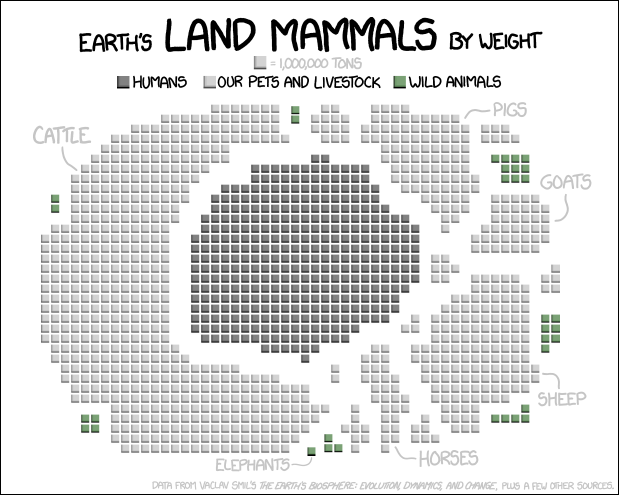
As to success, I’ll suggest my cite below is on-point as to mammals. For darn sure the total biomass of algae, or insects, or unicellular whatevers is monstrous huge, much hugher than the “mere” mammals.
But we, and our critters that exist in any material quantity only because we raise them, absolutely rule the mammal-o-sphere. Sea and sky mammals are a tiny rounding error on this land-only diagram.
Although I do see @Chronos’ point that from a pure “selfish gene” perspective, the critter with the greatest number of living individuals is the most “successful” at the moment.
And by that measure, the e. coli colony in any one of our bellies outperforms all of humanity by several orders of magnitude.
Beyond even that measure, arguably the best measure of biological success is actually “count of successful reproductions since species origin”. By which measure a short-lived bacteria that’s both numerous and has a short lifespan, and some decently long history on Earth would be the hands-down winner.
e.g. There’s trillions of them per acre of land, AND there’s ~14 billion acres of land on Earth AND they all die and are replaced every couple of days, AND they’ve existed as essentially the same species since the early days of the Archean biosphere ~3billion years ago? That’s success.
By a measure that’s orthogonal at best, and more likely antithetical, to anything tending towards answering the OP’s curiosity about the Drake Equation.
An interesting sidebar to the biological success story is very ancient species that are still extant today. The horseshoe crab has been essentially unchanged for 450 million years, predating the dinosaurs.
Dragonflies are also very ancient, although much smaller than the griffinflies that existed 320 million years ago which could have wingspans up to 2.5 feet. The modern version evolved during the Triassic.
Sharks also have very ancient ancestors, also going back about 450 million years, but again, have changed since then. Modern sharks like the Great White mostly evolved during the Jurassic and Cretaceous periods. I think it’s impressive enough to consider that sharks as we know them today co-existed with dinosaurs!
I mean, we don’t really know how similar they are beyond the overall body plan. Maybe all of the metabolic details are still the same, for all we know.
And were able to compete successfully with those aquatic dinosaurs. Some of whom look like they were pretty fierce predators in their own right. Yikes!