I’d think that you’d take into account not only the size of the feature but also the size of the city, since lots of small communities have landmarks in them, and also the prominence of the landmark in the community. So Shequaga Falls would do middling in the first part, the falls being medium-sized, lose points on the second mark, Montour Falls being a smallish town rather than a city, but get good marks for the last part, it being close to downtown and on a prominent street.
And furthermore according to Google Maps, Aunt Sarah’s Falls is also located in the limits of Montour Falls. It is probably splendid during the spring runoff, and is prominently visible from the largest road in town.
For the avoidance of doubt, this was a bit of ridiculous fake-news clickbait going around. Dublin has no ravine, and O’Briain is, to the best of my knowledge, fine and found the whole thing hilarious enough to do several minutes on it in a recent show.
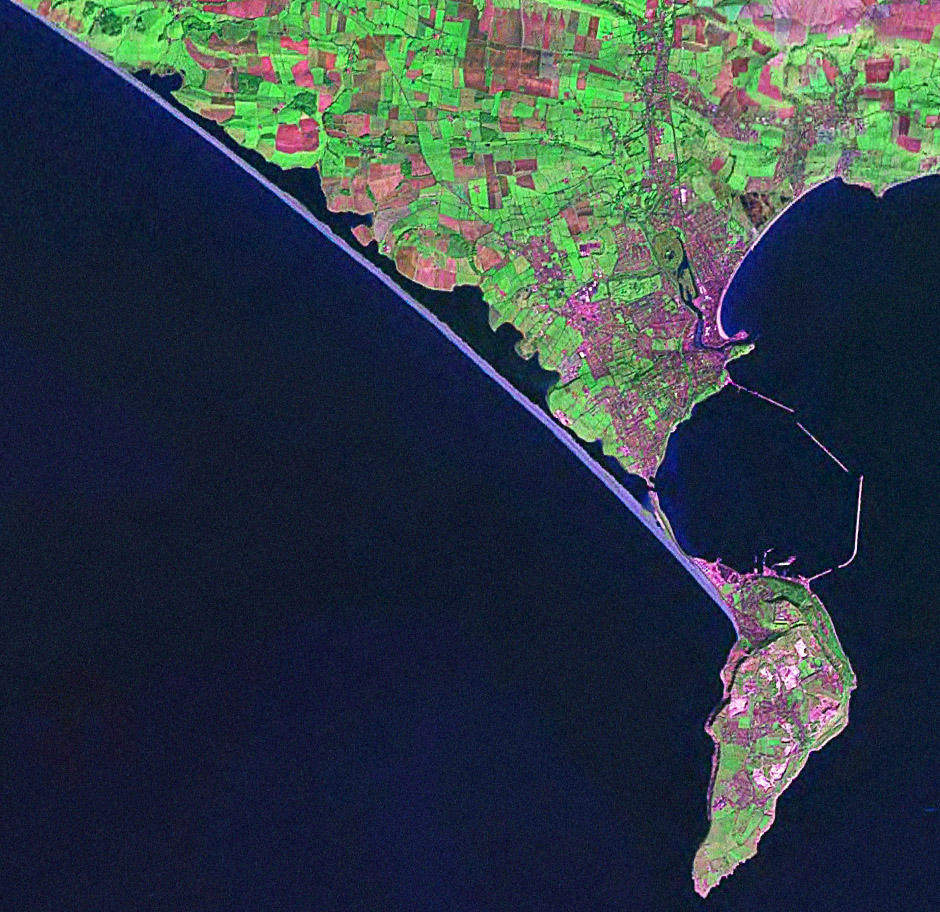
Weymouth, Dorset, UK, has Chesil Beach - a distinct bar of gravel and rocks that runs in an almost straight line for 18 miles - I think this qualifies as a natural wonder - it’s the diagonal feature in this satellite photo:
The rocks composing the beach have been sorted naturally by the action of waves. At the northwest end, it is fine pea shingle (gravel) increasing in size gradually and continuously to, at the southeastern end, very large cobbles.
It is said that local fishermen landing on the beach in fog can tell whereabouts they are just by looking at the size of the stones
On the other side of the Rockies, we’ve got the Flatirons here in Boulder. Slightly less spectacular than the stuff around GJ, but you can walk to them from downtown (a long walk, granted, but still).
This reminded me of Lone Mountain, a little standalone mound which rises up from the Las Vegas valley all by itself. I used to live just a couple of miles from it.
I’m not sure I’d call it a “wonder,” and it has nothing on Red Rock Park, a few miles away, but it is rather striking.
Something this Victoria resident has been told more than once, but feel is apocryphal, and curious if that gets confirmed or not, is that apparently Washington residents can’t really enjoy the view of their Olympic mountains because they’re at the foot of them, whereas us Canucks across the Juan de Fuca Strait… https://imgur.com/a/AowSXuo
The first time I came down the front staircase at the physics department at the University of Utah, I was confronted by this, and had to stop, smitten by it:
That’s the Oquirrh Mountain range to the west of Salt Lake. They looked like pictures and cartoons of mountains I’d seen in books and movies, with the snow at the top even in the summer. I was brought up near the seacoast, and even Mount Washington in New Hampshire didn’t look like this.
The Wasatch Mountains were behind me, too (Salt Lake City sits in a vast bowl formed by the Oquirrh and Wasatch ranges, which curl around it from the north and south, as well), but they don’t look as dramatic – they rise more gradually, and you don’t see the snow.
Anyway, I had to stop and stare for a long time. Hard to believe I was living in a place like this. For the first couple of months I’d stop every now and then and think “I’m living in Utah. What the hell am I doing in Utah?” (Long story. Short version – getting another degree.)
If you don’t want to count the mountain ranges as the requisite “Natural wonder”, you could include Timpanogos Cave in the Wasatch Range. Technically in Highland, Utah, but Mt. Timpanogos is visible from SLC
Are the boulders deposited by glaciers, bedrock, or placed there by people when the park was created (the latter being the theory my spouse subscribes to)?
Auckland has many volcanic cones scattered throughout the city.
We climbed up Mt. Eden when we were there and looked out over the city and bay and counted dozens.
Something of a sobering thought. A beautiful but somewhat unstable country, the potential for disaster is right there in plain sight.
(we also stayed in an old bank building right next to the Cathedral in Christchurch. So sad to see it later trashed in 2011)
There are some glacial erratics and some protruding bedrock in the park. I wouldn’t be surprised if some stones were brought in during the construction. Central Park is as much a wonder of engineering as it is a wonder of nature.
Yeah, “protruding bedrock” might have been what I saw on TV. There were grooves on a large rock that were supposed to have been caused by a passing glacier. I mean, it was just a TV show, so I can’t be sure. Actually, it might have been two shows, and if one of them was from the BBC and narrated by David Attenborough, I would tend to believe it, but the other might have been on the History Channel, and I’ve seen all kinds of nonsense in those productions.
The small town of McLouth, Kansas, has a boulder right in the middle of aptly-named Granite Street. Evidently it was too large to move or dig out when they created the street, so they left it right there. No warning signs or barricades; travel at your own risk.
The boulders outside the 77th Street Foyer of the American Museum of Natural History (which I mentioned upthread) were brought there precisely because they showed this grooving caused by the glacier’s passage. Are you sure that isn’t what you saw?

.jpg)

