I should have added that the stitch was (I’m positing) named after the London neighborhood/train station. That is, that particular stitching pattern was seen as something that needed to be differentiated with a name. Some were already calling it the “cross crosselet” (or perhaps it was the “Jerusalem cross”) by the mid-19th century. Others – presumably Londoners – were already familiar with the phrase “King’s Cross” (referring to the statue at the river crossing, the neighborhood around it, and soon thereafter to the train station), and they colloquially started to apply this phrase to the stitching pattern. The name stuck.
Its probably a decorative cross pattern. OR in the style of , when its not so intricate.
Like this
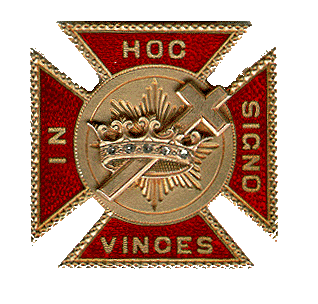
Or a cross with blobby ends. The end can vary, whether its a crown at each end, or a spade or fleur-de-lis at each end ?
All that matters is that its a distinctive mark like a signature , not something that was just random or accidental.
Maybe some of my conception problem is in the article phrasing. It describes him as having scratches on his arm, and giving the impression it is like claw marks from a demon hand or something. Then it describes the pattern as a “kings cross”. But perhaps my impression of the scratches being from a demon hand is a projection onto the actual article. I will look again.
The Geary monument is pictured here, and doesn’t include anything cross-shaped. So whatever a king’s cross is, it’s apparently a backformation or corruption.
Likely influenced by the fact that it was at an important crossing of the River Fleet.
Thanks for the linked image!
NP. I’m trying to remember if there any cross-like motifs inside King’s Cross Station. It was pretty thoroughly refurbished over the last few years, unfortunately.
Here is the passage from the article:
I cannot make sense of “king’s cross” in that sentence. I just don’t see how the fluted crosses fit that description. The authors are describing an event as presented on a TV show, Paranormal Witness, the claims to be true life presentations of actual events. It is unclear if the authors are describing a remark that Decker made at that time or a remark he made on the TV show about that event. It appears that “king’s cross” is Decker’s description, but it’s not a quoted statement, so it is possible it is one of the author’s descriptions. Though I’d think it most likely a remark by Decker on the show about what happened at the time.
Anyway, I cannot sensibly mix an elaborate pattern like any of the above described king’s crosses with the description of scratches down his arm that form the shape of a king’s cross near the inner elbow.
That’s actually rather unlikely, as by the time ‘the King’s Cross’ was erected, the Fleet was no longer visible, having been covered over several years earlier.
A ‘cross’ in that context instead meant a prominent structure in a central urban location, which might well take the form of an actual cross but, then again, often didn’t. Such as Banbury Cross or innumerable market crosses, such as those at Barnard Castle, Swaffham, Wymondham and, perhaps most famously, Chichester.
As I linked earlier, a Celtic cross is sometimes called a king’s cross.
Celtic crosses can be elaborate, but they don’t have to be. Essentially, it’s just two lines and a circle. Something that could be scratched onto an arm.
Okay, that’s the first one that makes sense to me.