What is the difference between England, Britain, Great Britain, the UK, the Commonwealth, and the Crown lands?

Continuing the discussion from Questions you should know but don't:

What exactly is the difference between all of these places, especially in terms of governance and politics?

This reddit graphic illustrates some of the complexity, but apparently even that doesn’t match the actual real-world situation:
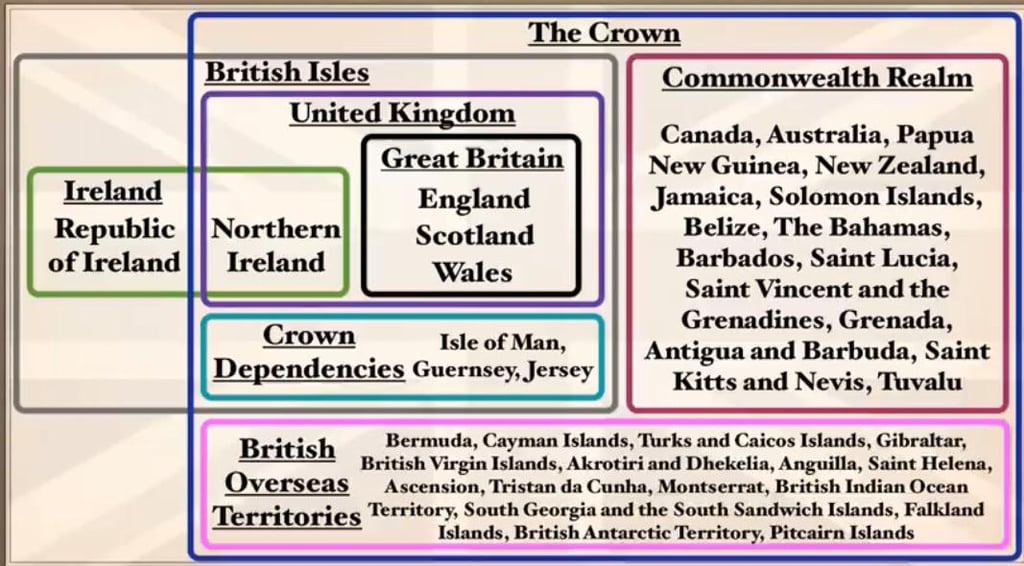
We had some older threads about this, but they’re 20 years old now. Has the situation changed at all, especially after Brexit? And who exactly Brexited… was it only Britain (England?), or the whole UK?

What about the two Irelands (north & south)… was that a recent civil war, or some long-ago division? Sorry, I know nothing about the history of this region.

And between the sub-Britains of England, Wales, and Scotland… are they provinces ruled by a central government? States in a federation? Independent countries under a union, like in the EU? Do they have both common and unique laws? How does Northern Ireland fit into all that, in terms of governance and sovereignty?

And then what are the ties between the UK and the Commonwealth… is there the right of free passage and work, like in the EU, or are they just close allies…? Do the dependencies and overseas territories get any sort of governance at all (do they have votes?)?

And how do the UKians (is there a collective term all the monarch’s subjects?) rule over all this complexity…? I’m surprised there aren’t more frequent separatist and succession movements.
(Sorry, self-flagged this for category change before realizing I can move it myself. It was initially in MPSIMS before I moved it to FQ.)

I know the UK lets Irish and Commonwealth citizens vote if they are currently in the country legally, which to me sounds strange, but I guess there’s historical reasons for it.

(In Canada, being a Canadian citizen is one of the requirements to vote)

The division occurred in 1922, after the Irish War of Independence. Roughly three-quarters of the island became an independent (and predominantly Catholic) nation, while the northern quarter (largely Protestant) remained a part of the UK.

Even after the division, there was still a great deal of sectarian violence, especially in the North, until about 30 years ago, as there is still a Catholic minority in the North. Tensions are less now, but haven’t entirely disappeared.

Ireland had been under British crown control for centuries, up until 1922, and that’s a very very long story.

Obligatory CGB Grey video

Brian

The UK exited - so that’s England, Scotland, Wales and Northern Ireland.
As I understand it, there is a customs border between Northern Ireland and the Republic of Ireland (which is still in the European Union.)

This is a sensitive issue, so I apologise if I get anything wrong (I’ve simplified 2000 years of history!).
Basically in the 1100s, the English first invaded and took land in Ireland.

Anglo-Norman invasion of Ireland - Wikipedia

Since then there have been further invasions and many casualties, resulting in a ‘divided’ Ireland.

British rule in Ireland - Wikipedia

I’m English, but I don’t know a word for the fact that my passport says I’m a citizen of the United Kingdom. Saying I’m British means I’m ignoring Northern Ireland…
The Monarch rules over the UK (Great Britain and Northern Ireland), but there are separate Parliaments.
We had a Civil War in the Middle Ages, but basically the people have the power and the Monarch is our country’s representative and formal leader.

Oh, and we’re a reasonable bunch (we like queuing and grumbling about the weather.)
We can get rid of useless politicians quickly too:

Liz Truss lasted just 44 days as Prime Minister :astonished:

Shortly before noon on 20 October, Truss’s forty-fifth day in office, Brady held a meeting with Truss where she asked if she would be able to remain in office. His response was “I don’t think so, Prime Minister”.
At 1:35 pm, Truss announced her resignation as the leader of the Conservative Party and as prime minister.

Image is outdated and to clarify one thing:

Commonwealth Realm is the countries that acknowledge the same monarch as the UK as head of state (currently Charles III). Barbados should be removed, they became a republic in 2021.

Commonwealth of Nations is an alignment of countries who usually have some kinship with the UK, but they don’t need to be part of the monarchy. It’s not much of a government as a discussion group. Barbados is still in here, as is India who abandoned that a long time ago. Plus some oddities like Mozambique, who never had a whole lot to do with UK (Portuguese colony).

The UK is a unitary state as opposed to a federation like US, Australia, Canada. Management is top-down rather than a collection of states with varying degrees of individual autonomy. Despite this there is some devolution, people in Scotland, Wales, and Northern Ireland have their own parliaments, but also are members of the UK parliament (and formerly the EU parliament via Brexit).

Scotland (and all of Ireland) were previously in a personal union with the crown of England. Basically separate countries but the king/queen is the same person.

Ireland did have a civil war, it was the war of independence which separated the republic. The treaty that separated the southern part of the island was controversial, both keeping the Protestant-dominated North under British control, but also demanding dominonship (similar to Canada, Australia, before they later got more independence). It was controversial, one faction supported it as “good enough for now” and others rejected it, leading to civil war between Irish factions (hence the “civil war” part).

(Great) Britain is of course the single landmass (Lesser Britain is Brittany in France, which was much fought over in the Middle Ages). However, there’s not a great term for the people (UKian?), so “British” describes people outside of the landmass, and nobody is more proudly British than Protestant Loyalists in NI.

The Crown Dependencies are weird and hard to wrap your head around. Sark (part of Guernsey) was a feudal state until 2008.

Free passage between any of these varies considerably, between the commonwealth generally not. Between UK, either Ireland, and the Channel Islands you can just go without visas etc. NI citizens may also choose Irish, UK, or both citizenships.

The geographic term ‘The British Isles’ is apparently falling out of favour and I suppose may be replaced by some more neutral term (such as proposed here) sometime in the near-ish future.

Effectively the customs border is actually between the islands of Ireland and Britain, much as the government may try to pretend that’s not the case. As an example, you can’t now legally move plants from Britain to Northern Ireland without an export check, but they can move freely within Ireland.

The border between the two countries in Ireland goes through buildings, down the centre of roads, splits farms in two and it took several years to even determine the exact location. Roads may cross the border multiple times in a mile. It’s completely impractical to put any checks on there, and would also require the agreement of the country of Ireland to even attempt it. As this would likely set off the nationalist violence again, I don’t think there was any serious attempt to try and add checks.

So officially Northern Ireland has Brexited, but in practical terms it’s in a weird halfway house, as Northern Irish people are entitled to an Irish passport if they choose to claim it, and there’s no actual import checks between there and the EU, if items come via Ireland. People can still move freely between the two countries.

This has left some really weird situations- it’s now better to have an Irish passport than a British one to live within the UK, as you can do everything a British one entitles you to with an Irish one, plus you can travel in Europe without needing a visa.

Small nitpick. I generally hear the term “Crown land(s)” (as it appears in the thread title) in several different contexts, and neither of them is the same as the “Crown dependencies” the OP’s chart.

In the UK, the term “Crown lands” is generally considered synonymous with the Crown Estate, which is not a geographic region but land holdings that belong to the sovereign only in their capacity as a sovereign. They are not public lands but neither do they belong to the sovereign or the royal family privately.

In other Commonwealth jurisidictions it may mean something altogether different. In Ontario, for instance, “Crown land” means all public land – land that isn’t privately owned nor owned by the government for a specific purpose. Crown land is managed by the Ontario Ministry of Natural Resources and covers most of the province. Despite the name, King Charles has no more right to build a castle on it than I do!

From 1801 onwards, the United Kingdom of Great Britain and Ireland was a legislative union. There was a single British Parliament that had supreme legislative authority over the entire country. Municipal and county governments were created by the Parliament. The individual countries (plus Wales) did not have separate parliaments.

The Irish from the mid-nineteenth century agitated for Home Rule: some sort of devolved power. The British government (controlled by English folk, by virtue of demographics) said “no”, although PM Gladstone and some Liberals supported it.

The Irish said, “Well sod that”, and beginning with the Easter revolt in 1916 fought for independence, which the southern part of Ireland achieved by a mixture of war and diplomacy leading to the Irish-Anglo Treaty and the Statute of Westminster. Eire left the Commonwealth in1949 as a republic.

During the sixties to the nineties, Scots and Welsh sought some sort of devolved power, which they finally achieved with the Scots Parliament and the Welsh Senedd. Technically, both those bodies were created by statutes passed by the British Parliament, which still in theory retains ultimate legislative authority, but there’s no chance Westminster will try to abolish the devolved parliaments.

The English do not have a separate parliament, only the British parliament.

And I’m not going to even try to talk about Northern Ireland.

So you’ve got four ethnic divisions called countries, which make up a larger country called the UK, with uneven parliamentary representation.

They’re not provinces, not states, and not a federation. But there are powerful local parliaments in three of the four countries.

As Huey Long once described himself:

“Oh, hell, say that I’m sui generis and let it go at that.”

There are local governments in the overseas territories that have population, such as the Falklands, Gibraltar, and Bermuda. Those governments are based on statutes passed by the British Parliament and have considerable self-government, but not international recognition as sovereign states. Britain is responsible for their defence, foreign relations, etc.

The Commonwealth realms are sovereign states that retain Charles as their monarch (Australia, Canada, Jamaica, etc). The British government has no authority over them. If the king needs to exercise any of his constitutional powers in respect of a Commonwealth realm, he does so on the advice of the government of that country.

It started long before that. The short version is, the English controlled the island for a long time, and the native Irish (mostly Catholic) were never happy about that. One of the things the English did to try to control the Irish population was to incentivize large numbers of British (in practice, mostly Scots, and Protestant) to settle on the island, to dilute the influence of the native Irish. This happened mostly in the North, and the British settlers were (as intended) much more amenable to British rule than the natives were. Hence, during and after the War of Independence, most of the North chose to remain a part of the United Kingdom. But there was a lot of resentment on both sides, resulting in what’s called “the Troubles”, with a lot of violence from terrorist/paramilitary/freedom fighter (depending on your perspective) groups. It’s only in around 1998, with the Good Friday Agreement, that this violence has (mostly) ended.

Which is one of the many messes Brexit created, because one of the terms of the Good Friday Agreement is that there not be a customs border between the North and South. So far, this has not resulted in a re-ignition of the Troubles, but folks are understandably nervous about the possibility.

While we’re at it on the Irish situation, Ireland as a whole is divided into four provinces, which are further divided into a total of 32 counties. The northern province is Ulster, but Ulster is not synonymous with Northern Ireland: Three of the nine counties of Ulster are part of the Republic, while the other six are the part that’s in the UK. You’ll sometimes see references like “26+6 = 1”, meaning that the 26 counties of the Republic of Ireland together with the 6 counties of Northern Ireland ought to all be one country.

One interesting, though rather trivial, side effect of all this is how the various entities are treated by international sporting regulations. Scotland is a traditional power in world curling, and compete in the world championships as Team Scotland. The Olympics don’t recognize Scotland as a participating nation, so those same players become Team Great Britain. I think football (soccer) and rugby are similar, with England, Scotland, and Wales all eligible to field teams for international competitions, even if one of them always dominates.