Really? Outer space is pretty big you know. I’d think it’s ideal for sending crap into - it’s the trashcan that never gets full.
Marzal, where all the blacks moved to in the Legion of Superheros, is very advanced. I suspect that Latveria would be rated behind it, if only because of Marzal’s hyper-advanced,Pimp-Swimsuit industry.

The issue is all of the crap which is in orbit around Earth – debris from all of our space missions. It’s actually becoming a significant hazard for satellites and spaceships.
You do realize this is exactly the argument once used for dumping garbage in the oceans, rivers and lakes, right? They were wrong then, and you’re wrong now.
Being the first to leave garbage on the moon will, a couple of generations from now, be seen in an entirely different light, in my opinion.
The US isn’t the only one making that problem. We have the most fragments up there (by a bit), but we have way more working systems which means we are much more efficient.
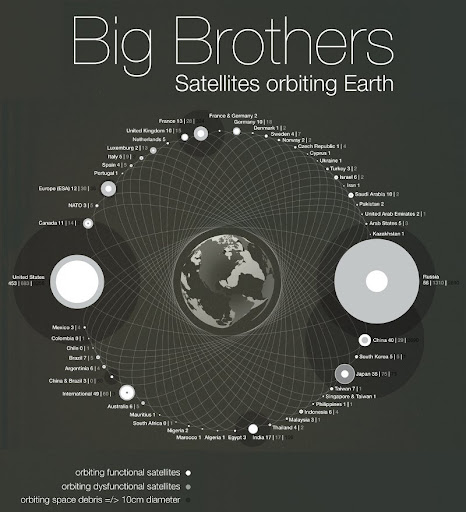
We have 7.2 fragments for every operational satellite up there, good ol’ China has 67 fragments for every operational satellite.
What it means is that those nations who have not produced space garbage, are way ahead, in my mind.
“On the Moon” and “in orbit” are not outer space though.
I disagree. I think it’s too simple to say, in hindsight, that everything would have worked out the same if we didn’t have the original impetus for these events. And while it’s true that universities were involved, the motivation, funding, and most of the design work for what would become the internet - came from the DoD. As wiki put -
Computer science was in its infancy when ARPA proposed its packet-switching network. It wasn’t something that was obviously ready to happen. Nor would it have happened outside of a laboratory without massive amounts of money. Universities alone wouldn’t have made it happen in 1969.
Would we have the internet today - possibly. Would it be as advanced and far reaching without the original money and motivation? I doubt it.
Singapore has a lot to be said for it - although I’m not sure their society would be sustainable if they had more territory. Beyond that, I don’t think you can hand wave away space exploration as simply junking up the universe. Space junk is a genuine problem but it’s hardly the sum total of what we’ve learned in the process.
I understand that former Prime Minister Chrétien made it a mandate for his government to provide internet connectivity across Canada (including the north). That’s some pretty impressive technological advancement, considering the geography and the challenges.
According to this site, we’re in the top five countries for internet usage, beating even the US percentage-wise (but not by much).
It’s also the trashcan that takes a huge amount of energy to put anything into, and where the trash can orbit right back into you at astronomical velocities. Now the Moon; the Moon is dead, and anything you put there stays there. Dumping stuff there is wasteful, but at least it isn’t going to smack into anything and punch holes in them.
It isn’t just that the US has these kinds of things, it is also that they work a lot better than the most common European versions of them. Take, for example, the British washer-dryer. A piece of crap machine that administers a mild waterboarding to dirty underwear to convince them to giving up a little bit of dirt after six hours of running time, leaving the owner with a somewhat moist pile of clothes ready to be put back into a marshy swamp.
Or the ubiquitous hand dryer that achieves wind speeds in excess of 35 km/h (is that a lot?) and at temperatures as high as 25 degrees centigrade (is that a lot?). Those things don’t stand a chance against the US-made Xcelerator which features air speeds of 200 mph and 135 degree Fahrenheit. Those things cannot be used in enclosed bathrooms without open doors or windows, because the overpressure generated tends to incinerate every living thing inside. Hoo-rah.
Vatican city? I don’t think they have the most advanced technology, but they probably win the award for 100% of people having the basic stuff 
Just to clarify, by “all of our space missions”, I meant the human race, not just the U.S. 
?!?!?!?
Everyone I’ve ever met has them all except for A/C (because, hey, who wants AC in our climate)?
I’m in the UK, by the way.
You really think that dishwashers and tumble dryers are somehow rare? I assure you that they are not. Dunno where you stayed, but you managed to find a* hole*.
We’ve been way ahead of you on mobile-phone tech for years (Apple forced a catch-up, though, followed by Android, so the tech is fairly universal now).
Garbage disposals aren’t ubiquitous here, either. I know it seems like it every 6 months on the Dope when we get to argue again whether the manual states what the unit is intended for, but I’m 36 years old, have lived in 10 different buildings in two states, and none of them have had a garbage disposal. My grandmother had one, and one of my friends had one once. They’re a novelty to me. A really cool novelty I’d love to have, but not really common in my neck of the woods.
[QUOTE=Sage Rat]
Drying Machines
Central Water Heaters
Central A/C
Garbage Disposal Systems
In-Wall Wiring
Dish Washing Machines
[/QUOTE]
There are lots of not-so-low rent apartments in Chicago without washers and/or dryers, Central A/C or dishwashers, too. I’ve only had one dishwasher that came with an apartment (bought my own portable that I moved twice), and only one place with Central A/C.
I don’t know that not doing things (not harming the environment, not putting stuff in space, etc.) = technological advancement.
I think when you look at who has been the driving force behind most of the world’s technological advancements over the last hundred and fifty years or so, the U.S. is the clear winner. The telephone, the automobile, airplanes, radio and television technology, exploration in space, electronic and medical technology, all have been invented in, developed, and/or made ubiquitous and well-functioning by the U.S. Some other countries may currently be ahead in some specific area or two, but I don’t know of any other country who’s had anywhere near the overall technological impact upon not only itself but upon the rest of the world as has the U.S.
I haven’t traveled internationally, so I can’t say.
However my impression is the transportation in east asia (bullet trains as an example) and communications via internet and cell phones are far more advanced than the US. So the transportation network and communications are probably much better in S. Korea and Japan.
Even though the US produces more science, we have about 7x more people than other OECD nations. So naturally we will have more science produced here. We are going to lead in space exploration because we have roughly 7x more scientists, engineers and taxpayers to fund space exploration than a nation like France, England or Germany
Britain has a very advanced domestic spying network of CCTVs. You can argue that is advanced.
France gets 80% of its grid energy from nuclear plants, that is more advanced than burning coal in the US.
It is a hard question to answer. My bet is an east asian nation, esp China, will soon become the most advanced. Not only because it is east asian (and they seem to love their tech) but I think China is going to do what the USSR did and use science/technology as a bragging tool and way to make the rest of the world think they are advanced. So the newest techs will probably be picked up in China first.
Which one has the most advanced medicine? I don’t know. I don’t know if there is even a difference.
Japan usually gets nominated. As someone who has lived in Japan for about 10 years now I can safely say, “not Japan.” If you live here, you quickly find out that the technology is a thin veneer. It looks high-tech from a distance, but the illusion fails up close.
The US has ubiquitous technology and more conveniences available than probably any other country. Japan lags severely in innovation. All of the top microprocessor designs originate in the US. NEC is way down the list of quality and performance.
You can pay with your cell phone through Suica and similar systems at some places in some urban areas. But forget about trying to pay for anything with an ATM card, or even a credit card in most places, even in Tokyo or Osaka. It’s a 90% or more cash-only society. Contrast this with the US where even in the 80s most places had at least a credit card imprinter. Low-tech, but they accepted plastic.
When I first left the US in 2000, even small shops had electronic credit card readers and ATM paypoint systems, while Japan had cash and ATMs that closed on holidays and just after regular banking hours. I live in the Tokyo area and still run into situations where a shop doesn’t accept anything but cash. At least the ATMs are mostly 24 hours now. Mostly.
Even close to 4 years later, there’s nothing in the Japanese market that can match the iPhone. Japanese handsets had a lot of things first, but many of the selling points were useless fripperies like integrated TV, crashy Java applets, mobile-optimized internet ghettos, and sparkly decorations for high school girls to decorate digital photos with. Capabilities are bullet-point stats in an electronic dick-waving contest with other manufacturers. Ooh, it’s waterproof. Ooh, it has a 13-megapixel camera. Big deal.
Usability lags, overall capabilities are uneven and include cool but mostly useless features. I mean, take a look at one of the top Pro series DoCoMo handsets. The biggest selling point is that it has an integrated projector. The OS looks like a bad knockoff of a knockoff of Android. The video recording capability (touted as a blu-ray recorder) is lower than the 720p on the iPhone 4. Smartphones like the iPhone or Android-based handsets are infinitely more expandable and capable, which is why many handset makers here are starting to adopt Android and make their own variants. Of course, both Android and iPhone are from US companies.
You can stream and download HD video in the US, and have been able to for years. Japan is just getting started with that, and my guess is that it’ll take several years before there’s decent content available, if ever. Shit, DVDs are just now starting to sell for reasonable prices due to competition with blu-ray disks. Blu-ray just took over the price point DVDs used to occupy; around US$40–50.
Washlets are very widespread, but I personally know a couple of people in Tokyo who had pit toilets up until at least a few years ago, the last time I visited. You read that right, they didn’t even have a sewer connection. Most homes might have a heated toilet seat that can spray your ass with heated water, but there’s probably someone a couple blocks away who still has a literal hole in the ground to shit in.
If you’re lucky, you have a central water heater. Apartments built in the last 20 years or so do. But most of the houses I’ve lived in had local on-demand water heaters: usually one in the kitchen and one in the bathroom. All other faucets were unheated, including most bathroom sinks. Public bathrooms have no hot water most of the time. (At least they now provide toilet paper; when I first came here you had to buy tissue from a nearby vending machine or carry your own because none was usually provided. There’s no soap in most of the bathrooms either, but that’s not technology related either.)
In space exploration, Japan lags behind the big three (US, China, Russia) and the EU space program. Hell, they arguably lag behind Mexico, according to the chart of capabilities on Wikipedia.
If you just look at what the tech news guys write (who whack it to everything they see at an Asian technology show) you’d think that Japan is at the forefront of technology, but virtually everything is an iterative improvement on technology that originated elsewhere, usually in the US.
For a good reason. They’re shit, always breaking down, and cause your kitchen to stink when they get clogged. There’s something to be said for not jumping all over every stupid technology when a £5 bin or compost heap does exactly the same job. (Yes, my parents had a waste disposal unit when I was young, but it didn’t last long.)
People in the UK usually spend more than £15 on their electrical appliances. You get what you pay for.