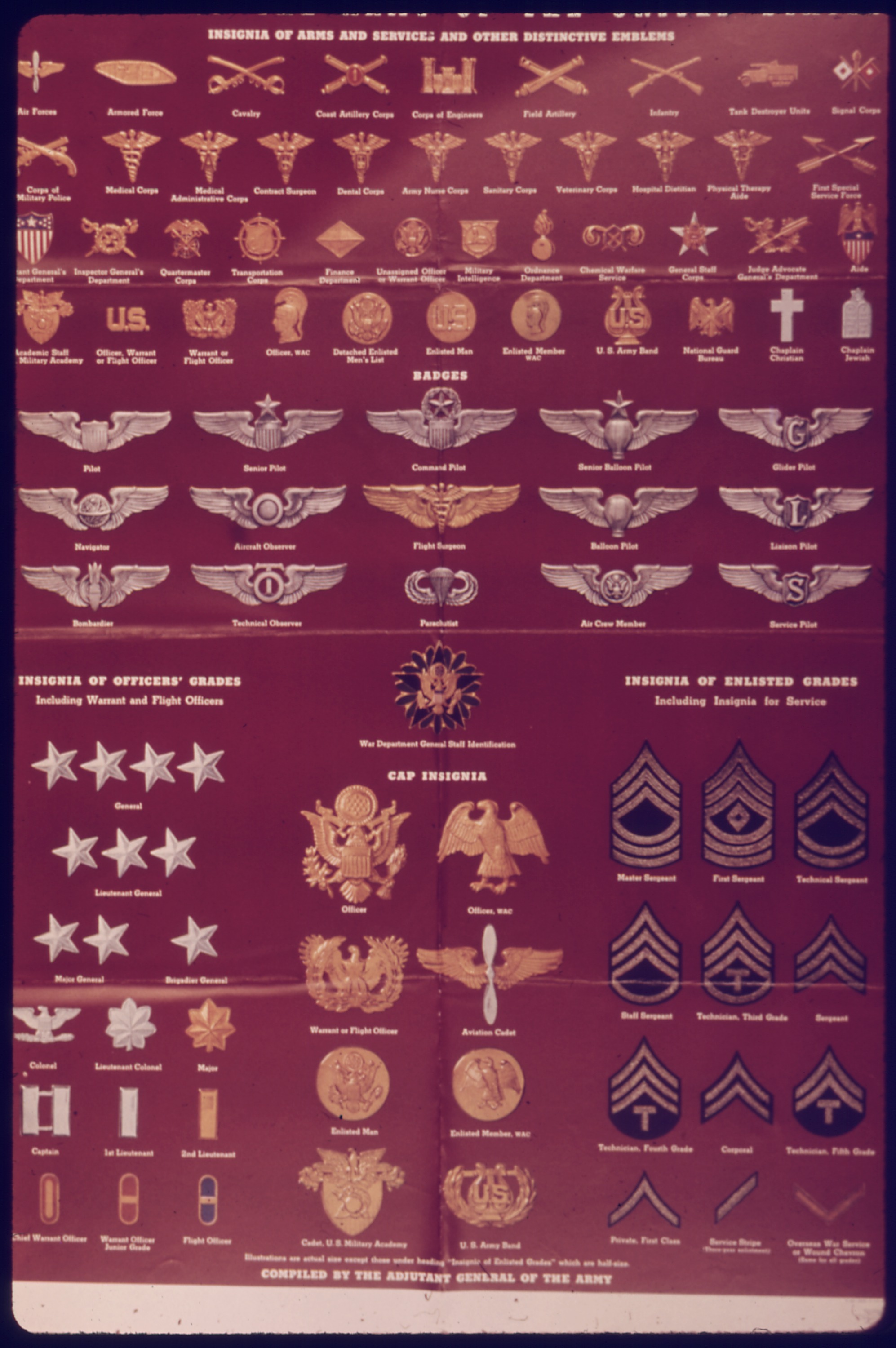
I thought the WWII armor badge was a squat tank looking thing, like a WWI landship. But if I’m wrong and the one you reference was in use at the time then you’re probably right.
EDIT: From your Wikipedia link:
On 10 July 1940 the U.S. Army Armored Force was created and on 25 February 1942 Army Circular 56 created a new collar insignia, consisting of the left side view of a Mark VIII tank. This simple tank design had no decorations or other objects surrounding it, and was the insignia worn by U.S. Army personnel throughout WWII.[8] Presently, the current U.S. Army “Armor” branch collar insignia, which consists of the front view of a U.S. M26 Pershing tank superimposed over two crossed sabers, replaces the WWII collar insignia with the “Army Reorganization Act of 1950, Section 404, Army Bulletin 9”, in which the current Armor insignia became authorized to wear in February 1951.
The new insignia didn’t come about until 1951. So I think I’m right about it.
His shooting badges, to my eye, are for his rifle and pistol qualifications. In the Marine Corps the qual levels are Expert (best), then Sharpshooter, then Marksman (lowest). The rifle qual badge is inboard, and pistol is outboard. It looks like your grandfather qual’d with Sharpshooter for both. Also, based on how he’s wearing his hat that picture looks a little informal. Well with his arms crossed like that it’s definitely informal. If it was formal, or official like for his ID card, then his hat would not be (my guess) canted backwards like it is. It would be lower over his eyes.
His collar emblems look to me like crossed canons which, if that’s what they are, then he was in the field artillery. I agree with @iiandyiiii on this. @LSLGuy, to my eye it’s more artillery than armor but I could be wrong on that.
If he was arty then he would have done his arty training at Fort Sill Ok, next to Lawton OK in the southwest part of the state. The basic artillery training for the Army as well as the Marine Corps both is done at Fort Sill for MOS certification.
I was artillery. Western Oklahoma is like the Texas Panhandle. Pretty flat, pretty boring. Eastern Oklahoma has some rolling red hills. There’s iron in the dirt there, so the dirt is redder. With the rolling topography, that red dirt together with the rolling green grass and fields is pretty.
In the summertime Oklahoma gets pretty hot and humid. Thick, heavy, oppressive air. In the winter it’s cold and windy. Colder than a witch’s tit (which, I’m told, are pretty damned cold).
A tidbit of trivia: Geronimo’s grave is on the grounds at Fort Sill. And there’s a decent museum of artillery there. And also a good museum on the plains indians.
@Alessan, there are ways to get his military info from the military, you can look into. My father’s cousin dug up the service record of my Great Uncle with a Bronze Star and I think a purple heart. This was done about 10 years ago.
I now agree with you that the insignia is not the WWII armor insignia. Good catch. I should’ve read more carefully.
At the same time, the artillery insignia has no blob where the two cannon cross. The infantry insignia has no blob where the two muskets cross and the cavalry insignia has no blob where the two sword-and-scabbards cross. For all three of those branch badges the current design predates WW-II by a good margin.
There was a coast artillery branch from 1901 to 1950 with crossed cannons with a central blob: United States Army Coast Artillery Corps - Wikipedia but the shape is not a great fit for the badge we see in the pic.
So for now I’m agreeing it’s not a WWII army Armor branch badge, but I can’t say what it is instead.
My grandfather was just a kid from Brooklyn - the 9th of 12 children, who spend the 1930s working in his family’s junkyard. Formality was not something that came naturally to him.
If this isn’t the place to be pedantic nowhere is. “E” ranks didn’t exist in WWII. Each service maintained its own distinct rank titles, pay grades, and structures. It didn’t change until the Career Compensation Act of 1949 which established uniform enlisted rank structure and pay of E-1 through E-7 across all branches. E-8 and E-9 were added in 1958.
The E, W, O-# system merely establishes a common vocabulary for interservice administrative stuff. And common rates of pay across all the services.
In typical day-to-day use a servicemember uses the traditional rank / rate names of their service: Sergeant, Petty Officer, Machinst’s Mate 2nd Class, Major, etc.
But if an e.g. Army and Navy person are interacting they might resort to E or O numbers for clarity.
As to Alessan’s granddad, that was probably a pic done privately at a photo shop in the post town, for sending back home.
In the case of a Pre-1950s Army soldier you could remain a “buck” Private for a considerable time, especially in peacetime — it was only later that the system of automatic progression thru the first 3 grades based just on time and training completed took effect (for a while after the grades were expanded, there were TWO grades of “slicksleeve” private).
As for the Navy I have heard but never confirmed that in the Old Days if you already had a trade that mapped to a rating, you could be quickly advanced to that.
Or in some colloquial insider contexts like the “E-4 Mafia” (a common reference to the group that has been around long enough to know the ropes and how to inflict malicious compliance, but not senior enough to have to be the Voice Of Authority who tells you to not do that).
For a very VERY short while (months) recently the Navy tried to move from rating to enlisted rank in everyday use. That was received exceptionally badly and they quickly gave up.
@LSLGuy’s point comes down to this: the “E-” or “O-” thing is a pay grade. It establishes compensation rates in pay and allowances, and nothing more. In interservice situations, comparing pay grades can be helpful in understanding the implicit authority of another service member, but can’t be the final arbiter. Sometimes leadership must go to a lower-pay-rate member because their position is explicitly higher-authority.
According to the Bureau of Naval Personnel (BUPERS), the job of a Machinist’s Mate is to “operate, maintain, and repair (organizational and intermediate level) ship propulsion machinery, auxiliary equipment, and outside machinery, such as: steering engine, hoisting machinery, food preparation equipment, refrigeration and air conditioning equipment, windlasses, elevators, and laundry equipment. Operate and maintain (organizational and Intermediate level) marine boilers, pumps, forced draft blowers, and heat exchangers; perform tests, transfers, and inventory of lubricating oils, fuels, and water. Maintain records and reports, and may perform duties in the generation and stowage of industrial gases.” Enlistees are taught the fundamentals of this rating through on-the-job training or formal Navy schooling. Advanced technical and operational training is available in this rating during later stages of career development.[1]
If you know your history and the date of the photo it’s easy to tell. From 1913 to 1949 engineering ratings wore their emblem on the left sleeve, deck ratings on the right.* In 1949 all ratings wear the emblem on the left sleeve only. Unlike the other services, navy enlisted rank emblems are only on the one sleeve.
*There are exceptions but in the main that’s the way it was.
Good point, and one that I thought about (but did not include) when I made my post. It was apparently not uncommon for young men to falsify their age in order to serve during WW2.