Clear image of his stripes. Circa 1944
What is his rank?
Does the insignia indicate his Duty Assignment?
He looks pretty young for 2 stripes.
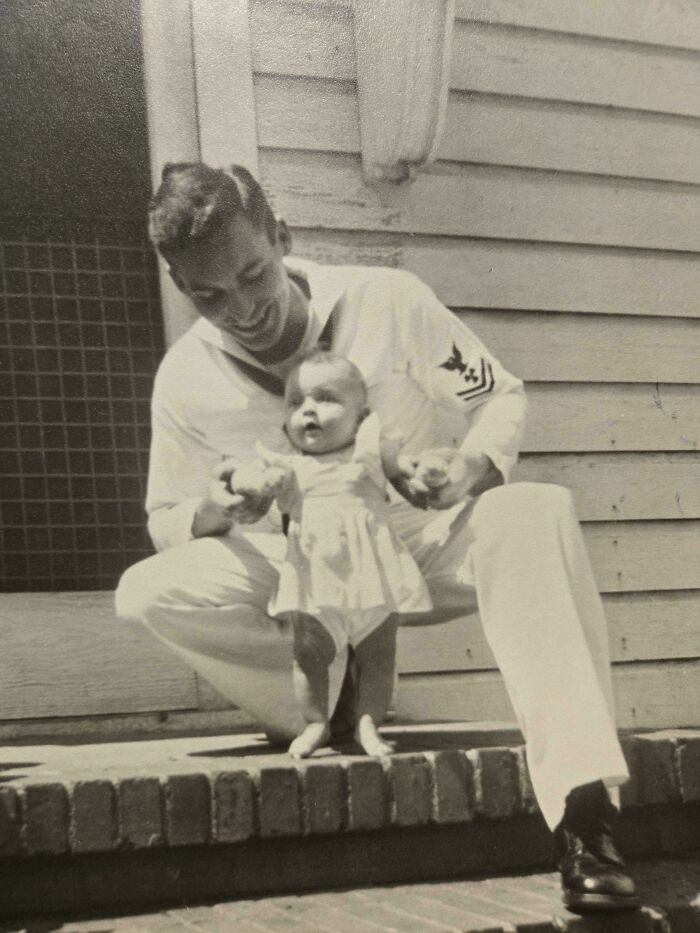
Clear image of his stripes. Circa 1944
What is his rank?
Does the insignia indicate his Duty Assignment?
He looks pretty young for 2 stripes.
According to this Wikipedia article on US Navy enlisted ranks: petty officer second class. The “Sleeve Insignia (summer)” exactly matches what’s on his shoulder.
And, related to his (possible) age vs. rank: it was common for members of the Navy (and other US armed forces) to be promoted rapidly during WW2.
2nd class petty officer. At least twenty years ago, it was very common to reach 2nd class petty officer in one’s twenties, or even early twenties for high performers. During WWII I’d bet it was even more common since there were so many ships and so much action (and thus many promotion opportunities).
I think the propeller above the stripes indicates some sort of engineering specialty.
Mildly amusing story – we had a 2nd class petty officer culinary specialist (i.e. cook) who was about to reach his twenty year service mark, meaning eligibility to retire with full benefits. He was a decent cook (and a decent shipmate) but otherwise perhaps the dumbest human being alive. Under normal circumstances (at least when I served twenty years ago), a 2nd class will be cycled out of the navy at 12 years or so if they’re unable to advance to 1st class, but somehow he made it. We called him the SECPON – Second Class Petty Officer of the Navy (a joke on the MCPON – Master Chief Petty Officer of the Navy – the most senior enlisted person in the US Navy).
Thank you
A little late, but Petty officer 2nd class and I believe Machinist Mate.
I was a fellow snipe, but 40 years later.
So I am curious; is he related to you?
That makes a lot more sense than a radioactivity symbol, which is what I thought it was. 
A second class petty officer is what the DoD personnel system now refers to as E-5: i.e. the fifth enlisted rank counting upwards from the bottom. USAF calls that a Staff Sergeant (SSgt) while USMC & the Army call that just plain “Sergeant” (Sgt) with no other qualifiers.
At least in my era, long after WWII, it was pretty common to make E-5 towards the end of one’s second enlistment. Which is to say 4-6 years in service. If one started at 18, they’d be 21-24 years old, but probably towards the older end of that. Somebody who was a slug, not a performer would take a couple years longer. Or eventually quit the service or be pushed out if they’re not ever going to make E-5.
As noted above, during WWII, people moved up very quickly. As in making 20 years’ peacetime career advancement in just 1 or 2 years.
My bottom line: It makes no sense at all to suggest
Not today and especially not late in a big war.
No. I saw it online and liked the photo of the man and his toddler.
I have a photo of my Dad in uniform. It’s a head shot and can’t see his rank. I know he was a senior Navy, Radio Man. He switched to the Air Force after I was born. Had to change his MOS. He always said his days in the Navy were special. But, he wanted to be home with his family.
Senior Chief maybe?
“senior” doesn’t mean much.
Dad was a Tech Sergeant in the Air Force and was promoted to Master Sergeant during his tour in Vietnam.
I always assumed he had a similar Navy rank. He served 10 years there. I regret not asking him more about his Navy service. He started in the Reserves because they were down sizing the Navy after WWII. I think he eventually was accepted in 1948 or 49.
Is E8, in the Navy that is a Senior Chief.
So he probably wasn’t a Sr. Chief in the Navy. Maybe he made it to 1st Class there E6, hard to guess. But I could see referring to self to non-military as a Senior Radio Man if he was a 1st Class Petty Officer.
Dad was lucky his ship didn’t deploy to Korea. He was based in Naval Air Station Pensacola just before marrying my mom. Later they went to the Philadelpha Navy yards.
He was at sea a lot. That was tough on my young mom. His move to the Air Force was a relief.
Seven years at Otis Air Force base in Cape Cod. We were lucky to stay so long. That base closed in the early 70’s. Long after we left.
Already answered, but I was also a Machinist’s Mate 2nd Class Petty Officer. My uniforms had the exact same symbol (the ship’s propeller).
Don’t confuse machinist’s mates with machinists. We were steam plant workers, specializing in running the main engines and all of the accoutrements.
We did not make the steam–that was the job of Boiler Technicians, or in my case, Reactor Operators.
ETA: I see it wasn’t clearly answered earlier, so let make it absolutely clear that that is the emblem of a Machinist’s Mate, a worker in steam turbines and such.
Thank You @minor7flat5 for your expertise.
I appreciate all the replies.
I was never able to get my dad talking about his service. It wasn’t because of his experiences. Dad wasn’t a talker. 
The Sailor in the photo is a Machinist’s Mate Second Class.
The US Navy does not use the term rank for Enlisted personnel. Rate is the terrm used. Rank is used for Warrant (W-1), Chief Warrant (W-2~5), and Commissioned Officers (O-1~10 plus the special wartime paygrade for Fleet Admiral). E-5 is the paygrade for the rate of Petty Officer Second Class. Rating is the Navy equivalent of Military Occupational Specialty (MOS).
If we’re already doing this thread, maybe you guys can tell me something about my grandfather?
I know he was in the army, and I know he served under MacArthur. Other than that, I know nothing about his WW2 service, and now that my parents are dead, I probably never will. What I do have is this photo, which he sent my grandmother right before she dumped him with a Dear John letter (she took him back after the war):

Any hints?
The pin on his left lapel looks like Field Artillery to me. The one on his right looks like the “US” identifier pin.
I think the rank should be on his shoulder, ironed into the coat, but there’s nothing, so it’s either invisible in the fold, out of view on the side of his shoulder, or some other explanation I can’t think of.
EDIT: The explanation I couldn’t think of is that he’s a recruit with no rank insignia yet.
Standard US army photo of a newly minted enlisted man fresh out of boot camp / basic training.
Which makes him what’s now termed an E-1 or Army Private. Which rank has no sleeve emblem. Upon promotion to what’s now called E-2 he’d gain one chevron and still called a “Private”, but a different flavor of Private.
The circular badge on his left lapel indicates the Armor Branch - Wikipedia. The badge on the right identifies him as enlisted (by the circularity) and Army by the color and design.
The two German-cross looking badges above the left pocket are Marksmanship badges (United States) - Wikipedia.
Overall this is a picture of him at the very beginning of his service and there’s not much more to glean from it. A picture later in his service would of course tell a much more complete tale.
ETA ref @iiandyiiii just above:
Here’s a chart of current army branches and their insignia. The insignia for WW-II & older branches has changed very little over time. Many of them have the “cross-ed something with maybe something else superimposed” motif.
My surmise of armor is based on the crossed swords with handguards and the [something] blob in the middle that’s fairly squat with maybe a cupola-blob on top.
Yeah, that’s pretty much what I figured. Thanks anyway.
I’d look for more pictures, but I doubt any exist. It’s been too many years and too many moves.