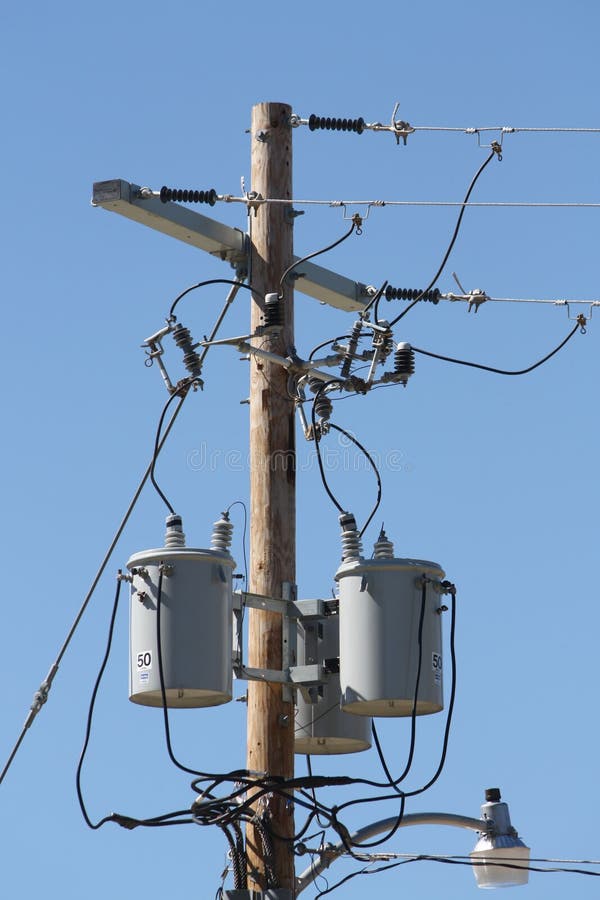
Since you didn’t mention a Delorean nearby, I’m going to guess either a capacitor bank or a recloser based on your description.
Capacitor bank:
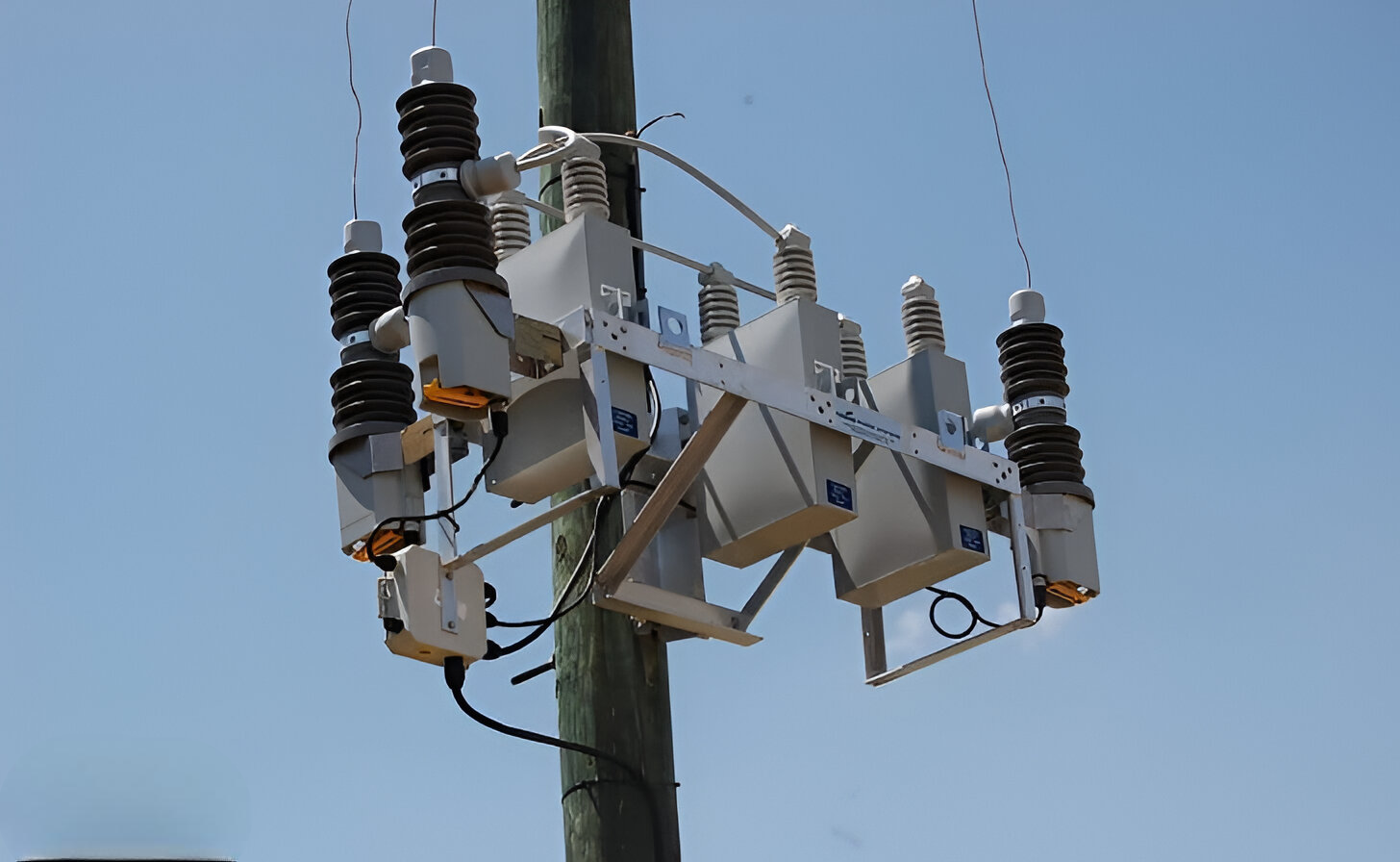
Recloser:
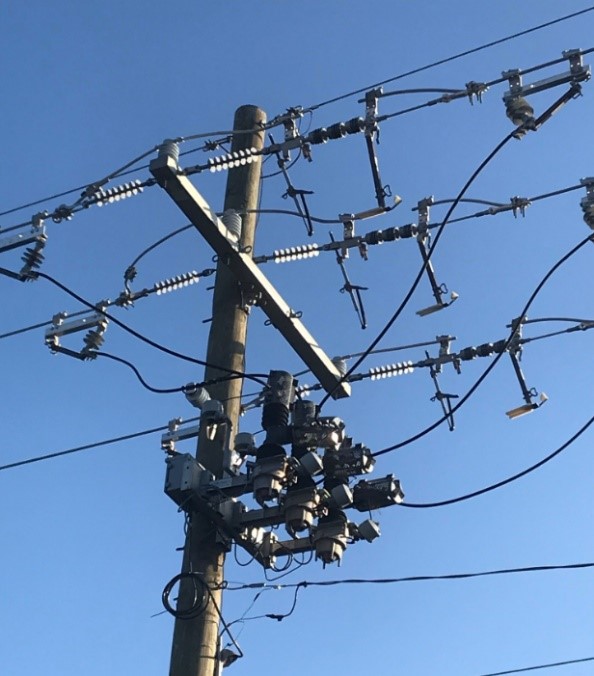
Power lines have protective devices just like your home has. Only if there is a fault on a power line, instead of just going down into the basement and flipping the breaker back on, a lineman would have to drive quite a distance to get to it. A recloser waits a bit then automatically turns the power back on. They are programmable, but what they typically do is try again a couple of times fairly quickly (within a few seconds), then maybe once more after a couple of minutes, and if the fault still isn’t fixed they give up. This allows the power lines to recover from temporary faults like tree limbs blowing into the lines during a storm.
Capacitors are a bit harder to explain, but power is made up of what we call “real” power (power that is actually used) and “reactive” power. If you have a coil of wire, when you run electricity through it, a magnetic field builds up. When you remove the electricity, the magnetic field collapses and the energy gets put back out as electricity again. Capacitors (just two plates of metal parallel to each other) do the same thing, except the energy is stored in an electric field instead of a magnetic field. The energy to charge these up isn’t used up, it just comes back out of the device after the electricity is removed. Power systems use a sine wave, so these “reactive” devices are constantly charging up and discharging during the sine wave cycle. But inductors and capacitors charge at opposite times during the sine wave cycle. So as inductors charge, capacitors discharge, and vice-versa.
Residential power tends to be slightly inductive, due to coils in motors for things like your washing machine, dryer, vacuum cleaner, hair dryer, etc. If you balance these out with capacitor banks on the power lines, instead of the generators having to charge up the inductive coils, the capacitors supply the energy to charge the coils. Then when the coils discharge later in the sine wave cycle, that energy goes into charging the capacitors back up again, so when it comes back around to the part of the sine wave where it’s time to charge the inductors, the capacitors are fully charged and can do the job again. In a perfectly balanced system, the reactive energy bounces back and forth between the capacitors and inductors, and the generators only need to supply the “real” power (the power that isn’t used just to charge up and discharge reactive devices). Electrical systems are at their most efficient when the reactive power is balanced in this way.
Again, based on your “Doc Brown” description, that’s my best guess. Designs vary, so you can google capacitor bank and recloser to see some of the variations if the above pictures don’t match. If none of those seem right, any other details that you remember might be helpful.