The main fighter jet in Canada’s arsenal is the CF-18, a land-based derivative of the F/A-18 Hornet. The planes were purchased in the 1980s and are nearing end of life.
Canada is a participant in the F-35 program, which allows some Canadian participation in the supplier chain. The F-35 would be assembled in the U.S. and Canadian maintenance facilities apparently wouldn’t have access to the electronics or software.
Saab’s proposal for Gripen promises assembly in Canada and Canadian control of the avionics and combat suites. The Gripen E is NATO-compatible, but still a fourth-generation fighter.
The F-18 E/F promised some compatibility with existing CF-18 maintenance facilities and procedures. It’s still not clear why it was eliminated from the competition.
There has been a lot of back-and-forth on which fighter should be purchased. As a stopgap, Canada has purchased some retired Australian F-18s.
There’s now a significant portion of the U.S. political class that depicts Canada as a dangerous socialist enemy of freedom.
So, is it better to buy an airplane that may be controlled by Washington ? Or is it better to buy a less capable plane that may remain under Canadian control, but will alienate the politicians in the U.S. even more ?
And, more fundamentally, which is the better choice from a military standpoint ? How are these things measured ?
I had mentioned this in another thread, but I’m not sure why the F-15EX Eagle II (aka “Super Eagle”) isn’t a candidate. It’s twin-engined and given Canada’s vast expanses, it means that if one engine had a malfunction it could still limp home on the other engine (something the single-engined F-35 can’t do.) It’s not stealthy but Canada has little need for stealth. It’s a great interceptor and has great air-to-air and air-to-ground capability.
Agreed. That will make it easier for US fighters to gain air superiority and for US air defense systems (which, unlike Russia’s, actually work) to conduct point defense of units operating on the ground.
This would depend on the role Canada plans to use them in. It’s hard to really answer this question, as I don’t know what Canada really is looking to do. Each of those planes has strengths and weaknesses. If Canada basically just wants a plane to defend its own skies over its own territory, then they should probably go for a cheaper model. If Canada is going to be flying against 2nd tier nations (or lower), then, again, a cheaper plane would be best. If it plans to go into a heavy combat zone against 1st tier opponents then I’d say something like F-35 is the clear choice…or, if they can wait, see what happens when the Europeans finally roll out their gen 5 aircraft sometime in the 2030’s. If Canada needs a fighter right now, I would go with one of the 4.5 gen fighters for now and wait to see what the requirements dictate down the road.
As far as I know, Canada doesn’t really need a state-of-the-art aircraft, as its proximity to the US and its alliance with the US and NATO is protection enough. It just needs to be able to defend itself. But, perhaps with how uncertain the way the world seems to be now, Canada wants something more to assist its allies in potential hotspots around the world.
Canada does need to protect its Arctic border and this is doubly so given recent Russian ambitions. Though it must continue to rely on NATO and the United States, I believe it should make a more independent military a higher priority.
I do not have the knowledge about which plane is best. There is a history of huge cost overruns and too much focus on regional economies and politics at the expense of practical use. Presumably buying something already useful would be quicker, cheaper and of more predictable dependency.
Canadian innovation should be encouraged but focus more on areas of proven expertise. The system allegedly needs to be streamlined. So many fingers are said to be in the procurement pudding that it is impossible to prepare it well, or quickly.
‘Best plane’ is really hard to quantify. It really depends on what role it’s being used for. All of the planes listed, plus several more I can think of, could be ‘best plane’ depending on circumstances and needs. I think a lot of these discussions get bogged down into personal preferences or spec sheets, but those don’t really tell the tale wrt requirements. None of the planes available to Canada is best at everything across the board, so it’s a balance between what Canada needs (or has identified as its core requirements) and what it wants to spend. ETA: Germany is going through the same thing, and it’s been a rather painful process for them…as always. It’s been notable that they are, again, seemingly circling back to include planes they had previous and very definitively taken off their potential list.
I have no idea if this is true, but I read somewhere that dividing work on a recent specific shipbuilding contract to include companies on both coasts added something like hundreds of millions to billions of extra dollars in costs while causing delays and inefficiencies. It seems like the government should entertain more projects rather than just be ambivalent about budgetary concerns and focused on political largesse. Whether something similar applies to aviation or elsewhere; I do not know. Not for sure.
While waiting for the aviation expert posters to answer specifically which choice is best with a primary focus on aggression from Russia for areas Russia will claim ownership over across the Arctic (heavy combat with a first tier opponent) I offer this cautious concern about state of the art:
The planes may be wonderful but using them in Arctic conditions takes lots of training in those conditions. It will take long enough to get delivery. Circumstances of the world may not have the time to have a long learning curve on using them too.
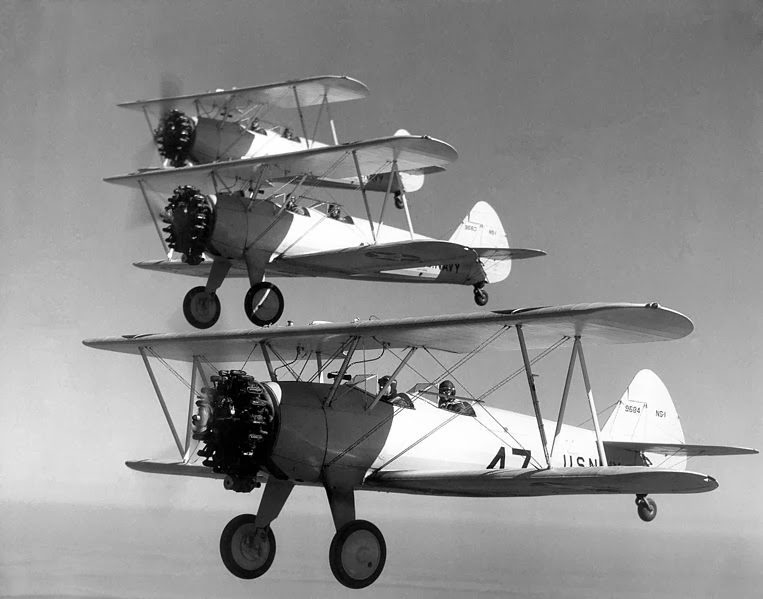
The Stearman 75 would make a striking addition to the Canadian Air Force. There are plenty of them still around, or maybe Boeing could be convinced to build some more on special order.
Given what Canada wants to actually spend on its military, they might be able to save by cleverly folding a gigantic sheet of paper. If it never gets gusty or snowy in the Arctic, should be okay.
Red Green: Well, I’m not gonna be calling the U.S. Air Force, Harold. What do I say? We’ve got a missile? They take that as a threat, we’re in real trouble.
Harold Green: Well, then, contact the Canadian Air Force.
Red Green: Harold, it’s after six; he’s gone home.