I believe any one needing subsistence food, you plant legumes.
More bang for the buck.
Cheap and easy to grow.
I believe any one needing subsistence food, you plant legumes.
More bang for the buck.
Cheap and easy to grow.
Food rationing occurred in the US because massive amounts of meat and canned goods were needed to feed not only our own military but also our allies. In order to ensure adequate food supplies were available domestically for both military and civilians. The folks at home got a certain amount of ‘coupon points’ allocated for rationed items. Victory gardens were exempt from rationing and meant that more commercial agricultural land could be devoted specifically for fulfilling military supply contracts and producing surplus to ship to our allies.
How much was grown in all those Victory gardens? The generally accepted estimate is around 40% of all vegetables were grown in those gardens during WW2.
It’s easy if you have some idea what you’re doing, and if the weather is at least somewhat kind to you. It’s also easy to lose most or even all your crop, if you don’t know what you’re doing, or if your neighborhood deer are particularly hungry, or sometimes even if you just have particularly bad luck.
It’s not hard to learn the basics. But some people misestimate the difficulty in either direction, and think either that it’s too hard for them to learn, or that there’s nothing they need to bother learning. The first will lead to no garden, but the second can lead to a messy failure; which may in turn lead to giving up, instead of to studying up.
True. But you don’t need all that much space to massively improve your diet with micronutrients and flavor. And it’s astonishing what can be grown in a fairly small space with the right techniques. You don’t need room to turn a tractor around, after all, or even a rototiller.
Plant the Three Sisters: corn, beans, and winter squash. All mixed together in one plot. All storable with minimal processing, depending on variety and harvest stage. All edible at more than one harvest stage, depending on variety.
Sweet potatoes also give you a whole lot of nutrients for the space. And regular potatoes don’t need as much space per calorie as you’d think. Some people grow them in barrels.
Last I heard, potatoes were the highest Calorie per land area yield of any crop. It’s why pre-famine Ireland was so dependent on them: It’s all the tenant-farmers could afford to grow for themselves, on their tiny personal plots.
And the Three Sisters are not only all symbiotic with each other when growing, but they provide very close to a complete nutritional profile.
My guess is that during the war, when most everyone was growing a victory garden, there was a lot of information sharing and cooperative effort going on. So that if you were having trouble growing something, your neighbors would be able to offer assistance and advice.
Back when I lived in Las Vegas I had a 80x100 foot backyard planted entirely in turf. Which consumed ungodly dollars of water staying perpetually green and growing like mad in the perpetual sunshine and perpetual warmth. Which in turn needed ungodly amounts of lawn service dollars to cut down my entire crop every week and haul it away.
One day it occurred to me that that was dumb. I did what research could be easily done in that pre-wiki era about how much crops I could grow in 8000 square feet of unlimited year round frost-free sunshine given unlimited water. And the willingness to shade-cloth part of it if needed.
The numbers I came up with were surprising. No problem feeding all the plant needs for a family of 4. No grain or meat, but plenty of everything else. Maybe not much variety, but plenty of quantity. It would’ve taken knowledge, skill, and diligence I utterly lacked, but as a thought experiment it was comforting.
With that area, and a Las Vegas growing season, you could probably keep a dozen families fully fed (if they didn’t mind an ovovegetarian diet).
You could get lots of variety in that space and situation. You could grow a hundred different things.
And you could probably support some chickens, for eggs and a bit of meat — and for fertilizer and for keeping insect pests down.
The area was zoned “ranchette”; some folks nearby on larger deeper lots had horses. We did often hear roosters at sunrise. So chickens would have been doable.
Adding to what’s been said about Victory gardens and Dig For Victory (U.K.), it wasn’t about growing vegetables that were limited by rationing, but raising them at home to overcome shortages due to things like agricultural workers being drafted and unable to farm, resulting in lack of sufficient vegetables and fruits on grocery store shelves, and fewer cans of peas and such being available due to military demand for canned foodstuffs.
Wanting something didn’t automatically translate to it being sold in sufficient quantity to meet demand.
As for White House edibles growing, there’s a long tradition of that (at least in past administrations). Eleanor Roosevelt had a Victory garden to promote civilian ones, and Michelle Obama had a White House kitchen garden. Not necessarily that they personally toiled for long hours cultivating the soil, but the intent at least was there.
We’re growing quite a lot in one of these: 5 Tier GreenStalk Original Vertical Planter | Evergreen (Basic Texture | GreenStalk Garden
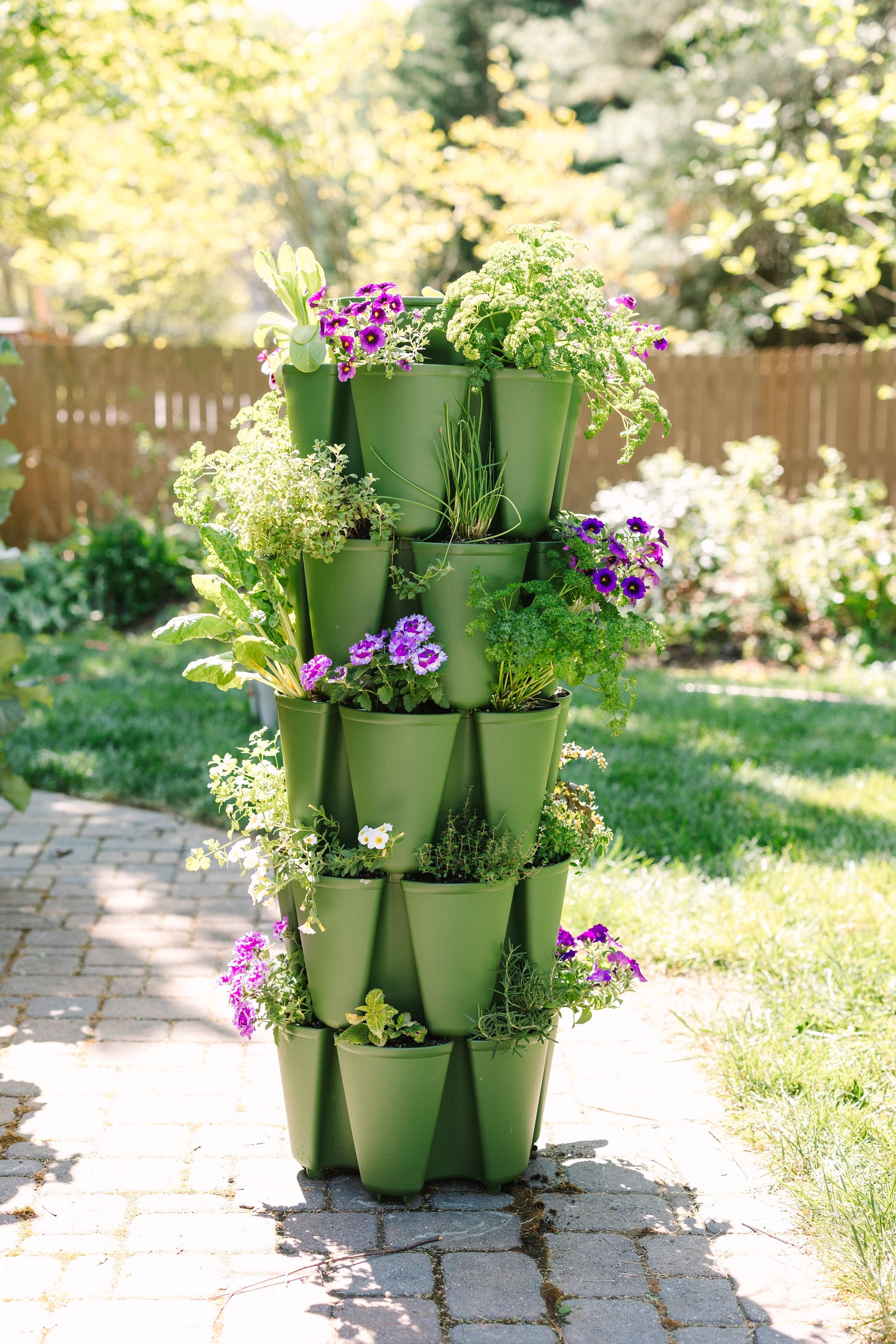
It rotates, so we’re keeping our greens faced north to keep them from bolting. I’m about to pull the bak choi and lettuces and put in strawberries and scallions.
We didn’t intend to grow produce, but did decide to grow a victory garden due to prices and gas costs.
A google search said that in WW2, victory gardens provided 40% of the nations fresh fruits and vegetables, making about 20 billion tons of food a year.
The only point I see hasn’t been raised is that people shouldn’t abstract any one government effort when the country is at total war. Almost no American alive today has adult memories of what total war meant in the mid-1940s. People in Ukraine can understand but we have, um, totally lost any conception of what that meant.
The government took over almost every aspect of consumption society. Everything grown, made, transported, mined, and built was examined, pulled apart, and forced to contribute to the war effort, directly, indirectly, or by being shut down. Morale was a critical factor.
Propaganda was merely one tool in the constant effort to encourage morale in a world where normality had been ripped from life and all existence was supposed to be dedicated to ending the war even one day earlier to save their loved ones’ lives. People needed to feel needed, kept busy both to avoid non-war related consumption and to take their minds off blaring headline news of disaster, and reminded that total war meant total participation. America learned most of these lessons from Britain, of course, and never suffered more than a tiny fraction of what Europe endured, but it was clear to the government by 1943 that nothing less than near perfection, endlessly repeated, would win the war.
tl;dr: The point was that everything was the point.
Some good points there. 
But it’s not as if everyone was in harmony with the idea of noble self-sacrifice in those days.
During WWII in the U.S. there was well-publicized corruption, labor strife, racial tensions spilling over and monumental bitching about shortages and other dissatisfactions with civilian life. Things got done regardless.
*Mild semi-diversion: I have a book on Victory gardening published in 1942, with abundant advice on growing various crops in your backyard. Most striking to me were suggestions on pesticides, which included the virtues of spraying arsenicals on fruit trees.
quoting here>>>. The problem with gardens is, you have to start them well before you have food shortages, because if you start them after, you can go several months before getting any kind of useful harvest.
The real problem is that they’re largely supplemental. You have to have a pretty large field to supply most of the calories for a family. A 16x8 backyard plot isn’t going to do much more than set you up with ripe vegetables for a little while- almost more like spice in your diet, rather than staples.
Which isn’t nothing, but it’s a long way from getting you and your family away from food insecurity in uncertain times.
I always espouse growing crops UP and I am sure that the Victory gardeners also did that as much as possible in the land that was available. I grew Japanese cucumbers and Tromboncino squash along the old clothes line because as vining crops they would have tended to wander for 10 to fifteen feet in all directions but on a pole or, a line stretched between poles, or branches of trees they grow straight fruits and lots of them. Pole beans , pretty much the same. One can choose to grow bush beans which were developed to all ripen at one time and get picked and packed or dried but pole beans are a cut and come again sort of crop, similar to indeterminate tomatoes. Wiith some foresight the small planting bed can be almost doubly productive. I recall some Victory Gardeners also mentioning letting their chickens running around the gardens in the day picking off bugs and they got the benefit of the high nitrogen manure from the hens. Back in the 60s my eldest brother subcribed to Organic Farming and Gardening and they gave pretty detailed information on what to look for in survival crops, and how to store them.
Perhaps the victory gardens should be looked at from an angle of, why not?
There was no harm in doing one, and only gain. It increases crop output, it improves people’s skill, it lets land and soil go to use that would otherwise not be used, there’s sunshine and water - it could only help and not hurt.
Exactly the answer that I was going to say, why not, and why not now? Also, during the wars it was hard to not know what was happening with family or friends who were overseas so it gave a safe place to ponder on life, perhaps shed a few tears where no one would see, and to feel useful in some way, even if you were just going to supplement the family diet with fresh fruits and vegetables. Rationing allowed bare subsitance food, a garden could provide nutrition and flavor to enhance what you had. Not a bad hobby, mentally and physically and a feeling of “doing your bit”
As an aside: do people not grow fruit trees in their yards in the U.S. and UK? They’re very common here - my parents, for instance, had lemons, olives and pomegranates; the lemon trees especially produced a ungodly amount of fruit, which they would happily give bags of to whoever came by. If they were ever forced to start a victory garden, the trees would have served as a pretty solid basis.
From what I understand, one reason some refrain from growing trees is for fear that the tree’s roots will start to damage and burrow into the house’s foundation or below-soil structures.
It’s reasonably common to have one or two fruit trees in the UK; I have 5 apples and a damson, but most of the apples are on very dwarfing rootstock on a cordon fence, so not really proper size trees. There are a couple of other fruit trees I’ve spotted in nearby gardens, but it’s commoner in more rural areas, while this is the edge of a city. There’s also allotments down the road, which have loads of fruit trees. Home growing is, perhaps oddly, commoner in slightly wealthier areas, in less-wealthy urban areas it’s disproportionately recent immigrants that grow stuff at home. Allotments are typically very mixed.
When I was little we lived rural and my parents grew a lot of our food at home, including chickens and rabbits (until we got too attached). It wasn’t a huge plot, but there were apples, a sour cherry and I think a pear tree or two (the apples were good, the pears weren’t), plus a load of fruit bushes, a big vegetable patch and a small greenhouse. They sold the spares at the gate, along with cut flowers. They obviously still bought stuff like bread, rice and cheese, but I’d estimate at least 1/3 of our diet was from the garden until mum started a job so had less time and more money.